Summary
The global GFRP rebar market is small, fast-growing and gated by codes. The best-documented estimate puts it at USD 0.54 billion in 2025, rising to USD 0.95 billion by 2030 at 12.1% a year [forecast, MarketsandMarkets], and published estimates span roughly USD 0.2 billion to 4.2 billion depending on scope [forecast, publisher pages]. MarketsandMarkets ranks Asia Pacific as the largest and fastest-growing region [forecast, MarketsandMarkets]; North America, at about 28% of value, is the most mature. It has a complete code stack, with ACI CODE-440.11-22 adopted through the 2024 IBC, ASTM D7957 and D8505, the AASHTO GFRP guide specification and CSA S807, and a cluster of state DOTs that specify GFRP for de-icing-salt and marine exposure. Outside Asia Pacific, the Gulf, led by Saudi Aramco's GFRP mandate for highly corrosive environments, and India have the fastest forecasts.
The international benchmark is Pultron Composites and its Mateenbar business: plants in New Zealand, the UAE, Saudi Arabia and North Carolina, a 60 GPa structural bar with a current ICC-ES evaluation report [company, ICC-ES ESR-5548], and three decades of project references. China has the world's largest glass fiber base, pultrusion capacity at commodity prices and the largest volume of FRP-bar research. Its domestic demand comes mostly from tunnel soft-eyes and coal-mine anchor bolts, not from permanent structures.
The gaps that matter to an international buyer are concrete. We found no Chinese-owned producer with a structural ICC-ES (AC454) report, a CSA S807 certification listing or a published Grade III (60 GPa) product, and some export catalogs list modulus values below the ASTM D7957 minimum. These gaps are in qualification and process discipline, not physics. China's wind-blade pultrusion sector already runs the high-fiber-volume process a 60 GPa bar needs, and one China-sited plant, owned by the foreign group Dextra, has passed ICC-ES quality-control inspection. For buyers, a Chinese GFRP bar can be an excellent value, but only with lot-level test evidence. A claim of 'compliant with ASTM D7957' on a website is not enough.
Three findings shape the rest of this report. First, market-size numbers are unreliable: the spread comes from scope (GFRP only, all FRP or 'composite rebar'), from whether China is counted and from whether mining bolts are included. Second, international demand is unlocked by codes and owner specifications, so market access depends on certification more than on price. Third, China's gap with the leaders is narrow on materials and process physics but wide on certification, high-modulus product lines, bend data and long-term field evidence. Section 10 turns this into an RFQ checklist.
1. What GFRP rebar is, and why corrosion, owners and codes create demand
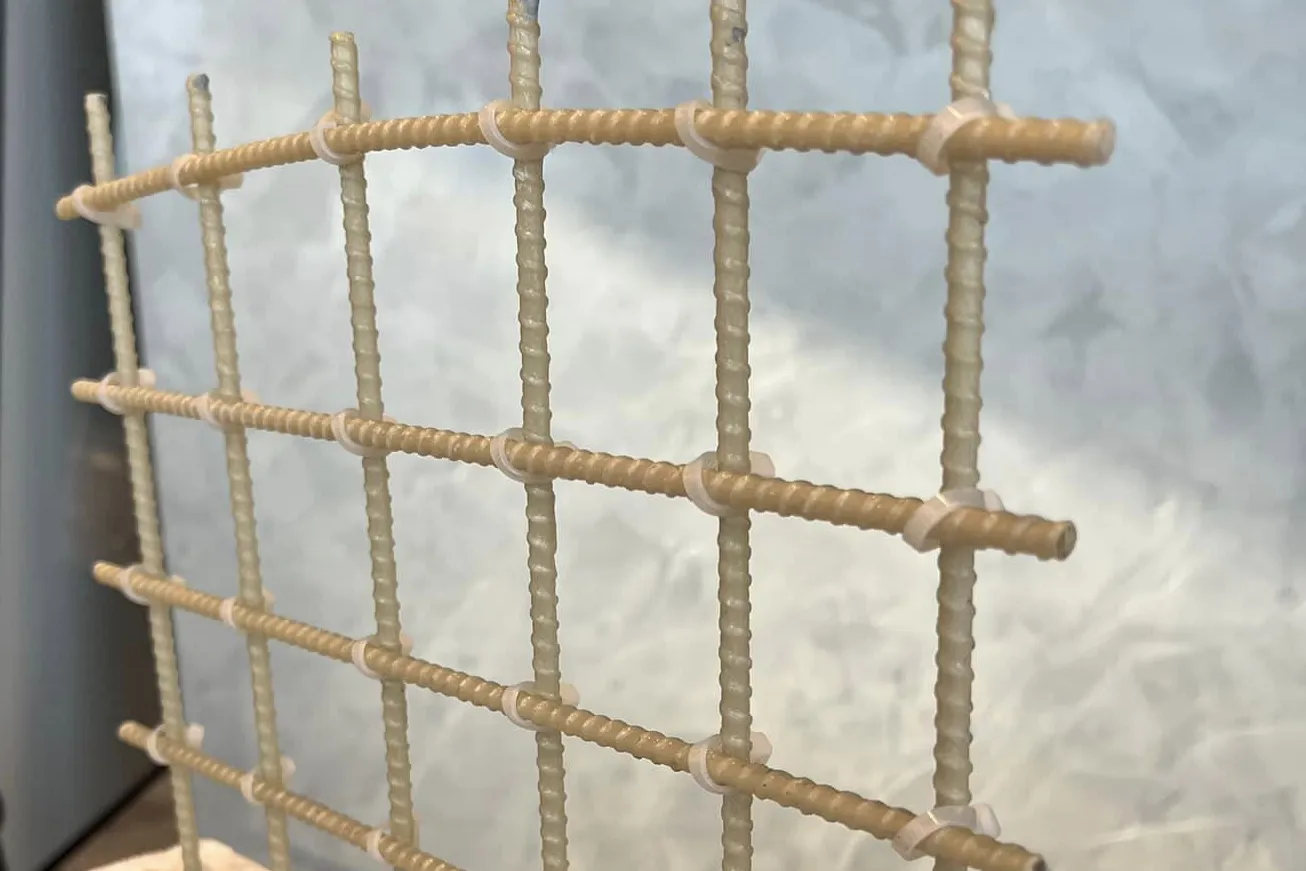
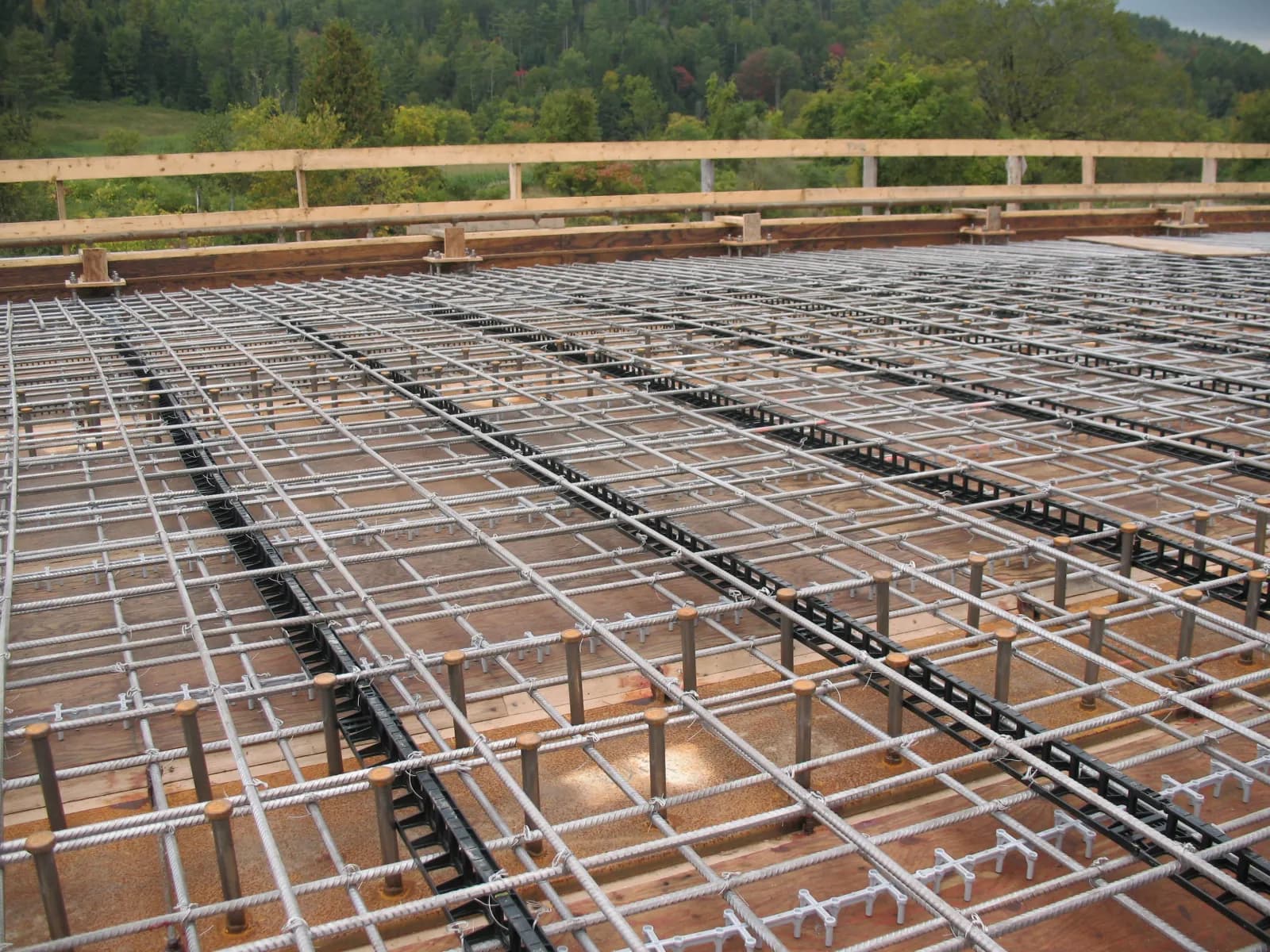
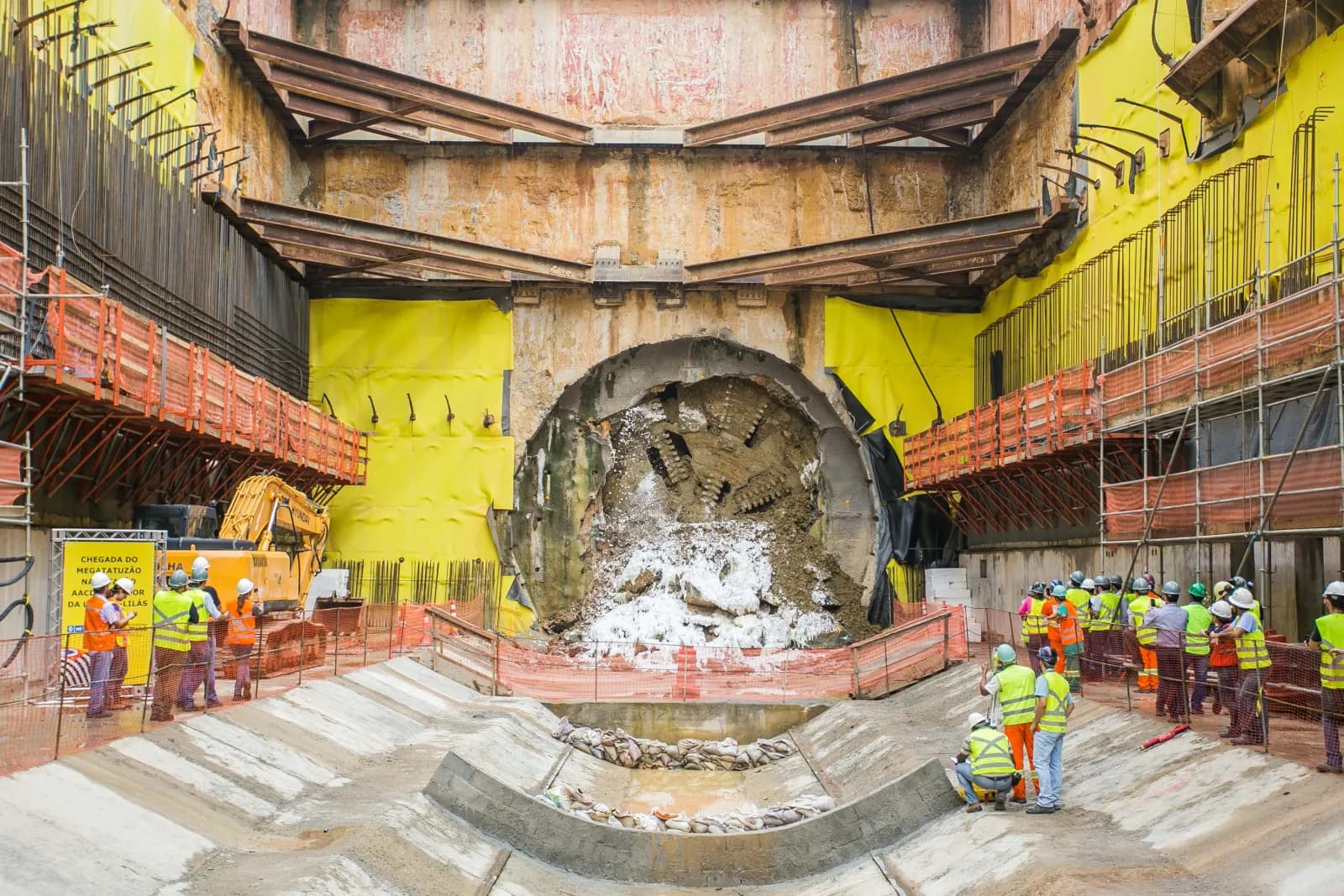
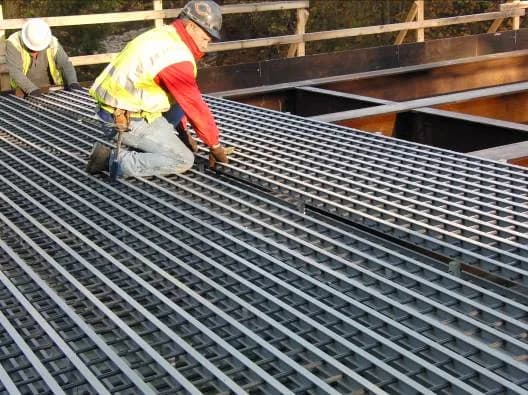
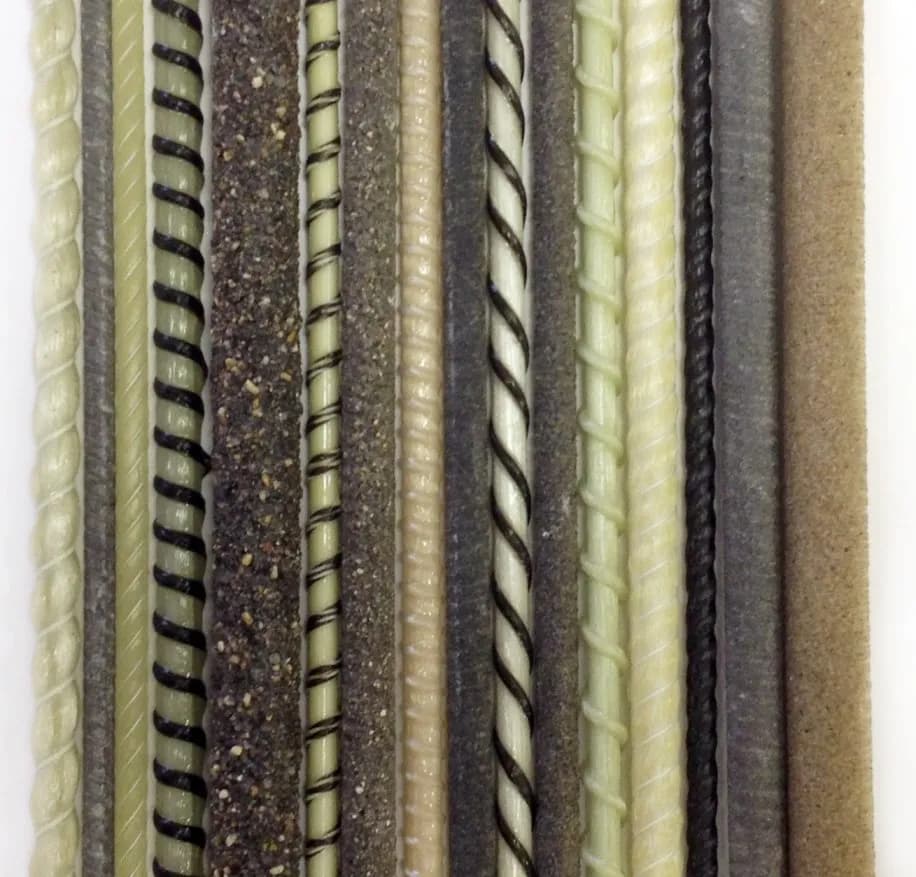
GFRP rebar is a pultruded bar of continuous glass fibers in a thermoset resin, sand-coated, helically wrapped or ribbed so that it bonds to concrete. ASTM D7957 requires at least 70% fiber by mass and a minimum tensile modulus of 44.8 GPa, or 6,500 ksi [company, vendor summary of ASTM D7957, Jivial Composite]. ACI CODE-440.11-22, the US building code for GFRP-reinforced concrete, limits its scope to solid round bars made with vinyl ester resin that conform to ASTM D7957 [statistic, PCI Journal]. The material's advantages are plain: it does not corrode, conducts neither electricity nor magnetism, and a tunnel-boring machine can cut straight through it. Its limits are just as plain. Stiffness is far lower than steel's: Schöck's ComBAR is approved at 60,000 N/mm² against 200,000 N/mm² for steel [company, Schöck]. The bar does not yield, cannot be bent on site, and code use is restricted in fire-rated and high-seismic members.
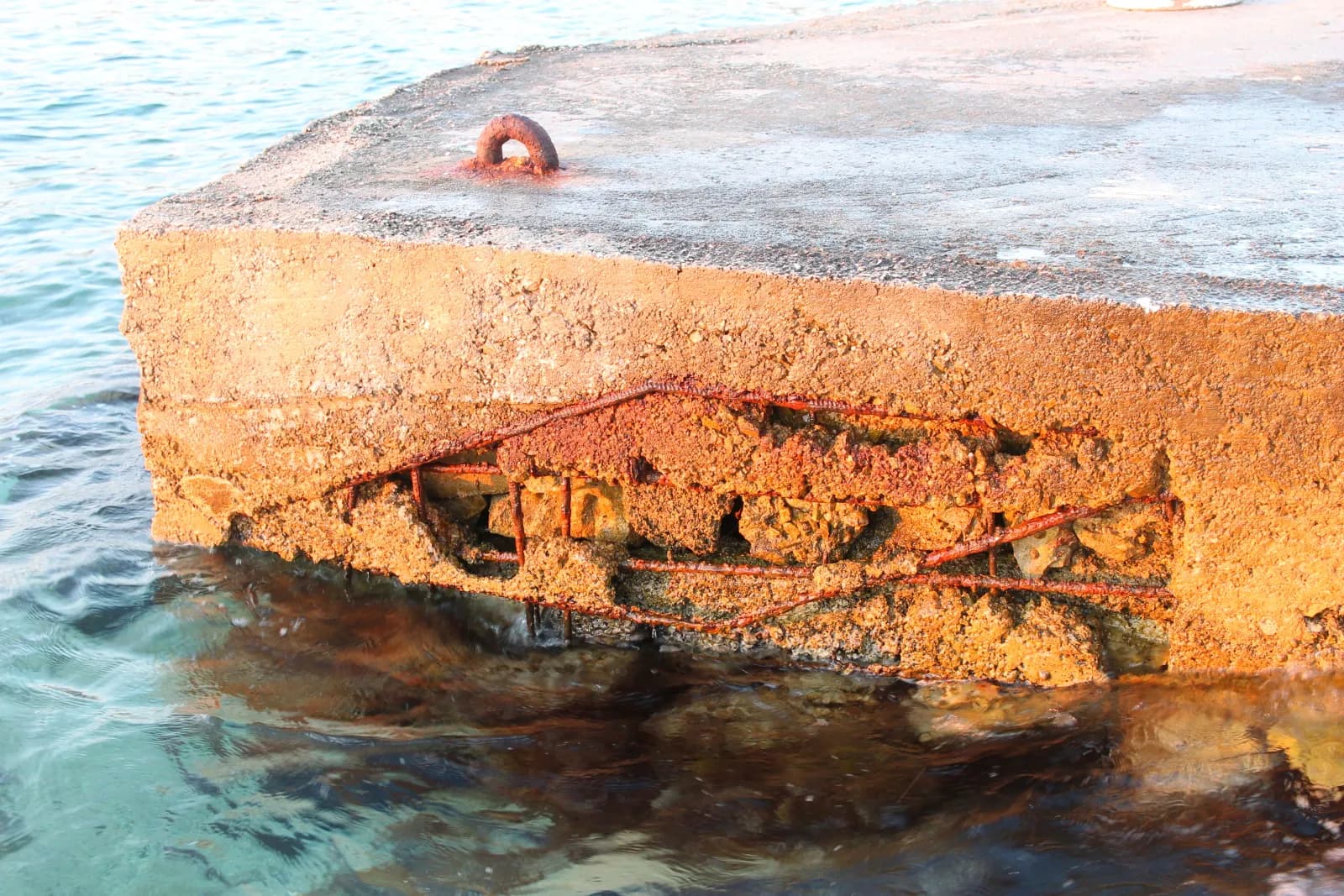
The demand case is corrosion economics. A NACE study put the global cost of corrosion at about USD 2.5 trillion a year, roughly 3.4% of world GDP [statistic, NACE IMPACT via Inspectioneering], and reinforced concrete exposed to de-icing salts and seawater carries a large share of that bill. Owners now write GFRP into their own practice. The Florida DOT uses FRP as the primary reinforcement for splash-zone concrete in its most severe environment, Minnesota allows it in decks that need extended service life, and Vermont uses it as an alternative to stainless steel [statistic, National Academies NAP 29045]. Saudi Aramco wrote GFRP into its standards for highly corrosive environments [media, CompositesWorld]. The life-cycle arithmetic supports these choices: a 100-year life-cycle study found a GFRP bridge deck cost 6% more up front but 89% of the total cost of an epoxy-coated steel deck [statistic, NAP 24888 citing Kostuk et al.].
Steel-side trade policy has widened the opening in the United States. Section 232 tariffs on steel and steel derivatives rose to 50% on 4 June 2025 [statistic, Congressional Research Service], which raises the cost of carbon, epoxy-coated and stainless rebar; GFRP contains no steel, so the tariff does not apply to it. The barriers are still real. State DOTs cite designer unfamiliarity, few suppliers, scarce test laboratories, extra handling time and the absence of repair procedures [statistic, NAP 29045]. Washington State warns that GFRP is vulnerable to hydrodemolition, which makes it a poor fit for high-traffic decks that will later receive bonded overlays [statistic, WSDOT Bridge Design Manual]. And because the modulus is low, crack width and deflection rather than strength usually govern design. A larger bar or more bars are often needed, which is why bar-for-bar price comparisons overstate GFRP's cost advantage.
How to read the evidence tags
Statistic: government, standards-body, DOT, customs and association sources, plus peer-reviewed and university measurements as institutional, non-commercial evidence. Company data: filings, datasheets, ICC-ES code reports, B2B listings and company statements. Forecast: every consultancy figure, including their estimates for past years. GetFRP estimate: our own calculation, with the arithmetic shown. Media report: trade press, news and commodity-price reporting. Figures from different sources are never added together, conflicting estimates are shown side by side with their scopes, and currency conversions assume USD 1 = RMB 7.1–7.2. 'Unverified' marks claims we could not trace to a primary source.
↔ Scroll horizontally to see the full diagram.
2. Global market size: published estimates span a twenty-fold range
No two consultancies agree on what 'the GFRP rebar market' is. The best-documented estimate, from MarketsandMarkets, puts it at USD 0.54 billion in 2025, rising to USD 0.95 billion by 2030 at 12.1% a year [forecast, MarketsandMarkets]. Other publishers place the 2025 base anywhere from about USD 0.2 billion (Stratview, all FRP rebar, 2024) to USD 4.16 billion (Market Research Future, all FRP rebar, 2024), with a GFRP-only high outlier of about USD 3.8 billion from Dataintelo and Verified Market Reports [forecast, publisher pages]. Table 1 and Figure 2 set the estimates side by side with their scopes. They are not averaged and they are not added together.
Two Chinese-language publishers report in renminbi. WENKH gives the global GFRP rebar market at RMB 7.497 billion in 2026, rising to RMB 12.327 billion in 2033 at 7.36% a year [forecast, WENKH via Gelonghui], which is about USD 1.04–1.06 billion [estimate: 7.497 ÷ 7.2 = 1.04; 7.497 ÷ 7.1 = 1.06]. Beijesi gives global FRP rebar, all fibers, at RMB 4.50 billion in 2023 rising to RMB 7.15 billion in 2029, an 8.06% annual rate [forecast, Beijesi via Gelonghui].
The credible cluster is USD 0.5–1.0 billion for 2025 with 6–12% annual growth. Within MarketsandMarkets' own numbers, GFRP makes up about 78% of all FRP rebar value [estimate: 0.54 ÷ 0.69 = 0.78], and the remainder is basalt (BFRP) and carbon (CFRP) bar. The separate BFRP and CFRP 'market sizes' of USD 0.25–0.4 billion each that circulate online are implausible next to that total. No public source gives global tonnage. As an order-of-magnitude check only, dividing MarketsandMarkets' USD 0.54 billion by a vendor-reported mill price of USD 2.60–3.40/kg [company, GTOFRP] implies about 160–210 kt a year [estimate: 540 m ÷ 3.40 = 159 kt; 540 m ÷ 2.60 = 208 kt].
China's own market is even less certain. MarketsandMarkets puts China at USD 85.58 million in 2025 for all FRP rebar, rising to USD 163.89 million in 2030 at 13.9% a year, while Verified Market Reports puts China's GFRP rebar market at USD 0.40 billion in 2024, rising to USD 0.80 billion [forecast]. The two differ about five-fold. Beijesi, QYResearch, DIResearch and Zhiyan Consulting all publish China reports, but their values are blank in public abstracts. Even the lower figure is hard to square with China's position as the world's largest producer by capacity, a description that recurs in Chinese consultancy summaries. By MarketsandMarkets' own figures China would be only about 12% of global FRP rebar value [estimate: 85.58 m ÷ 690 m = 12.4%].
Our reading is that Western reports undercount China for three reasons. They value Chinese tonnage at very low domestic prices. They probably exclude coal-mine GFRP anchor bolts, which may be China's largest volume use (Section 6). And they lack a domestic statistic to anchor on: we found no Chinese association or government figure for FRP-bar output in tonnes or renminbi. For a buyer the implication is practical. Market size is a poor guide to supplier choice; qualified, repeatable output is the relevant measure.
↔ Scroll horizontally to see the full chart and data table.
Source: MarketsandMarkets, GFRP rebar market (2025 base year) and FRP rebar market reports, with country pages; Transpire Insight; DIResearch; Trendx Insights; Dataintelo; Verified Market Reports; Stratview Research; Grand View Research; Fortune Business Insights; The Business Research Company; Market Research Future. MnM = MarketsandMarkets; VMR = Verified Market Reports; Fortune BI = Fortune Business Insights (composite rebar); TBRC = The Business Research Company; MRFR = Market Research Future. Scopes and base years differ, so the bars must not be averaged or summed. GFRP-only estimates are listed first; forecast end values and growth rates are in Table 1.
View the chart data and evidence
| Series | Category | Value | Unit | Evidence / value basis | Reported range | Point note |
|---|---|---|---|---|---|---|
| — | MnM, GFRP, 2025 | 0.54 | USD bn | Forecast | — | — |
| — | Transpire, GFRP, 2025 | 0.95 | USD bn | Forecast | — | — |
| — | DIResearch, GFRP, 2026 | 0.946 | USD bn | Forecast | — | — |
| — | Trendx, GFRP, 2025 | 1.83 | USD bn | Forecast | — | — |
| — | Dataintelo/VMR, GFRP, 2025 | 3.8 | USD bn | Forecast | — | about USD 3.8 bn, broad GFRP scope; high outlier |
| — | Stratview, all FRP, 2024 | 0.2025 | USD bn | Forecast | — | low outlier |
| — | MnM, all FRP, 2025 | 0.69 | USD bn | Forecast | — | — |
| — | Grand View, GFRP+BFRP, 2024 | 0.729 | USD bn | Forecast | — | second-hand figure |
| — | Fortune BI, composite, 2025 | 0.79 | USD bn | Forecast | — | — |
| — | TBRC, all FRP, 2025 | 1.41 | USD bn | Forecast | — | — |
| — | MRFR, all FRP, 2024 | 4.16 | USD bn | Forecast | — | high outlier |
↔ Scroll horizontally to see the full chart and data table.
Source: MarketsandMarkets China FRP rebar page; Verified Market Reports GFRP rebar report. MnM = MarketsandMarkets; VMR = Verified Market Reports. Two publishers, two scopes (all FRP rebar vs GFRP only) and different base years; the about five-fold gap is the finding. Neither appears to count coal-mine GFRP anchor bolts. Values from Beijesi, QYResearch, DIResearch and Zhiyan are paywalled.
View the chart data and evidence
| Series | Category | Value | Unit | Evidence / value basis | Reported range | Point note |
|---|---|---|---|---|---|---|
| — | MnM, all FRP, 2025 | 85.58 | USD m | Forecast | — | — |
| — | MnM, all FRP, 2030 | 163.89 | USD m | Forecast | — | — |
| — | VMR, GFRP, 2024 | 400 | USD m | Forecast | — | — |
| — | VMR, GFRP, end year not shown | 800 | USD m | Forecast | — | — |
| Publisher | Scope | Base value | Forecast value | Annual growth | Note |
|---|---|---|---|---|---|
| MarketsandMarkets | GFRP rebar | USD 0.54 bn (2025) | USD 0.95 bn (2030) | 12.1% | Best-documented anchor; consistent regional pages |
| Transpire Insight | GFRP rebar | USD 0.95 bn (2025) | USD 2.80 bn (2033) | 14.4% | |
| Trendx Insights | GFRP rebar | USD 1.83 bn (2025) | USD 3.16 bn (2034) | 6.27% | |
| DIResearch | GFRP rebar | USD 0.946 bn (2026) | USD 1.303 bn (2033) | 4.68% | |
| Dataintelo / Verified Market Reports | GFRP rebar (broad) | about USD 3.8 bn (2025) | not shown | 8.6% | High outlier |
| WENKH (via Gelonghui) | GFRP rebar | RMB 7.497 bn (2026), about USD 1.04–1.06 bn | RMB 12.327 bn (2033) | 7.36% | Conversion is a GetFRP estimate at RMB 7.1–7.2 per USD |
| MarketsandMarkets | All FRP rebar | USD 0.69 bn (2025) | USD 1.19 bn (2030) | 11.5% | GFRP about 78% of this total [estimate] |
| Grand View Research | GFRP + BFRP rebar | USD 0.729 bn (2024) | USD 1.01 bn (2030) | 5.7% | Second-hand figure |
| Fortune Business Insights | Composite rebar | USD 0.79 bn (2025) | USD 1.3 bn (2034) | 5.8% | |
| Stratview Research | All FRP rebar | USD 0.2025 bn (2024) | USD 0.2853 bn (2030) | 5.6% | Low outlier |
| The Business Research Company | All FRP rebar | USD 1.41 bn (2025) | USD 2.45 bn (2030) | not stated | |
| Market Research Future | All FRP rebar | USD 4.16 bn (2024) | USD 17.53 bn (2035) | not stated | High outlier |
| Beijesi (via Gelonghui) | All FRP rebar | RMB 4.50 bn (2023) | RMB 7.15 bn (2029) | 8.06% |
Source: Publisher pages, press releases and Gelonghui summaries as listed in Sources. Figures are reproduced as published; none are combined.
| Publisher | Scope | Base value | Forecast value | Annual growth | Status |
|---|---|---|---|---|---|
| MarketsandMarkets | China, all FRP rebar | USD 85.58 m (2025) | USD 163.89 m (2030) | 13.9% | Public country page |
| Verified Market Reports | China, GFRP rebar | USD 0.40 bn (2024) | USD 0.80 bn (end year not visible) | not shown | Public summary |
| Beijesi, QYResearch, DIResearch, Zhiyan Consulting | China FRP rebar or GFRP anchor bolts | blank in public abstracts | blank | blank | Paywalled |
Source: MarketsandMarkets China page; Verified Market Reports; Gelonghui, DIResearch and Zhiyan abstracts. No Chinese association or government series for FRP-bar output was found.
3. Regional demand and applications: Asia Pacific is largest, North America most mature, the Gulf and India fast-growing
Only MarketsandMarkets publishes a consistent set of regional GFRP figures, so the shares in Figures 4 and 5 come from one source. It names Asia Pacific the largest and fastest-growing region, with Europe third, but its public pages give no Asia Pacific total [forecast, MarketsandMarkets]. It puts North America at USD 152.84 million in 2025, about 28.3% of its global GFRP total [estimate: 152.84 ÷ 540]. The United States is USD 85.85 million, rising to USD 151.48 million in 2030 at 12.0% a year. Europe is USD 132.79 million, rising to USD 224.45 million at 11.1%. India is USD 56.52 million, rising to USD 110.26 million at 14.3%, the fastest country forecast. Japan is USD 21.37 million, growing at 11.5% [forecast, MarketsandMarkets]. The rest of North America is about USD 67 million by subtraction [estimate: 152.84 − 85.85]. A separate MarketsandMarkets report on all FRP rebar gives Russia USD 55.89 million in 2025 rising to USD 98.49 million in 2030, and China USD 85.58 million [forecast]. Those figures use a different scope and cannot be added to the GFRP regional values.
Other publishers conflict with MarketsandMarkets and with each other. A search summary of one market report put North America at about 35.4% of the global GFRP market in 2024, and Polaris gives the United States at USD 88.48 million in 2025 [forecast]. For the Middle East and Africa, Transpire gives USD 157.84 million in 2025 while Cognitive Market Research gives USD 0.04 billion in 2024 [forecast], a four-fold gap. Regional numbers are therefore best used to rank markets, not to size an order book.
North America is the most mature market. The Florida DOT lists about 27 selected FRP first-use projects, maintains dedicated specification sections (932 and 933) and developmental standard plans for GFRP gravity walls and approach slabs, and manages an addressable stock of 7,044 bridges and more than 4,000 miles of seawall [statistic, FDOT]. An FDOT-funded 2026 research report says the agency 'has moved toward requiring' GFRP transverse reinforcement in some slab-beam bridges [statistic, FDOT 2026 report]. In Canada, Ontario's transport ministry has used GFRP in over 400 bridges [company, MST-BAR presentation via ACMA]; that count comes from a vendor presentation, not from the ministry. Owens Corning put fiberglass at under 1% of a roughly USD 9 billion North American rebar market in 2022 [company, Owens Corning]. The headroom is large, but adoption has been gradual.
Grand View Research names the Middle East the fastest-growing region, while MarketsandMarkets gives that title to Asia Pacific [forecast, Grand View Research; MarketsandMarkets]. Saudi Aramco's Jizan flood channel is about 23 km long and up to 80 m wide, was designed for a 100-year life and used about 11,000 km of GFRP bar; Mateenbar's Dubai plant made about 6,000 km of it in seven months, and bent bars made up about 30% of project quantities [media, CompositesWorld]. The bent-bar share explains why the Gulf favors regional factories: thermoset bars cannot be bent on site, so supply of shapes has to be responsive. In October 2025 Bekaert and IKK Mateenbar signed an MoU covering hybrid GFRP and steel-fiber reinforcement across the Middle East and North Africa, with the GFRP made in Dammam [company, Bekaert]. Reports that Saudi municipal building codes added FRP provisions are unverified.
Europe has no harmonized design code; products enter through national approvals such as Germany's DIBt or through a European Technical Assessment (ETA). Applications include TBM soft-eyes on the Grand Paris Express [company, IKK Mateenbar] and Sardinia's Gonnesa hybrid-reinforced bridge of 2023 [media, Il Giorno]. Russia has its own product standard, GOST 31938-2012, and domestic producers. India has the fastest country forecast and its own standards, IS 18255 and IS 18256 of 2023 and IRC:137-2022. In Australia, Queensland's MRTS271 specification shapes demand alongside tunneling: GFRP soft-eyes were used at four Suburban Rail Loop stations in Melbourne [company, Beyond Materials Group]. New capacity is appearing in South Africa [media, CompositesWorld], and Manila's subway broke through a GFRP-reinforced wall in 2026 [media, Gulf News].
By application, roads, bridges and tunnels are both the dominant and the fastest-growing segment, followed by marine and waterfront structures, water treatment and desalination, MRI rooms and electrical isolation [forecast, Grand View Research]. No accessible source gives a numeric split. In mature markets, volume comes from bridge decks and barriers exposed to de-icing salt and from seawalls. Tunnel soft-eyes, pioneered by Dextra in Bangkok in 1996, are a smaller but higher-value niche sold as engineered cages [company, Dextra].
↔ Scroll horizontally to see the full chart and data table.
Source: MarketsandMarkets GFRP rebar country and region pages (North America, US, Europe, India, Japan), 2025 base year. * Rest of North America is a GetFRP subtraction [estimate]. Shares of the publisher's USD 540 m global GFRP total: North America 28.3%, United States 15.9%, Europe 24.6%, India 10.5%, Japan 4.0% [estimate]. The regions shown do not cover the world and must not be summed to a global figure.
View the chart data and evidence
| Series | Category | Value | Unit | Evidence / value basis | Reported range | Point note |
|---|---|---|---|---|---|---|
| — | North America | 152.84 | USD m | Forecast | — | — |
| — | of which United States | 85.85 | USD m | Forecast | — | — |
| — | of which rest of N. America | 67 | USD m | GetFRP estimate | — | 152.84 − 85.85 |
| — | Europe | 132.79 | USD m | Forecast | — | — |
| — | India | 56.52 | USD m | Forecast | — | — |
| — | Japan | 21.37 | USD m | Forecast | — | — |
↔ Scroll horizontally to see the full chart and data table.
Source: MarketsandMarkets GFRP rebar country and region pages (North America, US, Europe, India, Japan), 2025 base year. Annual growth 2025–2030: United States 12.0%, Europe 11.1%, India 14.3%. North America and Japan have no published 2030 value on the public pages.
View the chart data and evidence
| Series | Category | Value | Unit | Evidence / value basis | Reported range | Point note |
|---|---|---|---|---|---|---|
| 2025 | United States | 85.85 | USD m | Forecast | — | — |
| 2025 | Europe | 132.79 | USD m | Forecast | — | — |
| 2025 | India | 56.52 | USD m | Forecast | — | — |
| 2030 forecast | United States | 151.48 | USD m | Forecast | — | — |
| 2030 forecast | Europe | 224.45 | USD m | Forecast | — | — |
| 2030 forecast | India | 110.26 | USD m | Forecast | — | — |
| Region or country | 2025 value | 2030 value | Annual growth | Share of the publisher's global GFRP value, 2025 | Evidence |
|---|---|---|---|---|---|
| Global (GFRP) | USD 540 m | USD 950 m | 12.1% | 100% | forecast |
| North America | USD 152.84 m | not shown | not shown | 28.3% [estimate: 152.84 ÷ 540] | forecast |
| of which United States | USD 85.85 m | USD 151.48 m | 12.0% | 15.9% [estimate: 85.85 ÷ 540] | forecast |
| of which rest of North America | about USD 67 m [estimate: 152.84 − 85.85] | not shown | not shown | 12.4% [estimate: 67 ÷ 540] | estimate |
| Europe | USD 132.79 m | USD 224.45 m | 11.1% | 24.6% [estimate: 132.79 ÷ 540] | forecast |
| India | USD 56.52 m | USD 110.26 m | 14.3% | 10.5% [estimate: 56.52 ÷ 540] | forecast |
| Japan | USD 21.37 m | not shown | 11.5% | 4.0% [estimate: 21.37 ÷ 540] | forecast |
Source: MarketsandMarkets GFRP rebar country and region pages (North America, US, Europe, India, Japan), 2025 base year; global total from the MarketsandMarkets GFRP rebar market page. The Russia and China values come from a separate all-FRP report with a different scope and are not included. The regions shown do not cover the world and must not be summed.
4. Codes and standards: North America's stack is complete, China's is older
A code is what turns a material into a specifiable product, and the United States now has one for buildings and one for bridges. ACI CODE-440.11-22 is the first mandatory-language ACI building code for GFRP-reinforced concrete, and the 2024 International Building Code adopts it by reference with amendments [statistic, ACI presentation, InTrans 2025]. The AASHTO GFRP bridge guide specification (2nd edition, 2018) remains in force. Its 2026 ballot items do three things: they correct the shear upper limit to 25% of f'c, which allows longer spans without larger members; they credit GFRP's compression capacity; and they add ASTM D8505 alongside D7957, 'aligning the guide specifications with the materials available in the marketplace' [statistic, ASPIRE Fall 2026]. Adding D8505 rewards higher-strength, higher-modulus bars and raises the technical bar for low-cost exporters.
The code still limits seismic and fire use. ACI 440.11 permits GFRP in all members only in Seismic Design Category A, and in members outside the seismic force-resisting system in categories B and C; it does not permit GFRP in categories D to F. The IBC 2024 pathway is narrower still: Seismic Design Category A, and only members without fire-resistance ratings [statistic, STRUCTURE magazine]. Material specifications sit underneath: ASTM D7957/D7957M-25 for solid round GFRP bars, ASTM D8505/D8505M-25 for higher-strength glass and basalt bars, and CSA S807-19 (reaffirmed 2024) with three modulus grades. On an FDOT-hosted presentation of the 2010 edition, Grade I requires at least 40 GPa, Grade II at least 50 GPa and Grade III at least 60 GPa [statistic, FDOT]. Reaching Grade III needs fiber volume above 70%, about 85% by weight [statistic, ScienceDirect review 2025].
Approval is a separate layer from design. In the United States a building product enters through an ICC-ES evaluation report under acceptance criteria AC454 (structural) or AC521 (non-structural); in Canada through CSA S807 certification; on state highway work through DOT production-facility lists; and in Europe through a DIBt national approval or an ETA with CE marking. Outside North America, Eurocode 2's second generation includes an informative Annex R on embedded FRP reinforcement, whose publication status we could not confirm, alongside fib Bulletin 40 and Italy's CNR-DT 203. Russia (GOST 31938-2012), India (IS 18255/18256:2023) and Queensland (MRTS271, 2023) each have their own bar specification.
China's design framework is broad on paper. GB 50608-2020, the technical standard for FRP in construction, formally covers FRP-bar concrete for new construction as well as strengthening. It is also conservative: its creep-rupture reduction factor for GFRP is 3.5, against 1.4 for CFRP and 2.0 for BFRP [statistic, T/CCES draft quoting GB 50608]. A comprehensive association code for FRP-reinforced concrete structures, drafted by Southeast University and Tongji University, was planned in 2019 and was still a consultation draft in May 2025; it already covers FRP-steel hybrids and seawater sea-sand concrete. Tunnel soft-eyes have their own code, CJJ/T 192-2012, and glass-fiber anchor bolts in water-resources works are covered by T/CWEC 47-2024. We found no highway-bridge FRP-bar design specification, and the transport ministry's 2025 standards batch contains no FRP-bar item. Nor did we find a third-party product-listing system for FRP bars comparable to ICC-ES or CSA certification.
The real gap is on the material side. GB/T 26743-2011, the national product standard for FRP bars (official English title: Fiber reinforced composite bars for civil engineering), is 15 years old. Its August 2025 review concluded 'revise', and a revision (plan 20253786-T-609) was out for public comment at the cut-off [statistic, SAMR]. Its GFRP floor appears to be about 40 GPa, although the only machine-readable text we found was an OCR-garbled copy, so the value is unverified [statistic, SAMR openstd record; OCR copy]. A material standard with a floor near 40 GPa gives domestic producers no reason to chase 60 GPa. In North America, by contrast, CSA S807 Grade III has created a premium tier, and the AASHTO move to D8505 reinforces it. The slow progress of China's comprehensive code is a sign that national consensus is still forming.
| Function | International | China |
|---|---|---|
| Bar material specification | ASTM D7957/D7957M-25 (solid round GFRP); ASTM D8505/D8505M-25 (higher-strength glass and basalt bars); CSA S807-19 (R2024) with modulus grades; GOST 31938-2012 (Russia); IS 18255/18256:2023 (India); Queensland MRTS271 (2023) | GB/T 26743-2011 Fiber reinforced composite bars for civil engineering (official English title; review conclusion August 2025: revise; revision draft out for comment); JG/T 406-2013 Glass fiber reinforced plastic rebar for civil engineering; JG/T 351-2012 Fiber reinforced composite bars |
| Minimum tensile modulus | ASTM D7957: 44.8 GPa (6,500 ksi) and fiber at least 70% by mass [company, vendor summary]; CSA S807 Grade I 40, Grade II 50, Grade III 60 GPa [statistic, FDOT presentation of S807-10] | GB/T 26743-2011 GFRP class: about 40 GPa (unverified; read from an OCR-garbled copy now offline) [statistic] |
| Building design code | ACI CODE-440.11-22, referenced by IBC 2024; CSA S806 (Canada); Eurocode 2 second generation, informative Annex R (publication status unconfirmed); fib Bulletin 40; Italy CNR-DT 203 | GB 50608-2020 Technical standard for FRP in construction (FRP-bar and prestressed FRP-bar members); draft T/CCES specification for FRP-reinforced concrete structures (May 2025 consultation draft, includes FRP-steel hybrids and seawater sea-sand concrete) |
| Bridge design | AASHTO LRFD GFRP-RC Guide Specification, 2nd ed. 2018 (2026 ballot changes); CSA S6 Section 16 (Canada) | No highway-bridge FRP-bar design specification found; the 2025 transport-ministry standards batch contains no FRP-bar item |
| Tunnel soft-eye | Project specifications (no dedicated code found) | CJJ/T 192-2012 Technical specification for shield-cuttable concrete reinforcement |
| Anchor bolts | Project and mining specifications | T/CWEC 47-2024 Technical specification for retaining and protection engineering of glass fiber reinforced polymer anchors (water resources); a coal-industry bolt standard number could not be verified |
| Product approval route | ICC-ES AC454 (structural) and AC521 (non-structural) evaluation reports; CSA S807 certification; state DOT production-facility lists; DIBt national approval; ETA with CE marking | No equivalent third-party product-listing system for FRP bars identified |
Source: ACI; ASPIRE Fall 2026; STRUCTURE magazine; Eurocode 2 Annex R paper; ETIZ (GOST); MarketsandMarkets India page; Queensland TMR MRTS271; FDOT session presentation; ScienceDirect 2025 review; SAMR records for GB/T 26743 (official title, review status and revision plan); GB 50608-2020; T/CCES draft; JG/T 406-2013; T/CWEC 47-2024; Ministry of Transport 2025 batch.
| Standard or grade | Minimum tensile modulus | Evidence | Note |
|---|---|---|---|
| ASTM D7957 | 44.8 GPa (6,500 ksi) | company (vendor summary of the standard) | Also requires fiber of at least 70% by mass |
| CSA S807 Grade I | 40 GPa | statistic | From an FDOT-hosted presentation on S807-10; current edition S807-19 (R2024) |
| CSA S807 Grade II | 50 GPa | statistic | Same source |
| CSA S807 Grade III | 60 GPa | statistic | Same source; needs fiber volume above 70%, about 85% by weight [statistic, ScienceDirect review 2025] |
| GB/T 26743-2011 (GFRP class) | about 40 GPa (unverified; OCR-garbled text) | statistic | 15-year-old standard; revision draft out for comment |
Source: Jivial Composite (vendor summary of ASTM D7957); FDOT session presentation; ScienceDirect 2025 review; SAMR records for GB/T 26743 (official title and review status).
5. International producers: Pultron and Mateenbar set the benchmark
Pultron Composites was founded in Gisborne, New Zealand, in 1983 by Bronwen and Peter Holdsworth and remains in the Holdsworth family group [media, Wikipedia]. It spun off Mateenbar Limited around 2019 to 2020; sources differ on the year. In 2021 Pultron described itself as Mateenbar's majority owner and its key research and technology partner [company, AmCham NZ]. The New Zealand government fund Kānoa lent Pultron NZ$5.3 million to grow Mateenbar internationally [statistic, Grow Regions NZ]. The group's advantage is plants placed next to its demand pools. Jebel Ali in Dubai has operated since 2009 or 2010 (sources conflict). IKK Mateenbar in Dammam, Saudi Arabia, is a 10,000 m² joint venture with the Isam Khairy Kabbani Group under a 2019 MoU with Saudi Aramco, inaugurated in 2021; it is expected to displace about 50,000 t a year of steel rebar, which is steel replaced, not plant output [media, CompositesWorld]. Concord, North Carolina, opened in 2021 and is described as 100,000 to 130,000 sq ft depending on the source [media, CompositesWorld], and the company markets it as Build America, Buy America compliant with 'no waivers needed' [company, Mateenbar]. A stockholding warehouse in Brisbane opened in August 2026, with local manufacturing planned and no date given [media, CompositesWorld]. No plant capacity has been disclosed.
The product line is split by duty, and both bars carry a current code report. ICC-ES ESR-5548 was reissued in August 2026 and is valid to August 2027. It lists GREENBAR2X (#3 to #5) for flatwork, with a mean modulus of 46.8 GPa and guaranteed tensile strength of about 750–830 MPa, and MATEENBAR60 (#5, #6 and #8) for structural work, with a mean modulus of 60.0 GPa, guaranteed tensile strength of about 900–925 MPa, ultimate strain of 1.5–1.6% and bond strength of 7.6–9.6 MPa [company, ICC-ES ESR-5548]. Bent shapes are outside the report's scope. Mateenbar supplies factory bends only, covering most steel shapes except the 'Z' [company, Mateenbar]. Mateenbar60 is marketed against ASTM D8505, ACI 440 and CSA S807 Grade III [company, Mateenbar 60 ANZ datasheet]; we did not find a CSA certification-directory listing that confirms the Grade III claim.
The rest of the Mateenbar story is specifier-facing market development. Greenbar2X won an ACMA ACE award at CAMX 2025, and in June 2026 Mateenbar hosted bridge owners on a plant tour during the AASHTO committee meeting in Charlotte [company, ACMA]. Its reference list includes Jizan, the Dubai Deep Tunnel Stormwater System, the Burj Al Arab, US bridges in North Carolina and Ohio, the Adelaide desalination plant and the Port of Rotterdam [company, Mateenbar].
Owens Corning's involvement is part of the benchmark story. In 2021 Owens Corning became the exclusive North American distributor of Mateenbar, with the Concord plant using Owens Corning roving from Amarillo, Texas [media, Concrete Products]. In May and June 2022 the two companies formed a rebar joint venture: Owens Corning contributed about USD 47 million for a 65.5% controlling interest, a USD 25 million redeemable noncontrolling interest was recorded for Pultron's 34.5%, and the venture bought Pultron assets and technology for about USD 65 million [company, Owens Corning FY2023 10-K, Note 7, and press release]. The venture sold PINKBAR+ for flatwork through Lowe's and Home Depot and MATEENBAR for structural work. The evidence after 2023, summarized in the box below, points to a separation but does not prove one.
Pultrall, the maker of V-ROD, is based in Thetford Mines, Québec, where the Fonds de solidarité FTQ took a minority stake in 2024. It bought Fiberglass Innovations of Illinois in 2023 and in March 2026 launched a 127,000 sq ft plant in Edon, Ohio, said to double V-ROD capacity and create more than 60 jobs, with Buy America as the driver [company, Pultrall]. V-ROD is offered in 46, 50 and 60 GPa classes; the V-ROD 60 datasheet lists a 60 GPa minimum modulus and cites CSA S807-19, ASTM D7957-22, D8505-23 and Ontario MTO Grade III [company]. Pultrall's ICC-ES report, ESR-4923, is a non-structural AC521 report covering V-ROD Poly bars as shrinkage and temperature reinforcement [company, ICC-ES ESR-4923]. Two other North American bars hold structural AC454 reports: SFTec's SFT-BAR from Québec (ESR-5081) and Basalt Engineering's Bastech basalt bar (ESR-4648) [company, ICC-ES]. MST Rebar of Toronto, founded in 2012, built a 56,000 sq ft plant in Bladenboro, North Carolina, for USD 15.5 million and 83 jobs [media, Area Development], rated at 'up to 75 miles a day', or about 120 km [estimate: 75 × 1.609]. Its 4EQ Structural Bar holds ICC-ES ESR-4664 with a mean modulus of about 65 GPa for #3 [estimate: 9,427 ksi × 0.006895]. Neuvokas of Ahmeek, Michigan, makes GatorBar, whose ICC-ES ESR-4526 covers #3 only. ExxonMobil gained exclusive non-North-American sub-licensing rights to its process in November 2024, and in January 2026 the Indian steel rebar maker SBPIL agreed to license up to five lines [company, GatorBar].
In Europe, Schöck's ComBAR is approved at 60 GPa with characteristic tensile strength above 1,000 MPa under DIBt approval Z-1.6-238, whose renewal after 2024 we could not verify; its GFRP core is reportedly made with Fiberline Composites in Denmark, although sources conflict [company, Schöck]. Sireg Geotech of Arcore, Italy, holds an ETA (2022) and CE marking for straight and bent Glasspree bars (2024) with an EPD to 2029, and also sells Glasspree TP made with Arkema's Elium thermoplastic resin [media, Ediltecnico; World Construction Network]. Dextra Group, which originated in Bangkok, makes Durabar in Bangkok, Guangzhou and Pune; its Guangdong plant holds ICC-ES ESR-5501 under the non-structural AC521 criteria [company, ICC-ES ESR-5501]. Owens Corning's older Aslan line, bought from Hughes Brothers in 2017, was listed at 46 GPa on a 2019 datasheet [company, ACI datasheets 2019]. Further afield, Jindal Advanced Materials in India runs three plants in Haryana and a fourth in Rajasthan and claims a 100,000 t a year capacity target, which is unverified [company, NBM&CW]. Korea's InfraTechnix, a 2024 joint venture of Korea Petroleum Industries and Samwoo, opened the country's first 60 GPa mass-production line in July 2026; earlier Korean bars were about 45–50 GPa [media, Edaily]. GFRP Tech launched a plant in Johannesburg in 2025, and Russia has Galen, Armastek and Composite Group Chelyabinsk producing to GOST 31938.
The leaders compete less on the pultrusion line than on qualification assets, which take years to build. All three North American leaders, Pultrall in Ohio, MST in North Carolina and Mateenbar in North Carolina, have built or emphasized US production for Buy America. The newest competitive axis is process speed, through Neuvokas's licensed snap-cure process. Owens Corning's apparent retreat suggests that even a glass-fiber major found rebar too small for its portfolio, which leaves specialist pultruders as the structural-grade leaders.
- An ICC-ES AC454 structural evaluation report, with California and Florida supplements.
- CSA S807 Grade III certification and, for highway work, state DOT production-facility listings.
- European approvals: an ETA with CE marking, or a DIBt national approval.
- A 60 GPa grade, now table stakes for structural work.
- Factory bends and headed bars with test data for the shapes supplied.
- Anchor customers such as Saudi Aramco and state DOTs.
- Since October 2025, Buy America compliant US plants for federally funded work.
Owens Corning and Mateenbar: what the filings show
Owens Corning's balance sheet carried the USD 25 million redeemable noncontrolling interest at 31 December 2023 and zero at 30 September 2024 [company, Owens Corning 10-Q Q3 2024 and FY2024 10-K]. 'Rebar' stops appearing in its SEC filings after the FY2023 10-K, and 'Mateenbar' appears in no Owens Corning filing from 2024 to 2026 [company, SEC EDGAR full-text search]. The US business now operates as Mateenbar Composite Reinforcements, LLC, which holds ESR-5548 and filed the GREENBAR 2X trademark in August 2024; Mateenbar's website names its own CEO and makes no reference to Owens Corning; and the Owens Corning-held evaluation report ESR-4593 no longer resolves on the ICC-ES server. Separately, Owens Corning sold its Glass Reinforcements business to Praana Group, closing on 1 May 2026 at an amended USD 645 million enterprise value (originally USD 755 million); the release does not mention rebar [company, Owens Corning]. We could not confirm the transaction, if any, by which Owens Corning exited the rebar venture, nor who owns Mateenbar Composite Reinforcements, LLC today. Treat current ownership as unconfirmed.
↔ Scroll horizontally to see the full chart and data table.
Source: ICC-ES evaluation reports ESR-5548 (Mateenbar), ESR-4664 (MST Rebar), ESR-4923 (Pultrall), ESR-4526 (Neuvokas) and ESR-5501 (Dextra Guangdong); Pultrall V-ROD 60 datasheet; Schöck DIBt approval; Edaily; ACI product datasheets 2019; Pulwell website; Harbin Engineering University journal; exporter datasheet. Products: MST Rebar 4EQ Structural Bar (Canada/US); Mateenbar MATEENBAR60 and GREENBAR2X (NZ/US); Pultrall V-ROD (Canada); Schöck ComBAR (Germany); InfraTechnix (Korea); Owens Corning Aslan 100 (US); Pulwell (China); one Nanjing, China exporter. * MST value is a GetFRP unit conversion [estimate]. Bases differ: means from ICC-ES reports, minimums from datasheets, approval values, website claims and one press report; where a source gives a range the low end is plotted and the range is in the point note. Standard minimums are requirements, not products. InfraTechnix is a media report; the Chinese research bars are academic test specimens, not commercial products.
View the chart data and evidence
| Series | Category | Value | Unit | Evidence / value basis | Reported range | Point note |
|---|---|---|---|---|---|---|
| — | MST 4EQ, #3 (mean) | 65 | GPa | GetFRP estimate | — | 9,427 ksi × 0.006895, from ESR-4664 |
| — | MATEENBAR60 (mean) | 60 | GPa | Company data | — | — |
| — | V-ROD 60 (minimum) | 60 | GPa | Company data | — | — |
| — | Schöck ComBAR (approval) | 60 | GPa | Company data | — | — |
| — | InfraTechnix (press report) | 60 | GPa | Company data | — | media report, not a datasheet |
| — | CSA S807 Grade III minimum | 60 | GPa | Company data | — | — |
| — | CSA S807 Grade II minimum | 50 | GPa | Company data | — | — |
| — | China research bars (low end) | 47.2 | GPa | Company data | — | 12 and 16 mm academic test specimens; measured range 47.2–49.8 GPa |
| — | GREENBAR2X (mean) | 46.8 | GPa | Company data | — | — |
| — | V-ROD 46 (minimum) | 46 | GPa | Company data | — | — |
| — | Aslan 100 (2019 datasheet) | 46 | GPa | Company data | — | — |
| — | Pulwell claim (low end) | 45 | GPa | Company data | — | website claim; range 45–60 GPa |
| — | ASTM D7957 minimum | 44.8 | GPa | Company data | — | — |
| — | Nanjing exporter (low end) | 40 | GPa | Company data | — | one exporter's published datasheet; range 40–42 GPa |
| — | CSA S807 Grade I minimum | 40 | GPa | Company data | — | — |
| Producer | Headquarters and ownership | Plants | Flagship grade and modulus | Certifications | Notable moves 2024–2026 |
|---|---|---|---|---|---|
| Pultron / Mateenbar | Gisborne, NZ; Holdsworth family; US entity Mateenbar Composite Reinforcements, LLC (ownership unconfirmed) | NZ; Dubai; Dammam (IKK joint venture); Concord, NC; Brisbane warehouse | MATEENBAR60, 60.0 GPa mean; GREENBAR2X, 46.8 GPa mean [company] | ICC-ES ESR-5548 (AC454); CSA S807 Grade III and ASTM D8505 claimed | Brisbane warehouse (2026); ACE award; AASHTO plant tour; Owens Corning links vanish from filings |
| Pultrall (V-ROD) | Thetford Mines, Québec; Fonds de solidarité FTQ minority stake (2024) | Thetford Mines; Edon, Ohio (127,000 sq ft); Fiberglass Innovations, Illinois (bought 2023) | V-ROD 46, 50 and 60 GPa classes [company] | ICC-ES ESR-4923 (AC521, non-structural, V-ROD Poly); V-ROD 60 datasheet cites CSA S807-19, ASTM D7957-22, D8505-23, MTO Grade III | Ohio plant (March 2026) said to double V-ROD capacity, 60+ jobs [company] |
| MST Rebar (4EQ) | Toronto; founded 2012 | Bladenboro, NC (56,000 sq ft; USD 15.5 m; 83 jobs) [media] | 4EQ Structural Bar, about 65 GPa mean for #3 [estimate] | ICC-ES ESR-4664 | Plant rated up to 75 miles a day, about 120 km [estimate] |
| Neuvokas (GatorBar) | Ahmeek, Michigan; closely held | Michigan | #3 to #5 GFRP and bends | ICC-ES ESR-4526 (#3 only) | ExxonMobil non-North-American sub-licensing rights (Nov 2024); SBPIL to license up to five lines (Jan 2026) [company] |
| Schöck (ComBAR) | Germany; private (not verified) | Germany; GFRP core reportedly made with Fiberline, Denmark (sources conflict) | ComBAR, 60 GPa, characteristic tensile above 1,000 MPa [company] | DIBt approval Z-1.6-238 (renewal after 2024 unverified) | Soft-eye and headed-bar niche |
| Sireg Geotech (Glasspree) | Arcore, Italy | Italy | Glasspree thermoset; Glasspree TP with Arkema Elium thermoplastic resin | ETA (2022); CE marking for straight and bent bars (2024); EPD to 2029 | First European hybrid GFRP bridge (Gonnesa) |
| Dextra Group (Durabar) | Bangkok origin; multinational | Bangkok; Guangzhou (China); Pune (India) | Durabar GFRP | ICC-ES ESR-5501 (AC521, non-structural), held by the Guangdong plant; CSA S807:19 alignment self-declared | Reported to have joined ACI's NEx center with a Saudi partner (2025, unverified) |
| Owens Corning / Aslan FRP | Toledo, Ohio; bought Aslan from Hughes Brothers (2017) | Seward, Nebraska (historic) | Aslan 100, 46 GPa (2019 datasheet) [company] | Historic ESR-4593 (now not found) | Status after the 2026 Praana sale unverified |
| Jindal Advanced Materials (Vantage) | India | Three plants in Haryana and a fourth in Rajasthan [company] | FRP rebar | not stated | Claims a 100,000 t a year capacity target [company], unverified |
| InfraTechnix | Korea; joint venture of Korea Petroleum Industries and Samwoo (2024) | Korea | 60 GPa class [media] | Meets Korea Expressway modulus requirement (reported) | Korea's first 60 GPa mass-production line (July 2026); earlier Korean bars about 45–50 GPa [media] |
| GFRP Tech | South Africa | Linbro Park, Johannesburg | EnviraBar, 4–32 mm | not stated | Plant launched 2025 |
| Galen, Armastek, Composite Group Chelyabinsk | Russia | Russia | GOST 31938 bars | GOST | Capacity undisclosed |
Source: ICC-ES ESR-5548, ESR-4923, ESR-4664, ESR-4526, ESR-5501; Fonds FTQ; Pultrall Ohio release; Concrete Products; V-ROD 60 datasheet; Area Development; CompositesWorld; GatorBar release; Schöck and DIBt; Ediltecnico; World Construction Network; Dextra; Owens Corning; ACI datasheets 2019; NBM&CW; Edaily; Engineering News; MarketsandMarkets player list.
| Product | Producer (origin) | Modulus, GPa (low) | Modulus, GPa (high) | Basis | Evidence |
|---|---|---|---|---|---|
| 4EQ Structural Bar (#3) | MST Rebar (Canada/US) | 65 | 65 | Mean, ICC-ES report; GetFRP unit conversion [estimate: 9,427 ksi × 0.006895] | company |
| MATEENBAR60 | Mateenbar (NZ/US) | 60.0 | 60.0 | Mean, ICC-ES report | company |
| V-ROD 60 | Pultrall (Canada) | 60 | 60 | Minimum, datasheet | company |
| ComBAR | Schöck (Germany) | 60 | 60 | DIBt approval | company |
| InfraTechnix 60-class | InfraTechnix (Korea) | 60 | 60 | Press report | media |
| GREENBAR2X | Mateenbar (NZ/US) | 46.8 | 46.8 | Mean, ICC-ES report | company |
| V-ROD 46 | Pultrall (Canada) | 46 | 46 | Minimum, datasheet | company |
| Aslan 100 | Owens Corning / Aslan (US) | 46 | 46 | 2019 datasheet | company |
| Pulwell GFRP rebar | Pulwell (China) | 45 | 60 | Website claim | company |
| Tested Chinese research bars (12 mm, 16 mm) | Academic test specimens (China) | 47.2 | 49.8 | Measured | statistic |
| Exporter GFRP rebar | One Nanjing exporter (China) | 40 | 42 | Catalog claim | company |
| Reference: ASTM D7957 minimum | Standard | 44.8 | 44.8 | Requirement | company |
| Reference: CSA S807 Grade III minimum | Standard | 60 | 60 | Requirement | statistic |
Source: ICC-ES evaluation reports ESR-5548 (Mateenbar), ESR-4664 (MST Rebar), ESR-4923 (Pultrall), ESR-4526 (Neuvokas) and ESR-5501 (Dextra Guangdong); Pultrall V-ROD 60 datasheet; Schöck DIBt approval; Edaily; ACI product datasheets 2019; Pulwell website; Harbin Engineering University journal; exporter datasheet. Bases differ (means, minimums, approvals, claims and one press report), so the rows are not like-for-like.
6. China's demand: tunnel soft-eyes and mining bolts, not bridges
Chinese demand is shaped by process economics rather than durability, because steel is extremely cheap. Rebar traded at RMB 3,120–3,320/t across Beijing, Guangzhou and Changsha on 30 October 2026 [media, Mysteel]. At those prices GFRP has to win where steel imposes a process cost, not where it merely corrodes. A 12 mm steel bar weighs about 0.888 kg/m [estimate: 0.00617 × 12²], which puts it at about RMB 2.77–2.95 per meter [estimate: 0.888 × 3.12–3.32]. That is roughly the same as the cheapest domestic GFRP listings at RMB 2.5–3.9 per meter (Section 7). It matches the Chinese industry saying that GFRP is 'cheaper per meter, dearer per tonne, slightly more expensive overall' [media, Zhihu explainer]. Equal-diameter substitution is not structural equivalence, so this parity applies only where stiffness does not govern.
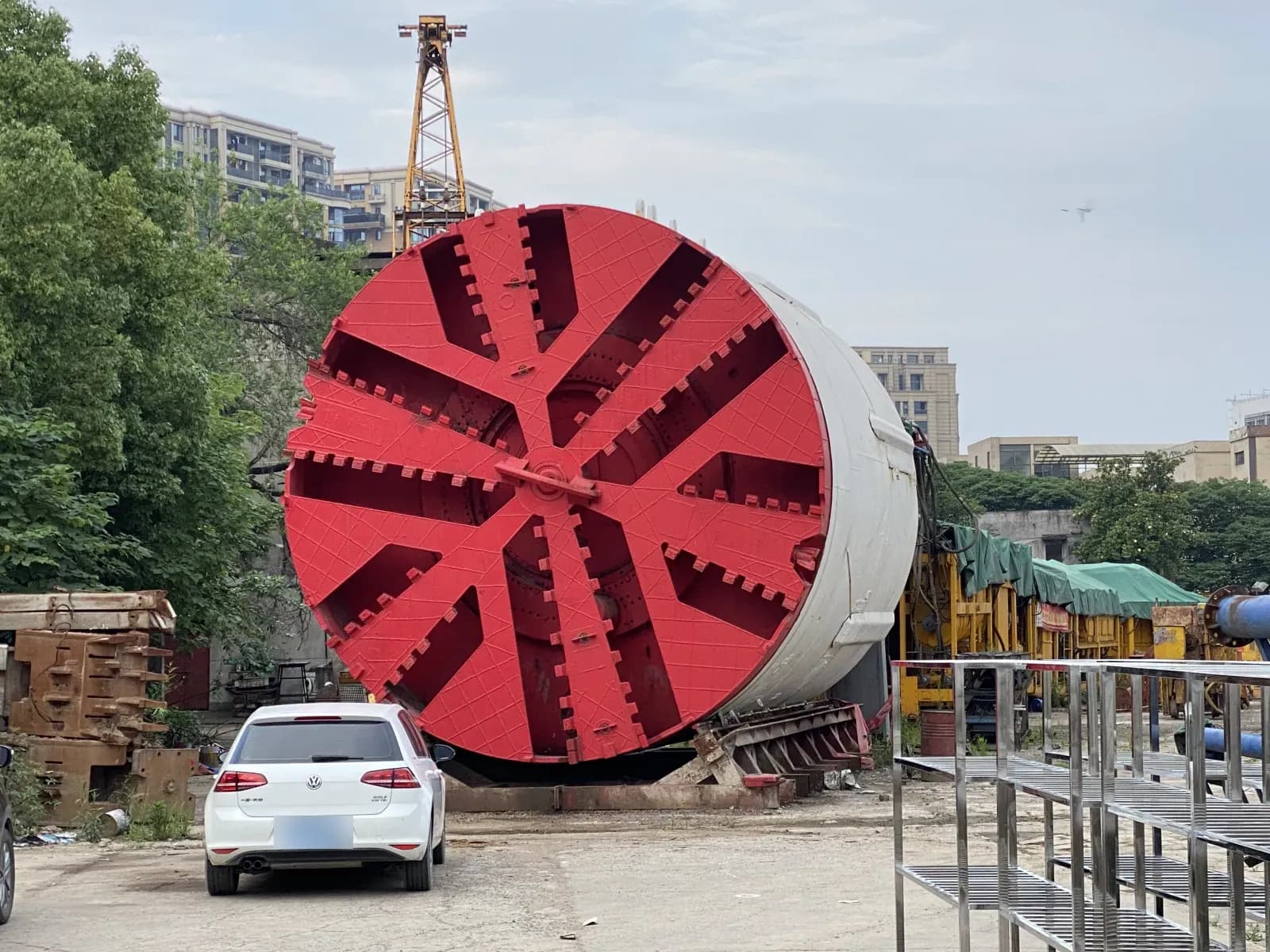
Metro shield-shaft soft-eyes are the flagship civil use. GFRP cages go into diaphragm walls or bored piles at TBM launch and reception shafts, so the machine can cut through without crews breaking out a steel cage by hand. On Shanghai's Chongming Line, built by China Railway 12th Bureau, a TBM ground through a 40 cm GFRP-reinforced diaphragm wall in 193 minutes in July 2025, with surface settlement within 1 mm; the city's transport commission described it as the first grind-through reception of its kind in Shanghai [statistic, Shanghai Municipal Transportation Commission]. The practice goes back at least to Shenzhen Metro Line 2's eastern extension, where GFRP replaced steel in an 800 mm wall about 23.8 m deep and saved about RMB 675,000 [media, China Urban Rail Transit network]. An older cost comparison found GFRP saved about RMB 30,000 per wall panel and 7–10 days of schedule because no manual breakout was needed [statistic, technical paper]. Vendors list references on Qingdao Metro Line 2, Shanghai Metro Line 11 and Zhengzhou lines [company, vendor case list]. Soft-eye demand therefore follows the metro shaft count and the construction cycle. A competing technology is emerging: a draft group standard for steel-fiber, rebar-free shield segments was published in November 2024.
Coal-mine GFRP anchor bolts are probably the largest volume use, but they are poorly measured. GFRP bolts support the side walls of coal roadways, and a shearer can cut through them without sparking, which links the product to mine safety [statistic, SciEngine paper]. A 2024 Coal Engineering paper reported 22 mm fully threaded glass and epoxy bolts with about 1,027 MPa tensile strength [statistic, Coal Engineering]. Volume claims are unverified marketing: a blog cites more than 12 million GFRP bolts a year in Shaanxi, an RMB 18.6 billion roadway-support materials market and a 32.5% GFRP share [company, unverified blog post], and one manufacturer claims capacity of more than 8 million bolt sets a year [company, via Sohu]. Bolt production clusters in Huaibei, Anhui, home to Huaibei Yuxin and Huaibei Jinjiu, and Taiyuan Wuhe and Shanghai Jiman are also named in consultancy player lists. Western 'FRP rebar' reports almost certainly exclude this segment.
Among civil applications, a consultancy summary ranks underground construction first at about 30% share, ahead of bridges and ports and then roads [forecast, consultancy summary via Zhihu]. The long tail includes foundation-pit and slope anchors, sewage plants, chemical plants, electrolysis halls, radar and MRI sites, and airports. Marine use is still at the research and demonstration stage. Hainan University's real-seawater tests predict 75.6% strength retention after 50 years for BFRP in seawater sea-sand concrete and show BFRP degrading faster than GFRP [statistic, Hainan University journal]. Sichuan's basalt-fiber research institute launched a basalt-composite aquaculture platform in December 2025 and plans work on island bridges [media, Sina Finance]. A Yingxiu-Wenchuan expressway deck design substituted about 2.25 t of BFRP for 33 t of steel on strength equivalence [media, The Paper]. We found no verified GFRP or BFRP main reinforcement in China's flagship marine megaprojects, such as the Shenzhen-Zhongshan Link and the Zhoushan works.
Policy support targets basalt, not GFRP. We found no central-government document that promotes FRP bars by name. Sichuan province supports basalt-fiber products through municipal procurement catalogs, green-building-material certification and first-batch new-material insurance [statistic, Sichuan Provincial Government], and Guang'an city lists basalt products for municipal, road and water projects [statistic, Guang'an Municipal Government]. These are regional industrial-development measures. Domestic barriers echo those abroad: low modulus and brittleness, conservative code factors, cages that loosen, jam or float during lifting and concreting, and 'non-unified industry standards and limited technical familiarity' [media, Maimai industry article]. Chinese sources describe a market in which domestic products dominate the low and mid end while imports lead on brand and technology [forecast, consultancy summary via Zhihu].
↔ Scroll horizontally to see the full chart and data table.
Source: Mysteel spot steel rebar prices (30 October 2026); 1688 GFRP rebar listings (October 2026). * Steel per meter is a GetFRP estimate: 0.888 kg/m × RMB 3,120–3,320/t. GFRP listings are company prices with diameters mostly unstated. Equal diameter is not equal stiffness; the comparison applies only to temporary and cuttable uses where stiffness does not govern.
View the chart data and evidence
| Series | Category | Value | Unit | Evidence / value basis | Reported range | Point note |
|---|---|---|---|---|---|---|
| Low end of range | Steel rebar, 12 mm (derived) | 2.77 | RMB/m | GetFRP estimate | — | — |
| Low end of range | GFRP workshop listings | 2.5 | RMB/m | GetFRP estimate | — | — |
| High end of range | Steel rebar, 12 mm (derived) | 2.95 | RMB/m | GetFRP estimate | — | — |
| High end of range | GFRP workshop listings | 3.9 | RMB/m | GetFRP estimate | — | — |
7. China's supply: a vast fiber base under a fragmented, two-tier bar industry
No authoritative public statistic exists for China's GFRP rebar output, producer count or exports. GFRP rebar has no dedicated customs code, and the industry associations publish no rebar breakdown. What listings and company sites show is a two-tier industry. The workshop tier consists of dozens of small pultruders in Hebei (Zaoqiang, Jingxian, Hengshui) and Shandong that sell bar without published specifications on the domestic B2B marketplace 1688; many offer drop-shipping and seven-day returns, and they serve temporary works such as soft-eyes, pit support and slope anchoring [company, 1688 listings]. The engineering and export tier is a smaller group that publishes mechanical data, runs ISO systems, drafts standards or has passed foreign audits; it is concentrated in Jiangsu (Nanjing), Guangdong and Zhejiang. A separate basalt chain sits in Sichuan, Jiangsu, Hebei, Xinjiang and Heilongjiang. The glass-fiber majors, China Jushi, Taishan and CPIC, appear to act as roving suppliers rather than bar makers; that was not confirmed either way.
The best-documented China-sited producer is foreign-owned. Dextra's Guangdong plant in Zengcheng, Guangzhou, holds ICC-ES ESR-5501 under the non-structural AC521 criteria, limited to #3 bars at no more than 12 in spacing as shrinkage and temperature reinforcement [company, ICC-ES ESR-5501]. Among Chinese-owned exporters, Pulwell Composites in Zhongshan publishes 800–1,200 MPa tensile strength and 45–60 GPa modulus, claims more than 10,000 t of annual capacity, holds ISO 9001 and claims ASTM D7957 and ISO 10406 compliance [company, Pulwell]. Jiangsu Green Materials Valley, a Southeast University spin-off founded in 2010, focuses on basalt, claims BFRP bars to 1,400 MPa and up to 60 mm diameter, co-drafts national standards and has a cooperation agreement with CCCC Shanghai Harbour Institute [company]. Haining Anjie Composite Materials lists ISO 9001, 14001 and 45001, an SGS audit and CE marking [company]. On the basalt side, state-owned China Energy Engineering Green Building Materials in Huaying, Sichuan, ran a 4,000 t product line in 2024 with a target above 10,000 t in 2025 [company], and a Mulei, Xinjiang project unrelated to China Jushi plans 1,000 t of BFRP rebar [media, China Chemical News]. All capacity and performance figures are self-declared unless noted.
The raw-material advantage is real. At end-June 2026 China had about 9.3 Mt of glass fiber yarn capacity, of which about 8.65 Mt of tank-furnace capacity was in production, and 2025 yarn output was 8.43 Mt [statistic, CGFIA flash report via Securities Star; CGFIA via China Jushi 2025 annual report]. An industry briefing expects roving capacity in operation to exceed 8.9 Mt by end-2026 [media, Sina Finance]. The price of 2400 tex direct roving bottomed at RMB 3,050–3,100/t before November 2025 and recovered to RMB 3,500–3,900/t by March 2026 [media, Sina Finance]. Unsaturated polyester (UPR) resin traded at RMB 8,700–10,900/t in mid-2026, from the market average to grade-specific ex-works quotes [media, Baiinfo; Mysteel]. We found no Chinese vinyl ester price series; a consultancy tracker put first-quarter 2026 vinyl ester at USD 3,186–4,557/t, with Taiwan at the low end and the United States at the high end [forecast, IMARC].
Resin choice matters more than glass. Figure 8 models each input's contribution to one kilogram of bar at 78% glass and 22% resin by mass, consistent with the 70–80% fiber range Chinese makers publish [estimate]. The rows are not added, because the inputs come from different price sources. Glass, China's headline advantage, is a commodity input either way. The resin decision roughly doubles or halves the resin contribution: switching from vinyl ester to UPR saves about RMB 2.6–3.1 per kg of bar [estimate: 4.97–5.04 minus 1.91–2.40]. That is a strong incentive in a market where workshop bar sells for about RMB 11,000–17,000/t [estimate, Table 10]. ACI 440.11 accepts only vinyl ester bars, so UPR substitution is the single most important hidden-quality risk for buyers. No laboratory study has named a Chinese brand for it; the risk is inferred from cost structure and from catalogs that openly offer polyester bars.
Prices tell the same two-tier story. Chinese 12 mm FOB offers of USD 0.70–0.89 per meter [company, Made-in-China] sit roughly 50–60% below the lowest US wholesale figure for #3 bar, even though a 12 mm bar is larger than a #3 [estimate: 1 − 0.89 ÷ 1.80 = 0.51; 1 − 0.70 ÷ 1.80 = 0.61]. That gap is before freight, duties and qualification costs. The implied FOB price per tonne, USD 3,000–3,900, sits well above an exporter price guide's China domestic band of USD 1,500–2,200/t [company, GTOFRP], which is consistent with export-tier bar being a different product from workshop bar. The unit-weight assumption is uncertain, because vendor tables list 12 mm bar at 0.20–0.23 kg/m. No public tender award prices were found.
GFRP rebar has no customs series. It can fall under glass-fiber articles (HS 7019), plastic profiles (HS 3916 or 3926) or, for carbon and basalt bars, HS 6815. The only hard export number is for basalt fiber and products: exports rose from 12,138.2 t in 2024 to 12,659.2 t in the first half of 2025 alone, up 136.84% year on year [statistic, China customs via Chinabaogao]. How much of that is rebar is unknown. We found no anti-dumping or countervailing measure aimed specifically at Chinese GFRP rebar in the EU, the United States, India or Türkiye. The upstream duties in Table 11 raise costs for foreign bar makers that buy Chinese roving, which could favor finished Chinese bar, although we have not verified that cured bars fall outside each measure's scope.
Quality shows dispersion rather than documented failure. We found no official spot-check failure notices or named incidents involving Chinese GFRP rebar. The evidence of dispersion is indirect but specific. One Nanjing exporter's published datasheet lists a modulus of 40–42 GPa, below the 44.8 GPa ASTM D7957 minimum, alongside a D7957 compliance claim, with tensile strength falling from 1,100 MPa at 6 mm to 675 MPa at 25 mm [company, exporter datasheet]. Exporters openly offer polyester resin, and workshop listings carry no diameter, resin or test data. Academic reviews document 'notable scatter' in GFRP bar properties driven by resin type and fiber content [statistic, PMC review]. Domestic demand for temporary, cuttable bar rewards low price over long-term alkali durability. That sustains the low-specification tier and makes it essential for importers to separate the tiers by evidence.
↔ Scroll horizontally to see the full chart and data table.
Source: GetFRP model from Sina Finance roving prices (RMB 3,500–3,900/t, March 2026), Baiinfo and Mysteel UPR prices (RMB 8,700–10,900/t) and the IMARC low-end vinyl ester quote (Taiwan proxy, converted at RMB 7.1–7.2 per USD). Each bar is one input's contribution: 0.78 × glass price and 0.22 × resin price. A bar uses either UPR or vinyl ester, never both, and the rows come from different price sources, so they are not added. Excludes sand, wrap, energy, labor and margin.
View the chart data and evidence
| Series | Category | Value | Unit | Evidence / value basis | Reported range | Point note |
|---|---|---|---|---|---|---|
| Low end of range | Glass roving, 78% of mass | 2.73 | RMB/kg | GetFRP estimate | — | — |
| Low end of range | UPR resin, 22% of mass | 1.91 | RMB/kg | GetFRP estimate | — | — |
| Low end of range | Vinyl ester, 22% of mass | 4.97 | RMB/kg | GetFRP estimate | — | — |
| High end of range | Glass roving, 78% of mass | 3.04 | RMB/kg | GetFRP estimate | — | — |
| High end of range | UPR resin, 22% of mass | 2.4 | RMB/kg | GetFRP estimate | — | — |
| High end of range | Vinyl ester, 22% of mass | 5.04 | RMB/kg | GetFRP estimate | — | — |
↔ Scroll horizontally to see the full chart and data table.
Source: 1688 and Made-in-China listings (October 2026); GTOFRP price guides (2025); Composite-Tech US price guide (December 2025); ConstructEstimates. China workshop and China branded: 1688 domestic listings; China FOB 12 mm: Made-in-China; US #3 market: wholesale to retail per Composite-Tech; US #3 vendor guide: a Chinese vendor's 2025 US price guide. * Converted by GetFRP [estimate]: renminbi at RMB 7.1–7.2 per USD; US per-foot prices × 3.281. Diameters differ (China listings mostly unstated or 12 mm; US #3 is 9.5 mm), so these are market price bands, not like-for-like quotes. Stainless steel rebar at USD 11.48–24.61 per meter is in Table 10.
View the chart data and evidence
| Series | Category | Value | Unit | Evidence / value basis | Reported range | Point note |
|---|---|---|---|---|---|---|
| Low end of range | China workshop | 0.35 | USD/m | GetFRP estimate | — | — |
| Low end of range | China branded | 1.32 | USD/m | GetFRP estimate | — | — |
| Low end of range | China FOB 12 mm | 0.7 | USD/m | Company data | — | — |
| Low end of range | US #3 market | 1.8 | USD/m | GetFRP estimate | — | — |
| Low end of range | US #3 vendor guide | 4.92 | USD/m | GetFRP estimate | — | — |
| High end of range | China workshop | 0.55 | USD/m | GetFRP estimate | — | — |
| High end of range | China branded | 1.41 | USD/m | GetFRP estimate | — | — |
| High end of range | China FOB 12 mm | 0.89 | USD/m | Company data | — | — |
| High end of range | US #3 market | 2.95 | USD/m | GetFRP estimate | — | — |
| High end of range | US #3 vendor guide | 5.91 | USD/m | GetFRP estimate | — | — |
| Producer | Location | Tier | Products and published data | Certifications | GetFRP profile |
|---|---|---|---|---|---|
| Dextra Building Products (Guangdong), foreign-owned | Zengcheng, Guangzhou | Export, foreign quality control | Durabar GFRP; ICC-ES scope limited to #3 at 12 in spacing or less for shrinkage and temperature reinforcement [company] | ICC-ES ESR-5501 (AC521, non-structural), verified | — |
| Pulwell Composites | Zhongshan, Guangdong | Export | 800–1,200 MPa, 45–60 GPa; 10,000+ t annual capacity [company] | ISO 9001; claims ASTM D7957 and ISO 10406 compliance | View profile |
| Jiangsu Green Materials Valley New Material Technology | Nanjing; Southeast University spin-off, founded 2010 | Engineering (basalt focus) | BFRP bars claimed to 1,400 MPa and up to 60 mm diameter; basalt grids [company] | Co-drafter of national standards; cooperation agreement with CCCC Shanghai Harbour Institute | — |
| Haining Anjie Composite Materials | Haining, Zhejiang; factory in Yancheng, Jiangsu | Export | GFRP rebar; 20,000 m² site [company]; specifications not listed on the product page | ISO 9001/14001/45001, SGS audit, CE | — |
| Nanjing Fenghui Composite | Nanjing | Domestic engineering | GFRP rebar and anchors | not stated | — |
| Huaibei Yuxin New Materials; Huaibei Jinjiu; Hubei Yulong; Shandong Sifute; Shanghai Qipeng (KNP); Shanghai Jiman; Taiyuan Wuhe | Anhui, Hubei, Shandong, Shanghai, Shanxi | Domestic (bars and mining bolts) | Named in consultancy player lists | not stated | — |
| Workshop pultruders (not named) | Hebei (Zaoqiang, Jingxian, Hengshui) and Shandong | Workshop | Marketplace listings without diameter, resin or test data | None stated | — |
| China Energy Engineering Green Building Materials (state-owned) | Huaying, Sichuan | Basalt | 4,000 t product line (2024), target above 10,000 t in 2025 [company] | not stated | — |
| Mulei basalt project (unrelated to China Jushi) | Xinjiang | Basalt | 2025 plan includes 1,000 t of BFRP rebar [media] | not stated | — |
Source: ICC-ES ESR-5501; company websites; Gelonghui and Zhiyan player lists; 1688 marketplace; CEEC; China Chemical News. A GetFRP profile is a published listing, not an audit or a product certification. A further Nanjing exporter whose published modulus sits below the ASTM D7957 minimum is discussed anonymously in the text.
| Input | Price basis | Mass share | Contribution per kg of bar, RMB | Evidence |
|---|---|---|---|---|
| Glass roving (2400 tex) | RMB 3,500–3,900/t (March 2026) | 78% | 2.73–3.04 [estimate: 0.78 × 3.5–3.9] | estimate from media prices |
| UPR resin | RMB 8,700–10,900/t | 22% | 1.91–2.40 [estimate: 0.22 × 8.7–10.9] | estimate from media prices |
| Vinyl ester resin (Taiwan proxy, low end of the USD 3,186–4,557/t range) | RMB 22,600–22,900/t [estimate: low-end USD quote × RMB 7.1–7.2] | 22% | 4.97–5.04 [estimate: 0.22 × 22.6–22.9] | estimate from a consultancy forecast |
Source: GetFRP model from Sina Finance roving prices, Baiinfo and Mysteel UPR prices and IMARC vinyl ester prices. Assumes 78% glass and 22% resin by mass, consistent with the 70–80% fiber range Chinese makers publish [estimate]. A bar uses either UPR or vinyl ester, and the rows come from different price sources, so they are not added together.
| Market and basis | Product | Price range | Unit | Per-meter equivalent, USD | Evidence |
|---|---|---|---|---|---|
| China domestic, workshop tier (1688, Oct 2026) | Diameter mostly unstated | RMB 2.5–3.9 | per m | 0.35–0.55 [estimate: 2.5 ÷ 7.2; 3.9 ÷ 7.1] | company |
| China branded (1688, Oct 2026) | Diameter unstated | RMB 9.5–10 | per m | 1.32–1.41 [estimate] | company |
| China domestic, implied per tonne (if workshop listings are 12 mm at 0.23 kg/m) | 12 mm | RMB 11,000–17,000 | per t | not applicable | estimate: 2.5 ÷ 0.23 = 10,870; 3.9 ÷ 0.23 = 16,957 |
| China FOB (Made-in-China, 2026) | 12 mm, MOQ 1,000 m | USD 0.70–0.89 | per m | 0.70–0.89 | company |
| China FOB, implied per tonne | 12 mm at 0.23 kg/m | USD 3,000–3,900 | per t | not applicable | estimate: 0.70 ÷ 0.23 = 3,043; 0.89 ÷ 0.23 = 3,870 |
| China FOB, general listings (Alibaba) | Mixed sizes | USD 0.50–1.30 | per m | 0.50–1.30 | company, unverified |
| Exporter price guide: China / India / USA | Generic | USD 1,500–2,200 / 1,800–2,400 / 2,500–3,200 | per t | not applicable | company |
| US, #3 GFRP, wholesale to retail (2025–26) | #3 (9.5 mm) | USD 0.55–0.90 | per ft | 1.80–2.95 [estimate: × 3.281] | company |
| US, #3 / #4 / #5 GFRP (Chinese vendor's 2025 US guide) | #3 / #4 / #5 | USD 1.50–1.80 / 2.00–2.50 / 2.80–3.50 | per ft | 4.92–5.91 / 6.56–8.20 / 9.19–11.48 [estimate] | company |
| US, stainless steel rebar (estimators) | Mixed | USD 3.50–7.50 | per ft | 11.48–24.61 [estimate] | media |
| Weight basis, vendor comparison (2025) | GFRP / epoxy-coated steel / stainless | USD 2.60–3.40 / 1.40–1.80 / 3.50–4.20 | per kg | not applicable | company |
Source: 1688 and Made-in-China listings (October 2026); GTOFRP price guides (2025); Composite-Tech US price guide (December 2025); ConstructEstimates. Prices are listing and guide ranges, not tender awards; no public tender award prices were found.
| Jurisdiction | Measure | Product scope | Rate | Applies to finished GFRP rebar? | Evidence |
|---|---|---|---|---|---|
| United States | Section 301 additional duty (CBP ruling N303035, 2019) | Carbon-fiber rebar from China, HTS 6815.10 | 25% | No fiberglass-specific ruling found; applicability to the exact HTS line unverified | statistic |
| United States | MFN duty (CBP ruling NY B87240, 1997) | FRP rebar under HTS 3916.90.50 | 5.8% | Historic classification | statistic |
| United States | Additional duty on products of China, HTSUS heading 9903.05.31 (chapter 99, U.S. note 52) | Chinese-origin goods except those listed in 9903.05.85–9903.05.92 | +12.5% | Yes on its face; stacks with MFN and any Section 301 list duty; exclusions not checked against rebar lines | official |
| United States | Build America, Buy America | Federally funded infrastructure | not applicable | Effectively excludes imported bar on federal-aid work | company |
| European Union | Anti-dumping, glass fiber yarns (2025) | Yarns from China | 26.3–56.1% | No (upstream input) | statistic |
| European Union | Anti-dumping and countervailing, woven and stitched glass fiber fabrics (both renewed after expiry reviews, June and August 2026) | Fabrics from China (impregnated and prepreg fabrics excluded) | AD 34.0–69.0%; CVD 17.0–30.7% | No (upstream input) | statistic |
| European Union | Anti-dumping, continuous filament glass fiber (rates amended Nov 2025 by Regulation 2025/2337; anti-subsidy expiry review opened Feb 2026) | Rovings, chopped strands, mats | 17.2–23.0% by company (Jushi and Taishan 23.0%) | No (upstream input); scope text not verified | statistic |
| India | DGTR final findings, glass fiber from China, Bahrain and Thailand | Rovings, chopped strands, yarns, mats | USD 194–394/t recommended | No (upstream input) | statistic |
Source: CBP rulings N303035 and NY B87240; USITC HTSUS heading 9903.05.31; Mateenbar Buy America page; European Commission; EUR-Lex 2025/2337, 2026/1203 and 2026/1928; WTO trade remedies portal. No anti-dumping or countervailing measure aimed specifically at GFRP rebar was found in the EU, US, India or Türkiye. Verify live rates before quoting a landed price.
8. Research and development: China publishes the most, the West commercializes faster
By research volume, China leads. A 2024 bibliometric review found China to be the largest contributor of publications on FRP-bar durability, ahead of Canada, the United States, Egypt, India, Italy and Germany [statistic, Civil Engineering Journal]. Its flagship program is the Hong Kong Polytechnic University's research on FRP-reinforced seawater sea-sand concrete, led by Prof. Jin-Guang Teng, which was awarded more than HK$52 million, the largest award in its 2018 funding round [statistic, PolyU]. The program has produced ultra-high-performance sea-sand concrete above 180 MPa and several demonstrations: a wave wall at Lei Yue Mun (April 2025), precast pier slabs at Lai Chi Chong (December 2025) and a marine exposure frame on Guishan Island, Zhuhai [statistic, PolyU, September 2026]. On the mainland, the draft association code already covers FRP-steel hybrid reinforcement and seawater sea-sand concrete, an area international codes do not yet address. Southeast University's basalt work, commercialized through Green Materials Valley, and university studies of tunnel segments, compression behavior and braided bars complete the picture.
The international frontier is about products and evidence. Neuvokas's process, paired with ExxonMobil's Proxxima resin, is claimed to run 'up to 20 times faster' than conventional pultrusion [company, ExxonMobil], and trade press reported 23–37 m/min against a typical 1.5–3 m/min [media, Concrete Products; Indian Chemical News]. Field-bendable thermoplastic bar is the other open frontier. The University of Maine runs a thermoplastic FRP rebar pultrusion line making #4 bar at 12 ft/min, about 3.7 m/min [statistic, UMaine], and Sireg markets an Elium-based thermoplastic bar. Bend performance is a known weak point of thermoset bar: factory-bent bars can retain as little as 25% of straight-bar strength, and design recommendations overestimate bend capacity in 'a significant number of cases' [statistic, Imjai et al., Polymers 2020].
The most important international asset cannot be bought: time in service. Bars extracted from 11 US bridges after 15 to 20 years showed minimal degradation, with one bridge showing only a 4.2% tensile reduction after 17 years [statistic, ASCE Journal of Composites for Construction]. A published discussion cautions that one bridge's bars sat at 73% of control strength and that baselines are uncertain [statistic, ASCE discussion]. Canada's Val-Alain bridge barrier yielded GFRP with no significant change after 11 years [statistic, Benmokrane et al., via the ASCE study's citations]. We found no comparable decade-plus extraction program on named Chinese commercial products; China's marine exposure platforms date from around 2019 to 2020.
China does have the process know-how a 60 GPa bar needs. CSA Grade III requires fiber volume above 70% [statistic, ScienceDirect review 2025], and Chinese wind-blade pultrusion already makes spar-cap planks that target 65–68 GPa laminates at about 70% fiber volume [media, wind industry article]. No Chinese producer has published a 60 GPa rebar grade, but the obstacle is product focus and qualification, not the pultrusion physics.

| Dimension | International | China |
|---|---|---|
| Publication volume (FRP-bar durability) | Canada and the United States strong | Largest contributor (2024 bibliometric review) |
| Seawater sea-sand concrete with FRP | Smaller programs | PolyU flagship program, 2025 demonstrations, draft association code |
| High-modulus (60 GPa) commercial bar | Four or more producers plus a new Korean line | None published; wind-blade pultrusion targets 65–68 GPa laminates at about 70% fiber volume [media] |
| Process speed and snap-cure resin | Neuvokas-Proxxima process licensed globally | No public data on line speeds |
| Thermoplastic field-bendable bar | UMaine pilot line; Sireg TP | No program found |
| Long-term field extraction on commercial bars | 15–20-year US bridge study; 11-year Canadian study | Not found for named products |
| Mining bolts (glass and epoxy, shearer-cuttable) | Niche | Active research and large installed use |
Source: Civil Engineering Journal 2024; PolyU; CompositesWorld; UMaine; ASCE Journal of Composites for Construction; wind industry article; Coal Engineering 2024.
9. Gap analysis: certification and modulus, not fiber or physics
Put side by side, the comparison is lopsided in a specific way. China is ahead on fiber supply and cost, on pultrusion scale, on research volume and on FRP-reinforced sea-sand concrete. It is at parity on soft-eye engineering, where it has a dedicated code and a fresh Shanghai record, and on the breadth of its design code. Mining bolts are a domestic specialty with no Western equivalent of similar scale. The high-severity gaps are all about qualification: no certified 60 GPa product, no structural North American report held by a Chinese-owned producer, no European approval and no decade-plus field extraction on a named product, as far as we could find.
The gaps fall into two groups. Some can be closed with money and discipline: a vinyl ester Grade III line, third-party certification and published bend data. Dextra's Guangdong plant already shows that a China-sited plant can pass ICC-ES quality-control audits, and China's wind-blade sector already runs the high-fiber-volume process a 60 GPa bar needs. The other gap can only be closed with time: decade-plus field evidence on named products. Buy America is a separate case, a policy barrier that no product improvement removes.
| Dimension | International frontier | China status | Gap severity |
|---|---|---|---|
| Structural modulus grade | Grade III (60 GPa or more) standard for structural leaders; up to about 65 GPa (MST) | Claims of 40–60 GPa; tested research bars 47–50 GPa; no certified 60 GPa product found | High (product and certification gap) |
| North American certification | AC454 reports (Mateenbar, MST, Neuvokas, SFTec; basalt: Basalt Engineering); CSA S807 Grade III; DOT facility lists | None found for Chinese-owned producers; China-sited, foreign-owned Dextra holds AC521 (non-structural) | High |
| European approval | ETA with CE marking (Sireg); DIBt (Schöck) | None found | High |
| Resin compliance | ACI 440.11 accepts vinyl ester bars only | Polyester, vinyl ester and epoxy all offered; strong cost incentive for polyester | Medium to high |
| Long-term field evidence | 15–20-year bridge extractions | Exposure platforms since about 2019–20; no extraction on named products | High (cannot be shortcut) |
| Factory bends and shapes | Full shape ranges; CE-marked bent bars (Sireg) | No published bend-strength datasets found | Medium |
| Material standard currency | CSA S807-19 (R2024), ASTM D7957-25, D8505-25 | GB/T 26743-2011 under revision (draft out for comment); about 40 GPa floor (unverified) | Medium |
| Process speed and resin innovation | Snap-cure licensed process, claimed up to 20 times faster | No public data | Unknown |
| Local plants near demand | Buy America plants in the US; Saudi joint venture; Australian warehouse | Export from China only (Dextra has plants in several countries) | High for US federal work |
| Design code scope | ACI 440.11 and IBC 2024 restrictive on seismic and fire | GB 50608-2020 covers FRP-bar members for new build; conservative factors | Parity |
| High-fiber-volume pultrusion know-how | Fiber volume above 70% for Grade III | Wind-blade planks at about 70% fiber volume | Low |
| Field-bendable thermoplastic bar | Pilot (UMaine), early commercial (Sireg TP) | No program found | Low to medium (frontier open) |
| Glass fiber supply and cost | Owens Corning exited glass reinforcements (2026) | About 8.65 Mt tank capacity in production (mid-2026); roving RMB 3,050–3,900/t | China ahead |
| Research volume; FRP with seawater sea-sand concrete | Strong university groups | Top publisher; PolyU demonstrations | China ahead |
| Tunnel soft-eye practice | Standard worldwide | Standard practice with its own code (CJJ/T 192-2012) | Parity |
Source: GetFRP assessment from the evidence in Sections 2 to 8: ICC-ES ESR-5548 and ESR-5501; Harbin Engineering University journal; exporter datasheets; Ediltecnico; PCI Journal; ASCE; Imjai et al. 2020; SAMR; CompositesWorld; Mateenbar; STRUCTURE magazine; ScienceDirect 2025 review; wind industry article; UMaine; Sina Finance; Civil Engineering Journal; PolyU; Shanghai Municipal Transportation Commission. Severity ratings are qualitative judgments.
10. What buyers sourcing GFRP rebar from China should ask for
The market's two-tier structure decides the sourcing strategy. A capable Chinese supplier can deliver a code-compliant bar at a large discount to North American list prices, while a low-specification supplier can deliver a bar whose published modulus sits below the ASTM D7957 minimum even as its catalog claims compliance. The difference shows only in documents and tests. A claim of 'compliant with ASTM D7957' on a website is not evidence: ASTM D7957 is a material specification, not a certification scheme, so compliance means a test report on the bars being bought. Table 14 lists the evidence to request in an RFQ, with the pass criteria and the red flags.
Requirements differ by destination (Table 15). US federal-aid projects are effectively closed to imported bar under Buy America, whatever its quality. US private building work needs an ICC-ES report or an engineer's acceptance of ASTM D7957 test evidence. Canadian bridges need CSA S807 grading, Queensland projects need MRTS271 conformity, and European projects increasingly expect an ETA and CE marking. Gulf and Asian projects tend to follow ASTM or CSA test evidence plus owner approval. In every market, ask for a lot-level test campaign on the delivered bars, not a type test from years ago; it is the cheapest insurance against resin substitution and low fiber content.
Two further rules keep comparisons honest. First, compare prices only between offers backed by the same evidence: a workshop bar sold for temporary tunnel works and an export-grade structural bar are different products even at the same diameter. Second, compare designs, not bars. Because GFRP's low modulus means crack width and deflection usually govern, the engineer's bar schedule, including bent shapes ordered from the factory with bent-bar test data, is the right basis for a cost comparison with steel, stainless or epoxy-coated reinforcement.
GetFRP lists Chinese FRP rebar producers with their published capabilities, but a profile is a listing, not an audit or a product certification. Use the supplier verification checklist to confirm the legal entity and the production site, send one controlled RFQ that names the specification edition, modulus grade, resin, shapes and test regime, and compare responses on the same evidence basis.
| Evidence item | What to ask for | Pass criterion or red flag |
|---|---|---|
| Governing specification | Name the specification in the RFQ: ASTM D7957/D7957M (or D8505 for higher grades), the CSA S807-19 grade, or the project specification (for example FDOT 932 or MRTS271) | Red flag: 'meets ASTM/ACI/CSA' with no edition or test report |
| Tensile test report | ASTM D7205 results per diameter with guaranteed strength (mean minus three standard deviations) and lot numbers | Red flag: one value for all diameters; tensile figures with no lot data |
| Modulus grade | Measured mean modulus per diameter; state the CSA grade (I 40, II 50, III 60 GPa minimum) | Red flag: below 44.8 GPa for any D7957 claim; structural work typically needs Grade III |
| Resin type | Written statement of resin (vinyl ester for ACI 440.11 designs) plus resin supplier and grade | Red flag: 'polyester, vinyl ester or epoxy depending on specification' with no lot traceability |
| Fiber content | Fiber mass fraction by ignition (ASTM D2584 or equivalent) and glass type (E-CR preferred by FDOT) | Red flag: below 70% by mass |
| Durability and bond | Alkali-resistance retention, transverse shear, bond strength, moisture absorption, glass transition temperature and degree of cure per D7957 | Red flag: durability data missing or 'available on request' |
| Bends and shapes | Bent-bar tensile data for the actual shapes and radii ordered; factory bending only | Red flag: an offer to field-bend thermoset bar; no bent-bar data |
| Third-party laboratory | Report from an ISO/IEC 17025-accredited independent laboratory, ideally one recognized by the owner (university laboratories in Sherbrooke or Miami are common references) | Red flag: in-house reports only |
| Code report or certification | ICC-ES report (AC454 structural or AC521 non-structural), CSA S807 certificate, DOT facility listing, ETA and CE marking where required | Red flag: CE or 'certified' logos without a certificate number you can look up |
| Quality system | ISO 9001 plus documented lot sampling frequency and retained samples | Red flag: drop-shipping or retail-style storefronts |
| Trade compliance | HS classification, origin, Section 301 exposure for the US, Buy America status for federally funded US work | Red flag: no customs classification proposal |
Source: GetFRP sourcing practice based on ASTM D7957, ACI CODE-440.11-22, CSA S807, FDOT Section 932 and ICC-ES acceptance criteria as summarized in this report.
| Destination and project type | Gate | What an importer needs |
|---|---|---|
| United States, federally funded highway and bridge work | Build America, Buy America | A US plant; imported bar is effectively excluded whatever its quality |
| United States, private building work | ACI CODE-440.11-22 via IBC 2024; building official | An ICC-ES evaluation report, or an engineer's acceptance of ASTM D7957 test evidence on vinyl ester bar |
| Canada, bridges | CSA S6 Section 16 and CSA S807 | CSA S807 grading of the bar |
| Australia, Queensland road and bridge work | TMR MRTS271 | MRTS271 conformity evidence |
| Europe | National approval or European Technical Assessment | An ETA with CE marking, or a DIBt approval in Germany |
| Gulf and Asia | Owner specifications | ASTM or CSA test evidence plus owner approval; responsive supply of factory bends |
Source: ACI; STRUCTURE magazine; Mateenbar Buy America page; Queensland TMR MRTS271; Ediltecnico; DIBt; CompositesWorld. Confirm project-specific requirements with the engineer of record.
Conclusion
The global industry is a qualification business that looks like a materials business. The leaders' lasting advantages are evaluation reports, 60 GPa grades, factory-bend data, plants inside protected markets and decades of field evidence, and Owens Corning's apparent exit suggests that scale in glass fiber alone does not win in rebar. This explains why China can hold the world's largest fiber base and research output yet have no Chinese-owned producer with a structural North American report. It also shows what is cheap and what is expensive for Chinese makers to fix. Grade III modulus, vinyl ester discipline and third-party certification are within reach, as China's wind-blade pultrusion and Dextra's Guangdong audit show. Twenty-year field data is not.
For international buyers, the opportunity is a supply market with a wide quality distribution and a large price gap to North America. The value lies in buying the top tier on evidence, not the median on price. Three things will change the picture over the next two to three years: AASHTO's move toward ASTM D8505, Korea's entry at 60 GPa, and the spread of licensed high-speed processes into India. Each raises the specification floor globally. Chinese producers that publish lot-level Grade III data and secure an AC454 or CSA listing first are likely to set the export benchmark for the rest.
Frequently asked questions
How big is the global GFRP rebar market?
The best-documented figure is USD 0.54 billion in 2025, growing 12.1% a year to USD 0.95 billion in 2030 (MarketsandMarkets, GFRP only). Credible estimates cluster at USD 0.5 to 1.0 billion, while outliers reach USD 3.8 to 4.2 billion on broader scopes. China's own market is poorly measured: estimates range from USD 85.58 million to USD 0.40 billion, and coal-mine bolts are probably excluded. Treat any single number with caution.
Who are the leading GFRP rebar producers?
Pultron Composites and its Mateenbar business are the benchmark, with plants in New Zealand, Dubai, Saudi Arabia and North Carolina and a 60 GPa structural bar covered by ICC-ES ESR-5548. MST Rebar (4EQ), Neuvokas (GatorBar) and SFTec (SFT-BAR) also hold structural ICC-ES (AC454) reports, Pultrall (V-ROD) holds a non-structural AC521 report, Schöck holds a German DIBt approval for ComBAR, and Sireg holds a European Technical Assessment with CE marking.
Can I use Chinese GFRP rebar on a US project?
On federally funded highway and bridge work, Buy America requirements effectively exclude imported bar, which is why Mateenbar, Pultrall and MST all built US plants. On private building work, ACI 440.11 designs require vinyl ester bars that conform to ASTM D7957, and building officials often expect an ICC-ES evaluation report. We found no Chinese-owned producer with a structural (AC454) report; the China-sited Dextra plant holds a non-structural AC521 report limited to shrinkage and temperature reinforcement. A 2019 CBP ruling applied the 25% Section 301 duty to Chinese carbon-fiber rebar, and the current HTSUS adds 12.5% on Chinese-origin goods under heading 9903.05.31; under HTS 3916.90.50 that is 5.8% MFN plus 25% plus 12.5%, or 43.3%, if the List 2 duty applies to the bar.
What modulus should I specify for GFRP rebar?
For flatwork and non-structural uses, a bar meeting ASTM D7957's 44.8 GPa minimum is the floor. For structural members where deflection and cracking govern, specify CSA S807 Grade III (60 GPa or more) or the equivalent ASTM D8505 grade, which is now the norm among North American leaders. Ask for measured mean modulus per diameter, not a catalog range.
Why are Chinese GFRP rebar prices so much lower?
Part of the gap is a real cost advantage: glass roving traded at RMB 3,050 to 3,900 per tonne between late 2025 and early 2026, and the plants run at scale. Part of it is product mix. Switching from vinyl ester to polyester resin saves roughly RMB 2.6 to 3.1 per kg of bar, and workshop bar sold for temporary tunnel works is a different product from export-grade structural bar. Compare prices only between offers backed by the same test evidence.
Can GFRP rebar be bent on site?
Thermoset GFRP cannot. Bends must be made in the factory, and bent portions can retain as little as 25% of straight-bar strength. Bent bars can be about 30% of project quantities, as on Saudi Aramco's Jizan flood channel, so order shapes with bent-bar test data. Field-bendable thermoplastic bars exist only at pilot or early-commercial stage (University of Maine, Sireg).
Are there anti-dumping duties on Chinese GFRP rebar?
We found none aimed specifically at GFRP rebar in the EU, the United States, India or Türkiye. The EU and India have measures on upstream Chinese glass fiber, including EU yarn duties of 26.3% to 56.1% and India's recommended USD 194 to 394 per tonne. Finished bars appear to fall outside these measures, but check each measure's scope text against your product's classification.
Sources and scope
Figures were cross-checked against primary documents where available; secondary citations are marked in each scope note. Company figures are reported as disclosed by the companies themselves. This note is an independent market assessment and not investment advice.
- [S1]MarketsandMarkets, GFRP rebar market
Global GFRP rebar USD 0.54 bn (2025) to USD 0.95 bn (2030), 12.1% CAGR; best-documented anchor. Forecast.
- [S2]MarketsandMarkets, FRP rebar market
All FRP rebar market report page. Forecast.
- [S3]GlobeNewswire, MarketsandMarkets FRP rebar release (30 May 2025)
All FRP rebar USD 0.69 bn (2025) to USD 1.19 bn (2030), 11.5% CAGR. Forecast.
- [S4]MarketsandMarkets, GFRP rebar market, United States
USD 85.85 m (2025) to USD 151.48 m (2030), 12.0%. Forecast.
- [S5]MarketsandMarkets, GFRP rebar market, Europe
USD 132.79 m (2025) to USD 224.45 m (2030), 11.1%. Forecast.
- [S6]MarketsandMarkets, GFRP rebar market, India
USD 56.52 m (2025) to USD 110.26 m (2030), 14.3%; references Indian standards. Forecast.
- [S7]MarketsandMarkets, GFRP rebar market, Japan
USD 21.37 m (2025), 11.5% CAGR. Forecast.
- [S8]MarketsandMarkets, GFRP rebar market, North America
USD 152.84 m (2025). Forecast.
- [S9]MarketsandMarkets, FRP rebar market, Russia
All FRP rebar USD 55.89 m (2025) to USD 98.49 m (2030). Forecast; different scope from the GFRP pages.
- [S10]MarketsandMarkets, FRP rebar market, China
All FRP rebar USD 85.58 m (2025) to USD 163.89 m (2030), 13.9%. Forecast.
- [S11]MarketsandMarkets, FRP rebar key players release
Player list used to cross-check the producer benchmark.
- [S12]Transpire Insight, GFRP rebar market
USD 0.95 bn (2025) to USD 2.80 bn (2033), 14.4%. Forecast.
- [S13]Transpire Insight, Middle East and Africa GFRP rebar market
MEA USD 157.84 m (2025). Forecast.
- [S14]Cognitive Market Research, Middle East and Africa GFRP rebar market
MEA USD 0.04 bn (2024). Forecast; conflicts four-fold with Transpire.
- [S15]Trendx Insights, GFRP rebar market
USD 1.83 bn (2025) to USD 3.16 bn (2034), 6.27%. Forecast.
- [S16]Dataintelo, GFRP rebar market
About USD 3.8 bn (2025), 8.6%; high outlier. Forecast.
- [S17]Verified Market Reports, GFRP rebar market
Broad GFRP figure and China GFRP rebar USD 0.40 bn (2024) to USD 0.80 bn. Forecast.
- [S18]Grand View Research, FRP rebars market
GFRP and BFRP USD 0.729 bn (2024) to USD 1.01 bn (2030), 5.7% (second-hand figure); Middle East fastest-growing; application ranking. Forecast.
- [S19]Fortune Business Insights, composite rebar market
Composite rebar USD 0.79 bn (2025) to USD 1.3 bn (2034), 5.8%. Forecast.
- [S20]Stratview Research, FRP rebar market
All FRP rebar USD 0.2025 bn (2024) to USD 0.2853 bn (2030), 5.6%; low outlier. Forecast.
- [S21]The Business Research Company, FRP rebars market
All FRP rebar USD 1.41 bn (2025) to USD 2.45 bn (2030). Forecast.
- [S22]Market Research Future, FRP rebar market
All FRP rebar USD 4.16 bn (2024) to USD 17.53 bn (2035); high outlier. Forecast.
- [S23]Polaris Market Research, US GFRP rebar market
US USD 88.48 m (2025). Forecast.
- [S24]DIResearch, GFRP rebars market
USD 0.946 bn (2026) to USD 1.303 bn (2033), 4.68%; China values paywalled. Forecast.
- [S25]Gelonghui summary of the WENKH global GFRP rebar report
RMB 7.497 bn (2026) to RMB 12.327 bn (2033), 7.36%. Forecast.
- [S26]Gelonghui summary of the Beijesi global FRP rebar report
RMB 4.50 bn (2023) to RMB 7.15 bn (2029), 8.06%. Forecast.
- [S27]Gelonghui summary of a China FRP rebar report with player list
China player list; market values blank in the public abstract.
- [S28]Zhiyan Consulting, GFRP anchor bolt industry report
Mining bolt producers and clusters (Huaibei, Taiyuan, Shanghai); values paywalled.
- [S29]Zhihu summary of a China GFRP rebar consultancy report
China described as largest producer by capacity; underground construction about 30% of civil use; domestic low and mid end vs imported brands. Forecast.
- [S30]National Academies, NAP 29045: State DOT practices for corrosion-resistant reinforcement (2025)
FDOT, Minnesota and Vermont GFRP practice; DOT-reported barriers to adoption. Statistic.
- [S31]National Academies, NAP 24888, life-cycle cost chapter
Kostuk et al.: GFRP deck 6% more up front, 89% of total cost of an epoxy-coated steel deck over 100 years. Statistic.
- [S32]Florida DOT, FRP innovation page
About 27 selected FRP first-use projects; specifications 932/933; developmental standard plans. Statistic.
- [S33]Florida DOT, 2021 FRP implementation presentation
7,044 bridges and more than 4,000 miles of seawall. Statistic.
- [S34]Florida DOT, 2026 research report BED30-977-09
FDOT 'has moved toward requiring' GFRP transverse reinforcement in some slab-beam bridges. Statistic.
- [S35]Florida DOT, CSA S807 grading presentation
CSA S807-10 modulus grades I, II and III at 40, 50 and 60 GPa. Statistic.
- [S36]WSDOT Bridge Design Manual, chapter 5
GFRP vulnerability to hydrodemolition; caution on decks that will receive bonded overlays. Statistic.
- [S37]ACI CODE-440.11-22 store page
Building code requirements for structural concrete reinforced with GFRP bars.
- [S38]ACI presentation, InTrans National Concrete Consortium 2025
ACI 440.11 as first mandatory-language GFRP code; adoption by reference in IBC 2024. Statistic.
- [S39]ASPIRE Fall 2026, upcoming changes to the AASHTO LRFD bridge design specifications
2026 ballot items for the GFRP guide specification: shear limit 25% of f'c, compression credit, ASTM D8505. Statistic.
- [S40]PCI Journal, ACI 440.11 scope (March-April 2023)
ACI 440.11 covers solid round vinyl ester GFRP bars conforming to ASTM D7957. Statistic.
- [S41]STRUCTURE magazine, new code provisions for GFRP-reinforced concrete
Seismic design category limits in ACI 440.11. Statistic.
- [S42]STRUCTURE magazine, 2024 IBC significant structural changes (archived copy)
IBC 2024 pathway: Seismic Design Category A and members without fire-resistance ratings. Statistic.
- [S43]Embedded FRP reinforcement in concrete structures according to the new Eurocode 2 (ResearchGate)
Informative Annex R of the second-generation Eurocode 2; publication status unconfirmed.
- [S44]Queensland TMR, MRTS271 specification
Queensland specification for FRP reinforcing bars (2023). Statistic.
- [S45]ETIZ, GOST 31938-2012 composite rebar
Russian product standard GOST 31938-2012.
- [S46]Jivial Composite, FRP rebar specifications and properties table
Vendor summary of ASTM D7957: fiber at least 70% by mass; modulus at least 44.8 GPa (6,500 ksi). Company.
- [S47]Review of high-modulus GFRP rebar (ScienceDirect, 2025)
Grade III bars need fiber volume above 70%, about 85% by weight. Statistic.
- [S48]Inspectioneering, NACE study estimates global cost of corrosion at USD 2.5 trillion
About USD 2.5 trillion a year, about 3.4% of world GDP. Statistic.
- [S49]Congressional Research Service, Section 232 steel tariffs (IN12519)
Section 232 tariffs raised to 50% on 4 June 2025. Statistic.
- [S50]CompositesWorld, composite rebar for future infrastructure
Jizan flood channel dimensions, 11,000 km of GFRP bar, Dubai output, 30% bent bars; Concord plant size. Media.
- [S51]CompositesWorld, Saudi Aramco inaugurates first GFRP rebar production facility
IKK Mateenbar Dammam plant, 10,000 m²; about 50,000 t a year of steel rebar displaced; Aramco GFRP standards. Media.
- [S52]Bekaert and IKK Mateenbar partnership (October 2025)
MoU on hybrid GFRP and steel-fiber reinforcement across MENA, GFRP made in Dammam. Company.
- [S53]ACMA, MST-BAR bridge deck presentation
Ontario MTO use of GFRP in over 400 bridges (vendor count). Company.
- [S54]Dextra, ASTEC soft-eyes
GFRP soft-eyes pioneered in Bangkok in 1996; engineered cages. Company.
- [S55]IKK Mateenbar, Grand Paris Express project
TBM soft-eye reference in France. Company.
- [S56]Beyond Materials Group, Suburban Rail Loop
GFRP soft-eyes at four Melbourne stations. Company.
- [S57]Il Giorno, Gonnesa GFRP bridge
Sardinia's hybrid-reinforced bridge (2023). Media.
- [S58]Gulf News, Manila subway tunnel breakthrough
Breakthrough of a GFRP-reinforced wall (2026). Media.
- [S59]ICC-ES ESR-5548 (Mateenbar)
GREENBAR2X and MATEENBAR60 modulus, strength, strain and bond values; reissued August 2026, valid to August 2027. Company.
- [S60]ICC-ES ESR-4664 (MST Rebar)
4EQ Structural Bar; #3 mean modulus 9,427 ksi. Company.
- [S61]ICC-ES ESR-4526 (GatorBar)
Neuvokas GatorBar, #3 only. Company.
- [S62]ICC-ES ESR-4923 (Pultrall V-ROD Poly)
Non-structural AC521 report: V-ROD Poly GFRP bars as shrinkage and temperature reinforcement; reissued June 2026. Not a structural (AC454) report. Company.
- [S63]ICC-ES ESR-5081 (SFTec SFT-BAR)
Structural AC454 report for a glass-fiber bar by SFTec, Inc. (Québec); reissued January 2026. Company.
- [S64]ICC-ES ESR-4648 (Basalt Engineering Bastech BFRP)
Structural AC454 report for a basalt FRP bar; reissued April 2026. Company.
- [S65]ICC-ES ESR-5501 (Dextra Guangdong)
AC521 non-structural report for the Guangdong plant; #3 at 12 in spacing or less for shrinkage and temperature reinforcement. Company.
- [S66]ICC-ES ESR-4593 link (no longer resolving)
Former Owens Corning evaluation report; not found at the cut-off.
- [S67]ICC-ES news, first evaluation reports for FRP reinforcing bars
Context for the AC454 report count.
- [S68]Mateenbar, US homepage
Project references; CEO named; no reference to Owens Corning. Company.
- [S69]Mateenbar, MATEENBAR 60 product page
Factory bends covering most steel shapes except the 'Z'. Company.
- [S70]Mateenbar, Build America, Buy America page
Concord plant marketed as BABA compliant with 'no waivers needed'. Company.
- [S71]Mateenbar 60 ANZ technical datasheet (archived copy)
Marketed against ASTM D8505, ACI 440 and CSA S807 Grade III. Company.
- [S72]Owens Corning FY2023 Form 10-K
Note 7: rebar joint venture, 65.5% interest for about USD 47 m, USD 25 m redeemable noncontrolling interest, about USD 65 m asset purchase. Company.
- [S73]Owens Corning Form 10-Q, Q3 2024
Redeemable noncontrolling interest at zero on 30 September 2024. Company.
- [S74]Owens Corning FY2024 Form 10-K
No rebar disclosures. Company.
- [S75]SEC EDGAR full-text search, Owens Corning filings mentioning rebar
'Rebar' absent after the FY2023 10-K; 'Mateenbar' absent 2024–2026.
- [S76]Owens Corning and Pultron Composites form joint venture (2022)
Joint venture terms; fiberglass under 1% of a roughly USD 9 bn North American rebar market. Company.
- [S77]Owens Corning completes sale of Glass Reinforcements business to Praana Group (May 2026)
Closed 1 May 2026 at USD 645 m enterprise value (originally USD 755 m); no mention of rebar. Company.
- [S78]Owens Corning acquires concrete reinforcement division of Hughes Brothers (2017)
Aslan FRP acquisition. Company.
- [S79]Concrete Products, Owens Corning and Mateenbar Buy America terms (2021)
Exclusive North American distribution; Concord plant using Amarillo roving. Media.
- [S80]Justia Trademarks, GREENBAR 2X
Trademark filed August 2024 by Mateenbar Composite Reinforcements, LLC.
- [S81]Wikipedia, Bronwen Holdsworth
Pultron founded in Gisborne in 1983 by Bronwen and Peter Holdsworth.
- [S82]AmCham NZ, Pultron and Mateenbar
Pultron as Mateenbar's majority owner and R&D partner (2021). Company.
- [S83]Grow Regions NZ, Pultron Composites loan
NZ$5.3 m government loan to grow Mateenbar. Statistic.
- [S84]Gulf Industry Online, Mateenbar Dubai
Jebel Ali plant operating since 2009 or 2010. Media.
- [S85]CompositesWorld, Pultron Composites opens Brisbane warehouse (August 2026)
Stockholding warehouse; manufacturing planned. Media.
- [S86]CompositesWorld, Owens Corning and Pultron form joint venture
Concord plant size. Media.
- [S87]ACMA, ACE award winner webinar: Mateenbar Composite Reinforcements
Greenbar2X ACE award at CAMX 2025.
- [S88]ACMA, inside FRP rebar manufacturing: tour hosted by Mateenbar (June 2026)
Plant tour for bridge owners during the AASHTO committee meeting in Charlotte.
- [S89]Fonds de solidarité FTQ becomes minority shareholder in Pultrall (2024)
Pultrall ownership. Company.
- [S90]Pultrall launches V-ROD production facility in Edon, Ohio (March 2026)
127,000 sq ft plant, capacity doubling, 60+ jobs. Company.
- [S91]Concrete Products, V-ROD Ohio and product classes
V-ROD 46, 50 and 60 GPa classes. Media.
- [S92]Pultrall, V-ROD 60 product data sheet (distributor-hosted copy)
60 GPa minimum tensile modulus; cites CSA S807-19, ASTM D7957-22, ASTM D8505-23 and MTO Grade III. Company.
- [S93]Area Development, MST Rebar in Bladenboro, North Carolina
56,000 sq ft, USD 15.5 m, 83 jobs; up to 75 miles a day. Media.
- [S94]CompositesWorld, ExxonMobil licensing agreement for GFRP rebar processing technology
Exclusive non-North-American sub-licensing rights (November 2024). Media.
- [S95]GatorBar, advancing GFRP rebar in India (January 2026)
SBPIL to license up to five lines. Company.
- [S96]Concrete Products, GatorBar process speed (2016)
Line speed claims. Media.
- [S97]Indian Chemical News, ExxonMobil Proxxima licensing
'Up to 20 times faster'; 23–37 m/min vs 1.5–3 m/min. Media.
- [S98]Schöck, ComBAR technical information
60,000 N/mm² modulus against 200,000 N/mm² for steel. Company.
- [S99]Schöck, ComBAR material page
Characteristic tensile strength above 1,000 MPa. Company.
- [S100]DIBt national technical approval Z-1.6-238 (Schöck ComBAR)
German approval; renewal after 2024 unverified.
- [S101]Ediltecnico, CE marking of Sireg Glasspree bars
ETA (2022) and CE marking for straight and bent bars (2024). Media.
- [S102]World Construction Network, Arkema and Sireg Geotech thermoplastic rebar
Glasspree TP with Elium resin. Media.
- [S103]Dextra, Durabar GFRP rebar
Durabar product and plant locations; self-declared CSA S807 alignment. Company.
- [S104]ACI reinforcement identification guide and product datasheets (2019)
Aslan 100 at 46 GPa. Company.
- [S105]NBM&CW, Jindal Advanced Materials Vantage FRP rebar
Plants and a claimed 100,000 t a year target (unverified). Company.
- [S106]Edaily, InfraTechnix 60 GPa line (July 2026)
Korea's first 60 GPa mass-production line; earlier Korean bars about 45–50 GPa. Media.
- [S107]CompositesWorld, GFRP Tech launches South African facility
New capacity in South Africa. Media.
- [S108]Engineering News, GFRP Tech facility launch (March 2025)
Linbro Park plant; EnviraBar 4–32 mm. Media.
- [S109]Shanghai Municipal Transportation Commission, Chongming Line GFRP wall breakthrough (August 2025)
40 cm GFRP-reinforced diaphragm wall cut in 193 minutes; settlement within 1 mm. Statistic.
- [S110]China Urban Rail Transit network, Shenzhen Metro Line 2 GFRP wall (2012)
800 mm wall about 23.8 m deep; about RMB 675,000 saved. Media.
- [S111]Technical paper on GFRP in shield end-shaft walls
About RMB 30,000 saved per wall panel and 7–10 days of schedule. Statistic.
- [S112]Chengxinda, metro GFRP case list
Vendor references on Qingdao Line 2, Shanghai Line 11 and Zhengzhou. Company.
- [S113]SciEngine paper on GFRP rib bolts in coal roadways
Shearer-cuttable, non-sparking bolts. Statistic.
- [S114]Coal Engineering (2024), composite anchor bolts
22 mm fully threaded glass and epoxy bolts at about 1,027 MPa. Statistic.
- [S115]Cnblogs marketing post on mining bolts (unverified)
Claims of 12 million bolts a year in Shaanxi, an RMB 18.6 bn market and a 32.5% share. Unverified.
- [S116]Sohu, mining bolt manufacturer capacity claim
More than 8 million bolt sets a year (company claim).
- [S117]Hainan University journal, BFRP in seawater sea-sand concrete
75.6% predicted 50-year strength retention; BFRP degrades faster than GFRP. Statistic.
- [S118]Sina Finance, basalt-composite aquaculture platform (December 2025)
Sichuan basalt institute platform and island-bridge plans. Media.
- [S119]The Paper, BFRP road and deck examples
About 2.25 t of BFRP for 33 t of steel on a Yingxiu-Wenchuan expressway deck. Media.
- [S120]GB/T 26743-2011 standard record (NDLS)
National product standard for FRP bars; the Chinese title translates literally as 'for structural engineering'.
- [S121]SAMR standards portal, GB/T 26743-2011 record and review status
Current standard; last review 6 August 2025, conclusion: revise; revision plan 20253786-T-609 at public-comment stage. Statistic.
- [S122]SAMR openstd, GB/T 26743-2011 official record (OCR copy offline)
Official English title 'Fiber reinforced composite bars for civil engineering'; full text viewable online only. The about-40 GPa GFRP floor was read from an OCR-garbled copy (m.wdfxw.net) that went offline before November 2026, so the value remains unverified.
- [S123]GB 50608-2020 technical standard for FRP in construction (Jianbiaoku)
Covers FRP-bar and prestressed FRP-bar members.
- [S124]GB 50608-2020 standard record (NDLS)
Standard record and status.
- [S125]JG/T 406-2013 Glass fiber reinforced plastic rebar for civil engineering
Industry product standard.
- [S126]T/CCES draft technical specification for FRP-reinforced concrete structures (May 2025)
Consultation draft by Southeast University and Tongji University; quotes GB 50608 creep-rupture factors (GFRP 3.5, CFRP 1.4, BFRP 2.0). Statistic.
- [S127]T/CWEC 47-2024 Technical specification for retaining and protection engineering of glass fiber reinforced polymer anchors
China Water Enterprises Association standard for glass-fiber anchors, effective 19 August 2024.
- [S128]Draft standard for rebar-free steel-fiber shield segments (November 2024)
Competing technology for shield segments.
- [S129]Ministry of Transport, 2025 standards batch
No FRP-bar item in the 2025 transport standards batch.
- [S130]Sichuan Provincial Government, support for basalt fiber (2024)
Procurement catalogs, green-building certification and first-batch insurance for basalt products. Statistic.
- [S131]Guang'an Municipal Government, basalt measures
Basalt products listed for municipal, road and water projects. Statistic.
- [S132]Mysteel, steel rebar prices (October 2026)
Rolling price page; on 30 October 2026 it showed Beijing 12 mm RMB 3,120–3,160/t, Guangzhou RMB 3,320/t and Changsha about RMB 3,180/t (combined RMB 3,120–3,320/t). Media.
- [S133]Zhihu explainer on GFRP in diaphragm walls
'Cheaper per meter, dearer per tonne' industry saying. Media.
- [S134]Maimai industry article (November 2024)
Domestic barriers: cage handling problems, non-unified standards, limited familiarity. Media.
- [S135]1688, GFRP rebar marketplace listings
Workshop-tier and branded domestic listings, RMB 2.5–3.9 and 9.5–10 per meter (October 2026). Company.
- [S136]Made-in-China, GFRP rebar listings
12 mm FOB USD 0.70–0.89 per meter, MOQ 1,000 m. Company.
- [S137]Alibaba, fiberglass rebar prices
General FOB listings USD 0.50–1.30 per meter (unverified). Company.
- [S138]GTOFRP, fiberglass rebar price guide
China, India and US per-tonne bands. Company.
- [S139]GTOFRP, GFRP rebar price per kg and foot, 2025 update
US #3/#4/#5 per-foot guide; weight-basis comparison with steel. Company.
- [S140]GTOFRP, GFRP rebar cost per kg in 2025
Mill price USD 2.60–3.40/kg used for the tonnage check. Company.
- [S141]Composite-Tech, GFRP rebar price per foot and per kg in the USA (2026)
US #3 wholesale to retail USD 0.55–0.90 per foot. Company.
- [S142]ConstructEstimates, rebar cost per foot
Stainless steel rebar USD 3.50–7.50 per foot. Media.
- [S143]Pulwell Composites, fiberglass rebar
800–1,200 MPa, 45–60 GPa, 10,000+ t capacity, ISO 9001, standard compliance claims. Company.
- [S144]Haining Anjie, GFRP rebar application page
Certifications and site size. Company.
- [S145]Jiangsu Green Materials Valley, company site (archived copy, May 2026)
BFRP bar claims; standards role. Company.
- [S146]CTN news on Green Materials Valley cooperation
Cooperation agreement with CCCC Shanghai Harbour Institute. Media.
- [S147]China Energy Engineering, basalt green building materials (April 2025)
4,000 t product line (2024), target above 10,000 t in 2025. Company.
- [S148]China Chemical News, Mulei basalt project (March 2025)
1,000 t of BFRP rebar planned. Media.
- [S149]Sina Finance, glass fiber capacity and roving prices (March 2026)
Industry briefing: tank-furnace capacity close to 8.2 Mt at end-2025 on the briefing's own basis (not used; the association's in-production series is used instead), roving capacity in operation above 8.9 Mt expected by end-2026; 2400 tex roving RMB 3,050–3,900/t. Media.
- [S150]Securities Star via NetEase, glass fiber industry review citing CGFIA flash data (13 October 2026)
End-June 2026 total glass fiber yarn capacity about 9.3 Mt, in-production tank-furnace capacity about 8.65 Mt. Secondary summary of association data; the same figures are used in the GetFRP pultrusion and eVTOL reports. Statistic.
- [S151]China Jushi 2025 annual report summary (March 2026)
Quotes CGFIA: 2025 China glass fiber output 8.43 Mt, up 11.5%. Company filing.
- [S152]Baiinfo, unsaturated polyester resin prices
UPR market average, mid-2026. Media.
- [S153]Mysteel, unsaturated polyester resin prices
Grade-specific ex-works UPR quotes; combined range RMB 8,700–10,900/t. Media.
- [S154]IMARC, global vinyl ester resin prices Q1 2026
USD 3,186–4,557/t, Taiwan low end, US high end. Forecast.
- [S155]Chinabaogao, basalt fiber output and exports
Customs data: 12,138.2 t (2024) and 12,659.2 t (H1 2025, +136.84%). Statistic.
- [S156]CBP ruling N303035
Carbon-fiber rebar from China, HTS 6815.10, Section 301 at 25%. Statistic.
- [S157]USITC Harmonized Tariff Schedule, heading 9903.05.31 (checked 3 November 2026)
Duty of the applicable subheading plus 12.5% on articles the product of China under U.S. note 52 to chapter 99, except headings 9903.05.85–9903.05.92. Effective date not shown in the search record; the GetFRP pultrusion report dates it to 24 July 2026. Official.
- [S158]CBP ruling NY B87240
FRP rebar under HTS 3916.90.50 at 5.8% MFN (1997). Statistic.
- [S159]European Commission, duties on dumped glass fiber yarns from China (March 2025)
26.3–56.1% anti-dumping duties on yarns. Statistic.
- [S160]EUR-Lex, Implementing Regulation (EU) 2025/2337 (continuous filament glass fiber)
24 November 2025 amendment of Regulation 2023/1452: anti-dumping rates 17.2% (Changhai), 20.5% (CPIC and other cooperating companies) and 23.0% (Jushi, Taishan and all others); scope text not verified against cured bars. Statistic.
- [S161]EUR-Lex, Implementing Regulation (EU) 2026/1203 (glass fiber fabrics, anti-dumping)
8 June 2026 expiry-review renewal of anti-dumping duties of 34.0–69.0% on woven and stitched glass fiber fabrics from China; impregnated and prepreg products excluded. Statistic.
- [S162]EUR-Lex, Implementing Regulation (EU) 2026/1928 (glass fiber fabrics, countervailing)
7 August 2026 expiry-review renewal of countervailing duties of 17.0–30.7% on the same fabrics from China. Statistic.
- [S163]WTO trade remedies portal, India anti-dumping investigation on glass fiber
DGTR recommended USD 194–394/t on glass fiber from China, Bahrain and Thailand. Statistic.
- [S164]PMC review on GFRP bar tensile test scatter
'Notable scatter' in GFRP bar properties by resin type and fiber content. Statistic.
- [S165]Civil Engineering Journal (2024), FRP-bar durability bibliometrics
China the largest contributor of FRP-bar durability publications. Statistic.
- [S166]PolyU-led project awarded the largest Theme-based Research Scheme grant (2018)
More than HK$52 m for FRP seawater sea-sand concrete research. Statistic.
- [S167]PolyU, transforming marine infrastructure with sustainable materials (September 2026)
Sea-sand concrete above 180 MPa; Lei Yue Mun, Lai Chi Chong and Guishan Island demonstrations. Statistic.
- [S168]Engineering Mechanics, GFRP-reinforced tunnel segments
University research on GFRP shield segments. Statistic.
- [S169]Acta Materiae Compositae Sinica (Beihang), braided FRP bars
University research on braided bars. Statistic.
- [S170]Harbin Engineering University journal, GFRP-reinforced column tests
Measured modulus of 12 mm and 16 mm Chinese research bars, 47.2–49.8 GPa. Statistic.
- [S171]Wind industry article on pultruded spar-cap planks
65–68 GPa laminates at about 70% fiber volume. Media.
- [S172]University of Maine, field-bendable FRTP rebar (September 2025)
Thermoplastic #4 bar at 12 ft/min. Statistic.
- [S173]Imjai et al., strength of curved FRP bars, Polymers (2020)
Bent portions can retain as little as 25% of straight-bar strength; design recommendations often overestimate. Statistic.
- [S174]ASCE Journal of Composites for Construction, GFRP bars from bridges in service 15–20 years
11 US bridges; 4.2% tensile reduction after 17 years at one bridge; Val-Alain 11-year context. Statistic.
- [S175]ASCE discussion of the bridge extraction study
One bridge at 73% of control strength; baseline uncertainty. Statistic.
Image provenance and usage terms appear in each caption; see image credits. Submit a source correction.