1. What the China pultrusion market is, and why no single number exists
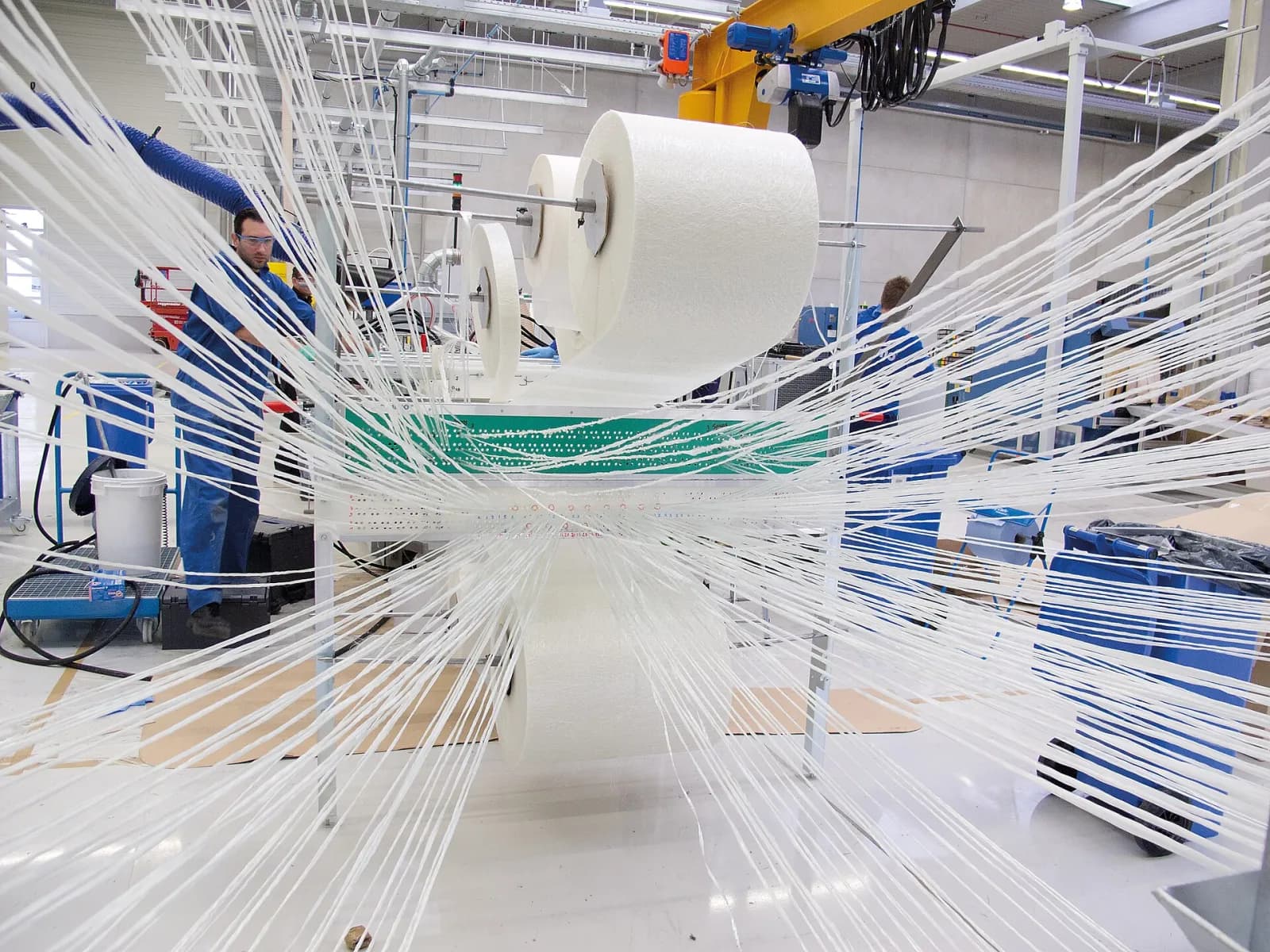
Pultrusion pulls continuous glass or carbon reinforcement through a resin bath or an injection box, a preformer and a heated steel die, and cuts the cured constant-section profile to length. It is the cheapest route to long, straight, fiber-dominated parts: structural shapes, gratings and handrails, cable trays, insulating rods and crossarms, window profiles, GFRP rebar, and the glass and carbon planks that now form the spar caps of most large wind blades. This report covers all of those products when made in China, for domestic use or export, and treats molded grating, filament-wound pipe and SMC/BMC parts as adjacent but separate markets.
No Chinese association publishes a pultrusion output series. The China Glass Fiber Industry Association (CGFIA) reports glass fiber yarn output and a derived figure for all glass-fiber-reinforced plastic (GFRP) products split into thermoset and thermoplastic; pultrusion sits inside the thermoset half together with filament winding, SMC/BMC, hand lay-up and infusion. The only pultrusion-specific national figure in the public record is a historical capacity statement of roughly 30,000 t from the 1990s [statistic, CCIA explainer, undated]. Every pultrusion number in this report is therefore one of three things: an association series for a wider universe, a company disclosure for one product, or a GetFRP estimate whose arithmetic is shown.
Three proxies carry most of the weight. First, CGFIA's thermoset GFRP series, which rose from 2.17 Mt in 2018 to 4.51 Mt in 2025. Second, the high-modulus glass yarn series, the feedstock of wind pultruded plates, which jumped 65.1% in 2025. Third, Sail Carbon Fiber's wind carbon fiber series, because essentially all wind carbon fiber becomes pultruded planks. Customs data under HS 3916.90 adds the export side, with the caveat that the line also carries non-reinforced plastic profiles.
How to read the evidence tags
Statistic: association, government or customs data. Company data: annual reports, prospectuses, IPO inquiry replies, datasheets and company statements. Forecast: consultancy or broker projections, including every 'global pultrusion market' figure. GetFRP estimate: our own calculation from cited inputs, always with the arithmetic in the note. Figures from different sources are never summed.
↔ Scroll horizontally to see the full diagram.
2. Market size: the thermoset surge of 2025 and a shrinking Europe
China's GFRP products output has doubled since 2018, from 4.30 Mt to 8.89 Mt in 2025, and the thermoset half, which contains pultrusion, grew faster than the total in 2025: +24.1% to 4.51 Mt against +13.5% for thermoplastics [statistic, CGFIA]. The association derives the GFRP figure from yarn consumption rather than from a plant census, so the thermoset and thermoplastic split is more defensible than any finer breakdown. Across 2018 to 2025 the thermoset series compounds at 11.0% a year [estimate: (451/217)^(1/7) − 1].
The 2025 jump has a traceable cause. CGFIA's yarn breakdown shows high-modulus wind yarn rising 65.1% to 1.436 Mt while ordinary thermoset direct roving, the feedstock of gratings, structural profiles and PV frames, fell 9.8% to 2.513 Mt [statistic, CGFIA]. The same year China hoisted about 130 GW of new wind turbines in 18,272 units, up 49.9%, an average of 7.16 MW per unit [statistic, CWEA]. The thermoset surge was a wind-blade materials surge, and pultruded spar-cap plates are the product that converts high-modulus yarn into blades.
Outside China the trend runs the other way. AVK's European series shows pultrusion output falling every year since 2021 to 46 kt in 2025, 18% below the 2019 peak, with the whole European thermoset GRP market down to 952 kt [statistic, AVK]. AVK attributes the decline to demand 'increasingly being met by non-European suppliers, both in terms of raw materials and products' and to relocation of production [official text, AVK 2026 report]. North America's association publishes no pultrusion line; its total glass-reinforced polyester and vinyl ester composites sales were 3.63 billion pounds in 2024, down 2.7% [statistic, ACMA].
Analyst estimates of the global pultruded-profile market for 2025 range from USD 2.2 billion (Global Industry Analysts) to USD 3.15 billion (Emergen), with Fortune Business Insights at USD 2.55 billion and a 38% Asia-Pacific share; scopes that count 'pultrusion products' including gratings and rebar run USD 3.8 to 4.0 billion [forecast]. Two of the three profile-only publishers put China at about USD 0.49 to 0.51 billion, or close to one fifth of global value [estimate: 0.49/2.55 = 19%]. Treat the spread as a definition problem, not a disagreement about growth; the analyst growth rates of 2.7% to 5.4% all sit above the measured European trend of −3.2% a year [estimate from AVK, 2019 to 2025].
↔ Scroll horizontally to see the full chart and data table.
Source: China Glass Fiber Industry Association, 2025 annual development report (March 2026) and earlier annual reports; 2024 figures as reprinted in China Jushi's 2024 annual report. Thermoset GFRP is the universe that contains pultrusion. * 2019 values are back-calculated from the association's published growth rates [estimate]. The GFRP total is derived by the association from yarn consumption.
View the chart data and evidence
| Series | Category | Value | Unit | Evidence / value basis | Reported range | Point note |
|---|---|---|---|---|---|---|
| Thermoset | 2018 | 2.17 | Mt | Statistic | — | — |
| Thermoset | 2019 | 2.3 | Mt | GetFRP estimate | — | — |
| Thermoset | 2020 | 3.01 | Mt | Statistic | — | — |
| Thermoset | 2021 | 3.1 | Mt | Statistic | — | — |
| Thermoset | 2022 | 3 | Mt | Statistic | — | — |
| Thermoset | 2023 | 3.22 | Mt | Statistic | — | — |
| Thermoset | 2024 | 3.64 | Mt | Statistic | — | — |
| Thermoset | 2025 | 4.51 | Mt | Statistic | — | — |
| Thermoplastic | 2018 | 2.13 | Mt | Statistic | — | — |
| Thermoplastic | 2019 | 2.15 | Mt | GetFRP estimate | — | — |
| Thermoplastic | 2020 | 2.09 | Mt | Statistic | — | — |
| Thermoplastic | 2021 | 2.74 | Mt | Statistic | — | — |
| Thermoplastic | 2022 | 3.41 | Mt | Statistic | — | — |
| Thermoplastic | 2023 | 3.5 | Mt | Statistic | — | — |
| Thermoplastic | 2024 | 3.86 | Mt | Statistic | — | — |
| Thermoplastic | 2025 | 4.38 | Mt | Statistic | — | — |
↔ Scroll horizontally to see the full chart and data table.
Source: China Glass Fiber Industry Association, 2025 annual development report (March 2026) and earlier annual reports; 2024 figures as reprinted in China Jushi's 2024 annual report; 2020–2022 association figures as quoted by Qianzhan and Huaon; CGFIA flash report for mid-2026 capacity. 2019 is implied by the association's 2020 figure of 5.41 Mt, up 2.64%. Pool-kiln yarn was 8.12 Mt or 96.3% of 2025 output. At end-June 2026 total yarn capacity was about 9.3 Mt, of which about 8.65 Mt of pool-kiln capacity was in production (CGFIA flash report via Securities Star).
View the chart data and evidence
| Series | Category | Value | Unit | Evidence / value basis | Reported range | Point note |
|---|---|---|---|---|---|---|
| — | 2019 | 5.27 | Mt | Statistic | — | — |
| — | 2020 | 5.41 | Mt | Statistic | — | — |
| — | 2021 | 6.24 | Mt | Statistic | — | — |
| — | 2022 | 6.87 | Mt | Statistic | — | — |
| — | 2023 | 7.23 | Mt | Statistic | — | — |
| — | 2024 | 7.56 | Mt | Statistic | — | — |
| — | 2025 | 8.43 | Mt | Statistic | — | — |
↔ Scroll horizontally to see the full chart and data table.
Source: AVK Industrievereinigung Verstaerkte Kunststoffe, European composites market reports 2020 to 2026. Latest-year values are AVK estimates made early in the following year and are revised in later editions. Pultrusion was 4.8% of European thermoset GRP in 2025.
View the chart data and evidence
| Series | Category | Value | Unit | Evidence / value basis | Reported range | Point note |
|---|---|---|---|---|---|---|
| — | 2016 | 50 | kt | Statistic | — | — |
| — | 2017 | 53 | kt | Statistic | — | — |
| — | 2018 | 55 | kt | Statistic | — | — |
| — | 2019 | 56 | kt | Statistic | — | — |
| — | 2020 | 50 | kt | Statistic | — | — |
| — | 2021 | 56 | kt | Statistic | — | — |
| — | 2022 | 52 | kt | Statistic | — | — |
| — | 2023 | 50 | kt | Statistic | — | — |
| — | 2024 | 48 | kt | Statistic | — | — |
| — | 2025 | 46 | kt | Statistic | — | — |
| Publisher and edition | Base value | CAGR | End value | Scope note | Regional view |
|---|---|---|---|---|---|
| Global Industry Analysts, Oct 2026 edition | USD 2.2 bn (2025) | 3.6% to 2032 | USD 2.8 bn | By fiber, resin and end use; profiles | China USD 553 m by 2032 |
| Fortune Business Insights, Oct 2026 | USD 2.55 bn (2025) | 5.3% to 2034 | USD 4.02 bn | Profiles by type and application | Asia-Pacific 38.0%; China USD 0.49 bn |
| Emergen Research, 2025 (updated Sep 2026) | USD 3.15 bn (2025) | 5.4% to 2035 | USD 5.35 bn | Pultruded profiles only; excludes fiber and resin sales | North America 38.7%; Asia-Pacific fastest at 7.6% |
| Global Market Insights, Dec 2025 | USD 3.8 bn (2025) | 2.7% to 2035 | USD 5.0 bn | 'Pultrusion products' incl. gratings, rebar, ladder rails | Not captured |
| Credence Research, Dec 2025 | USD 4.0 bn (2024) | 3.3% to 2032 | USD 5.2 bn | Products by end user and technology | North America 35%, Europe 30%, Asia-Pacific 25% |
Source: Publisher pages and press releases as listed in Sources; several pages were reachable only as search snippets and are flagged in the research notes.
3. Wind spar caps: the product that turned Chinese pultrusion into a volume industry
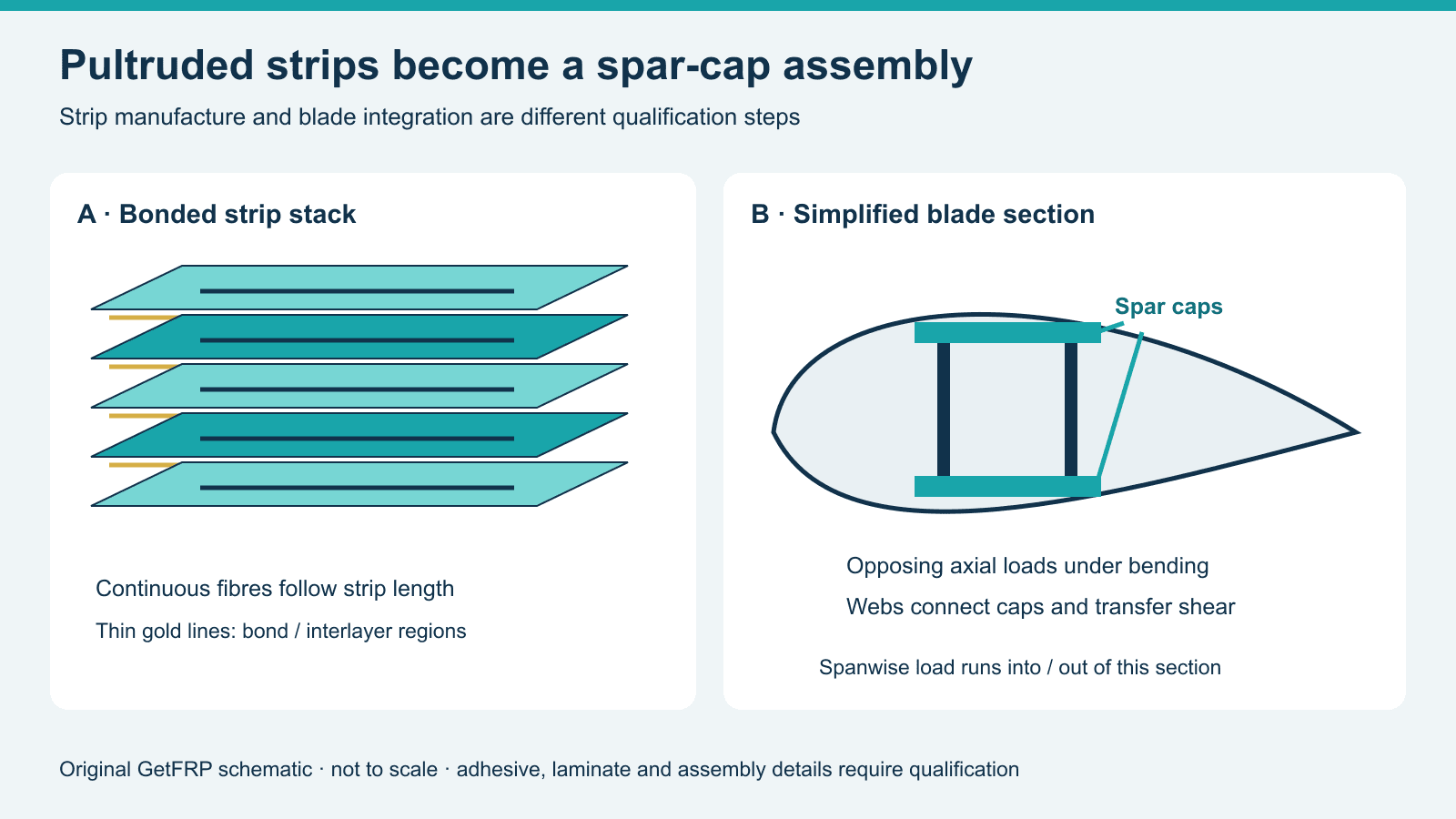
Vestas split the blade spar into stacks of pultruded carbon planks in 2015 and bought most of them from Chinese converters working with imported fiber; Guangwei Composites began batch supply in 2016 and Jiangsu Aosheng followed [company; analyst]. Global wind carbon fiber demand tracked that program: 25.5 kt in 2019, 34.7 kt in 2022, a 42% collapse to 20 kt in 2023 when Vestas destocked, then 44 kt in 2024 and about 100 kt in 2025 as Chinese turbine makers adopted carbon and hybrid spars on 7 to 10 MW onshore platforms [survey, Sail]. Chinese fiber makers supplied 62 kt of the 100 kt, and 24 kt of Chinese fiber left the country as finished planks [survey, Sail 2025 report].
Glass pultruded plates are the larger and less visible half. Chinese blade makers began switching infused glass spar caps to pultruded high-modulus glass plates in 2019 to 2021, before the Vestas carbon-plank patent expired on 19 July 2022, because a pultruded plank reaches about 68% fiber volume against 57% for infusion and gives 17% higher design strength at the same fiber fraction [company, Zhongfu Tanxin; peer-reviewed, ORNL]. By 2023 China had more than 1,420 spar-plate pultrusion lines with roughly 360 kt of capacity, of which only about 18 kt was carbon [company-affiliated review, Zhongfu Lianzhong authors]. The association's rule of thumb: glass below 80 m blade length, carbon-glass hybrid from 80 to 120 m, pure carbon above 120 m [official text, CCIA 2024].
The economics are now documented. In the ORNL and Sandia cost model a pultruded E-glass plank costs USD 2.65/kg against USD 1.92/kg for infused glass, a heavy-tow textile carbon plank USD 9.44/kg and a baseline carbon plank USD 17.38/kg; pultrusion adds 33% to 55% on top of material cost but cuts blade mass by 6% to 9% with glass and 30% to 31% with textile carbon [peer-reviewed, ORNL]. In China the reference price for a glass spar plate was about RMB 15/kg in 2024 with carbon plate at about five times that, while large-tow T300 48K fiber fell from RMB 147/kg at end-2021 to RMB 65–75/kg in August 2025 [company and media statements; Baiinfo via brokers].
Volume arrived with a price war. Zhenshi New Materials, which ranks itself among the top domestic sellers of wind pultruded profiles, told the Shanghai exchange that its pultruded-profile selling price fell 26.94% in 2024 after blade makers and composites firms flooded in during 2022 and 2023, and that the market 'entered a consolidation period' from the second half of 2024 as blade makers' in-house lines and small producers exited [company, IPO inquiry reply, November 2025]. Guangwei's carbon-beam revenue shows the same pattern from the other side: RMB 426 million on 4.09 million meters in 2023, RMB 537 million on 11.40 million meters in 2024, RMB 943 million in 2025 (+75.8%), with the implied price per meter roughly halved between 2023 and 2024 [company; estimate].
↔ Scroll horizontally to see the full chart and data table.
Source: Guangzhou Sail Carbon Fiber, global carbon fiber composites market reports 2020 to 2025. * 2021 back-calculated from the 2022 report's stated 5.2% growth [estimate]. About 80% of wind carbon fiber was already pultruded in 2019; new carbon spar caps since then are essentially all pultruded planks.
View the chart data and evidence
| Series | Category | Value | Unit | Evidence / value basis | Reported range | Point note |
|---|---|---|---|---|---|---|
| — | 2019 | 25500 | t | Industry survey | — | — |
| — | 2020 | 30600 | t | Industry survey | — | — |
| — | 2021 | 33000 | t | GetFRP estimate | — | — |
| — | 2022 | 34700 | t | Industry survey | — | — |
| — | 2023 | 20000 | t | Industry survey | — | — |
| — | 2024 | 44000 | t | Industry survey | — | — |
| — | 2025 | 100000 | t | Industry survey | — | — |
↔ Scroll horizontally to see the full chart and data table.
Source: Ennis, Das and Norris, Economic competitiveness of pultruded fiber composites for wind turbine applications, Composites Part B 265 (2023), Table 2. Finished part cost at 68% fiber volume (infused glass at 57%); glass fiber at USD 1.30/kg, baseline carbon at USD 17.98/kg, textile carbon at USD 7.82/kg. A China plank with 48K fiber at RMB 65–75/kg would model at roughly USD 10–12/kg [estimate].
View the chart data and evidence
| Series | Category | Value | Unit | Evidence / value basis | Reported range | Point note |
|---|---|---|---|---|---|---|
| — | Infused E-glass | 1.92 | USD/kg | Statistic | — | — |
| — | Pultruded E-glass plank | 2.65 | USD/kg | Statistic | — | — |
| — | Pultruded textile carbon plank | 9.44 | USD/kg | Statistic | — | — |
| — | Pultruded baseline carbon plank | 17.38 | USD/kg | Statistic | — | — |
| Year | Chinese wind carbon fiber demand | Used by domestic blade makers | Exported as pultruded planks | Note |
|---|---|---|---|---|
| 2020–2022 | 2.5 / 4.5 / 4.8 kt | domestic OEMs only | not counted in this series | Series excludes toll conversion for Vestas; the 2020 figure including it was about 20 kt |
| 2023 | 17 kt or 6 kt (same report, two figures) | — | — | Conflict left unresolved in the source |
| 2024 | 22 kt | 12 kt | about 10 kt | Planks were 'the absolute mainstay' of 15,134 t of carbon fiber exports in fiber-equivalent terms |
| 2025 | 64 kt | 40 kt | 24 kt | China total carbon fiber demand 132,027 t; wind 48% of it [estimate] |
Source: Sail Carbon Fiber annual reports as republished by CCIA and trade media; see Sources. Tonnages are carbon fiber, not finished plank; at a 75% fiber weight fraction 24 kt of fiber is about 32 kt of plank [estimate].
| Company | Product | Disclosed figure | Year | Evidence | GetFRP profile |
|---|---|---|---|---|---|
| Guangwei Composites (Weihai) | Carbon spar planks for Vestas and others | 11.40 million m sold; capacity 19.38 million m; revenue RMB 537 m, then RMB 943 m in 2025 | 2024–2025 | company (annual report via press) | View profile |
| Jilin Chemical Fiber Group | Carbon spar planks | more than 10,000 t sold Jan–Nov 2024, three times 2023; target above 30,000 t | 2024–2025 | company statement via Economic Daily | — |
| Jiangsu Aosheng (Suzhou) | Carbon spar planks and fabrics | about 10,000 t/yr of carbon fiber consumed; claims above 30% global share in wind carbon planks | 2020–2024 | company | View profile |
| Zhongfu Tanxin (CNBM, Lianyungang) | High-modulus glass spar plates | 80 lines, 30,000 t/yr digital plant opened July 2024; pull speed above 1 m/min | 2024 | company | — |
| Zhenshi New Materials (Tongxiang) | Glass and hybrid wind profiles, fabrics | 120,000 t/yr wind materials project; price −26.94% and volume −11.25% in 2024 | 2022–2025 | company (IPO filings) | — |
| Zhejiang Hengyida (Jiaxing) | Glass pultruded plates | 120 lines / 20,000 t in production; 60 lines / 12,000 t added from May 2024 | 2024 | company | — |
| Exel Composites (China operations) | Carbon planks, custom GFRP and CFRP profiles | Group revenue EUR 103.2 m in 2025, order intake +60.8%; a Nanjing plant was closed earlier and wind planks are now scaled in India | 2025 | company (financial statements release) | View profile |
Source: Company filings, announcements and verified press statements; capacities are nameplate, not output. Line productivity of 167–200 t per line-year for glass plates and about 133 t for carbon plates is implied by the Hengyida and national carbon-line figures [estimate].
4. Beyond wind: PV frames, electrical, building and infrastructure
Photovoltaic module frames are the most-watched substitution story and the most over-forecast. A September 2023 broker model projected composite frames at 15% of module-frame demand in 2024 and 25% in 2025, equal to about 550,000 t of glass fiber polyurethane profile on a global installation basis [forecast, Cinda Securities]. Reality: Covestro reported more than 3 GW of cumulative module shipments with its polyurethane composite frames by June 2025, roughly five million panels, and the named adopters are second-tier module brands; GetFRP's shipment-based estimate puts composite frames below 2% of 2025 Chinese module output [company; estimate]. The enabling pieces are in place: a group standard, T/CPIA 0081-2024, in force since 15 September 2024; MIIT's listing of PV glass fiber composites in its 2024 key-materials catalogue; and the largest disclosed frame project, Bofei Electric's 70,000 t/yr plant started in January 2024 [official text; company]. Covestro puts the aluminum frame at 10% to 15% of module cost, second only to the cells, so the material choice matters to module makers; the gap is Tier-1 bankability and a torsion and field track record [company].
Electrical insulation comprises several product markets with different business cycles. Listed manufacturer Jiangsu Shemar Electric increased group revenue from RMB 1,345 million in 2024 to RMB 1,721 million in 2025, while its line external-insulation segment, which includes composite crossarms, declined from RMB 209 million to RMB 169 million. The line segment gross margin fell from 25.95% to 14.00%; substation external insulation had a 48.67% margin in 2025. These are issuer categories, not crossarm-only sales or national market shares. [S24][S43] The design standard for composite crossarms is DL/T 5579-2020; live-working insulating tubes and rods move to GB/T 13398-2026 from 1 November 2026 [official text]. Demand context is large but indirect: State Grid capital expenditure of RMB 632.6 billion in 2024 and 4.838 million 5G base stations at end-2025 [statistic].
Building and infrastructure have the most complete standards stack and the least volume data. Glass fiber polyurethane window profiles are codified from material (JC/T 941-2016) through product (JG/T 571-2019) to engineering code (T/CECS 591-2019), pushed by the 65% to 80% building energy-saving ladder; the supply base is a small cluster of profile makers working with Covestro, Huntsman and Wanhua resin systems [official text; company]. GFRP rebar has a product standard (GB/T 26743-2011) and an engineering standard (GB 50608-2020, in force since 1 October 2020) and is routine in shield-tunnel soft-eye walls on metro projects, but no association publishes national bar tonnage [official text; contractor literature]. Gratings, platforms, handrails and cable trays remain the bread-and-butter of clusters such as Zaoqiang in Hebei, which counts more than 500 registered composites firms [statistic, CCIA visit report, December 2023].
Transport is at validation stage. China built 62,956 refrigerated trucks in 2024, of which 21,368 were electric, and pultruded polyurethane battery-pack beams appear in OEM research papers, but the volume polyurethane battery part shipping with a Chinese Tier-1 is spray-molded, not pultruded [statistic; company]. Treat every transport pultrusion claim as program-specific until a serial award is published.
↔ Scroll horizontally to see the full chart and data table.
Source: [S24][S43]. Only comparable disclosed years are shown; missing earlier segment values are not zeros. The line category includes crossarms and other line insulation. Its gross margin fell from 25.95% in 2024 to 14.00% in 2025; the 2025 substation category margin was 48.67%.
View the chart data and evidence
| Series | Category | Value | Unit | Evidence / value basis | Reported range | Point note |
|---|---|---|---|---|---|---|
| Group revenue | 2024 | 1344.89109958 | m | Company data | — | — |
| Group revenue | 2025 | 1720.69906546 | m | Company data | — | — |
| Line external insulation (incl. crossarms) | 2024 | 209.36811333 | m | Company data | — | — |
| Line external insulation (incl. crossarms) | 2025 | 168.96523082 | m | Company data | — | — |
↔ Scroll horizontally to see the full chart and data table.
Source: Cinda Securities PV frame deep-dive (19 September 2023); Covestro cumulative shipment statement (4 June 2025); MIIT module output; GetFRP calculation. Broker shares are of global module-frame demand. * Estimate: about 3 GW cumulative composite-frame modules by mid-2025 against 588 GW of Chinese module output in 2024 alone; even allowing for other resin suppliers, the 2025 share is under 2%.
View the chart data and evidence
| Series | Category | Value | Unit | Evidence / value basis | Reported range | Point note |
|---|---|---|---|---|---|---|
| — | Broker forecast for 2025 (Sep 2023) | 25 | % | GetFRP estimate | — | — |
| — | Broker forecast for 2024 (Sep 2023) | 15 | % | GetFRP estimate | — | — |
| — | GetFRP estimate, 2025 actual | 1.5 | % | GetFRP estimate | — | — |
| Segment | Scale indicator | Governing standard | Adoption gate | Evidence status |
|---|---|---|---|---|
| PV module frames | 317 GW installed 2025; >3 GW cumulative composite-frame modules (Covestro) | T/CPIA 0081-2024; IEC 61215/61730 module tests | Tier-1 qualification, torsion and 25-year field data | company and official; penetration is a GetFRP estimate |
| Composite crossarms and insulation | Shemar crossarm-containing segment RMB 169 m (2025) | DL/T 5579-2020; GB/T 13398-2026 | Utility tender specifications and type tests | company and official |
| Window and door profiles | No published volume; small producer cluster | JC/T 941-2016; JG/T 571-2019; T/CECS 591-2019 | System testing, air-tightness grade, fire integrity | official; volume unknown |
| GFRP rebar and anchors | No national tonnage; routine in metro shield tunnels | GB/T 26743-2011; GB 50608-2020 | Project specification and site acceptance | official and contractor literature |
| Gratings, platforms, cable trays | Zaoqiang cluster: 500+ composites firms | GB/T 31539-2015; project specs; ASTM E84 or EN 13501 fire class | Exposure-specific design, installed-cost comparison | statistic (cluster), no product tonnage |
| Transport and battery structures | 62,956 refrigerated trucks built 2024 | OEM specifications | Crash, joining and serial-production award | statistic (vehicles); pultrusion at validation stage |
Source: NEA, MIIT, CCIA, company annual reports and standards registries; see Sources.
5. Supply chain: fiber, resin, equipment and the pultruders themselves
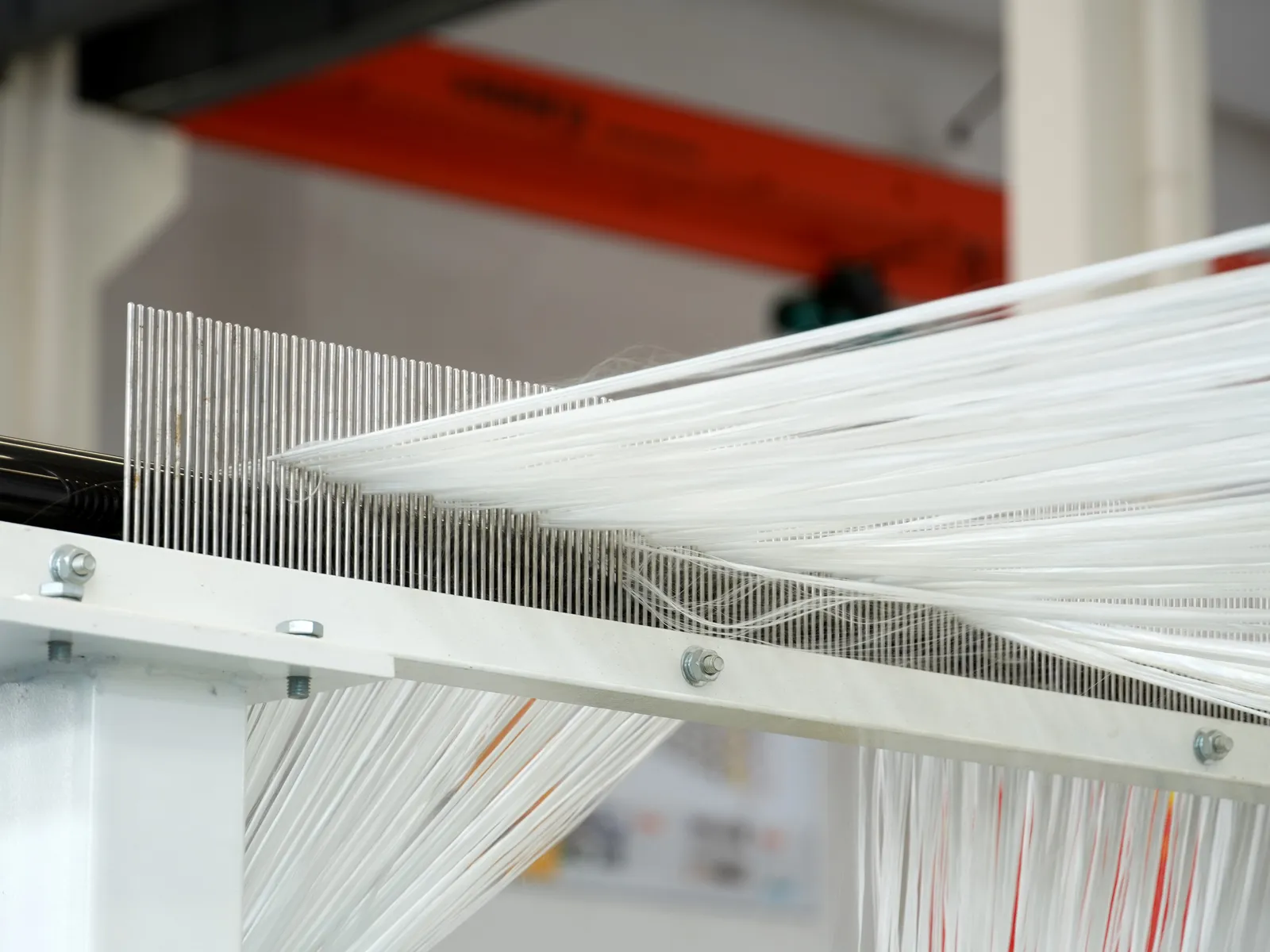
China's structural advantage in pultrusion starts one step upstream. Three producers, Jushi, Taishan Fiberglass and CPIC, hold about 90% of the domestic wind-yarn market, and Jushi alone sold 3.025 Mt of roving and products in 2024 [statistic via consultancy; company]. High-modulus grades now ladder from Jushi's E7 at 90 GPa through E8 at 95 GPa to E9 above 100 GPa fiber modulus, which is what lets a glass plank reach 62 GPa and a 90 to 100 m blade stay all-glass [company]. Standard 2400 tex E-glass direct roving, the input for everything else, traded at RMB 3,500–3,800/t delivered with VAT in late April 2025, fell to a trough of RMB 3,050–3,100/t in November 2025 and traded at RMB 3,500–3,900/t by March 2026; broker reports put the 2021 peak above RMB 6,000/t [statistic, SCI via brokers; media, industry call; forecast for the peak]. Chinese pultruders therefore buy their main input at roughly half the 2021 price, while European pultruders pay anti-dumping duties on the same roving.
Resin is the second cost block and the one where chemistry choice shows up in price. Unsaturated polyester for FRP sold at RMB 7,100–7,350/t excluding VAT in 2024 and the first quarter of 2025 at a listed producer, liquid epoxy E-51 at RMB 13,200–14,400/t in East China through 2025, and polymeric MDI at RMB 13,900–14,000/t in February 2026, with pure MDI higher [company; price services]. At a 30% to 35% resin weight fraction the move from polyester to epoxy or polyurethane adds about RMB 2 to 2.6 per kilogram of profile [estimate: (13,500 − 7,350) × 0.32 / 1,000]. Resin shares in pultrusion are only available as forecasts: polyester about 51% of resin value in 2021, epoxy about 15%, polyurethane the fastest-growing [forecast, Verified Market Research].
Equipment splits into two worlds. Hebei trading companies list complete hydraulic reciprocating pultrusion lines at USD 8,000 to 80,000 per set, while Western machines from Pultrex or KraussMaffei are rated in 3 to 20 tonne pull-force classes with injection boxes and up to 24 die zones and are priced accordingly [company listings; company]. The high end of the Chinese fleet is self-built: Zhenshi bought RMB 205 million of pultrusion equipment developed by a related-party research institute in 2022 and 2023 because it 'better meets the company's process requirements than general-purpose equipment on the market' [company, IPO reply]. Chinese machine makers with published profiles on GetFRP cover the full range from crawler and servo-hydraulic pullers to resin-injection units and dies.
The pultruders are more fragmented than any other link. No national count exists; the only verifiable numbers are cluster-level (Zaoqiang, 500+ composites firms) and product-level (more than 300 carbon-plank lines with over 40,000 t capacity in 2024, more than 1,420 spar-plate lines in 2023) [statistic; company-affiliated review]. The table below lists the published GetFRP profiles across the chain so that a buyer can start from the right counterparty: a fiber producer, a resin formulator, a machine or die maker and a profile maker solve different procurement problems.
↔ Scroll horizontally to see the full chart and data table.
Source: Sublime China Information (SCI) as quoted by Hexun, Guosen Securities and broker weeklies; CGFIA monthly chart; industry conference call March 2026. * Values marked with an asterisk are read from the association's monthly chart or are range midpoints [estimate]. Delivered, VAT inclusive. Mar 2026 is the low end of a RMB 3,500–3,900/t range. Observations are unevenly spaced; the line shows direction, not a continuous series.
View the chart data and evidence
| Series | Category | Value | Unit | Evidence / value basis | Reported range | Point note |
|---|---|---|---|---|---|---|
| — | Jan 2023 | 4100 | RMB/t | GetFRP estimate | — | — |
| — | Oct 2023 | 3300 | RMB/t | GetFRP estimate | — | — |
| — | Apr 2024 | 3225 | RMB/t | Statistic | — | — |
| — | Dec 2024 | 4150 | RMB/t | GetFRP estimate | — | — |
| — | Apr 2025 | 3735 | RMB/t | Statistic | — | — |
| — | Nov 2025 | 3075 | RMB/t | GetFRP estimate | — | — |
| — | Mar 2026 | 3500 | RMB/t | Statistic | — | — |
↔ Scroll horizontally to see the full chart and data table.
Source: ST Yongyue Q1 2025 operating data (cninfo); ChemicalBook East China quotes; SunSirs MDI commentary. * Midpoints of published ranges [estimate]. A polyurethane system also needs polyol, so the resin cost of a PU profile is not the MDI price alone.
View the chart data and evidence
| Series | Category | Value | Unit | Evidence / value basis | Reported range | Point note |
|---|---|---|---|---|---|---|
| — | Unsaturated polyester, FRP grade (Q1 2025, ex-VAT) | 7346 | RMB/t | Company data | — | — |
| — | Liquid epoxy E-51, East China (2025 range midpoint) | 13800 | RMB/t | GetFRP estimate | — | — |
| — | Polymeric MDI (Feb 2026) | 13950 | RMB/t | GetFRP estimate | — | — |
| — | Pure MDI (Feb 2026) | 17500 | RMB/t | Company data | — | — |
| Stage | Company | Relevant products | GetFRP profile |
|---|---|---|---|
| Glass fiber | China Jushi | E6, E7, E8, E9 direct rovings; 312T pultrusion roving; 332 polyurethane-compatible roving | View profile |
| Glass fiber | Taishan Fiberglass | Pultrusion rovings and high-modulus wind yarn | View profile |
| Glass fiber | CPIC (Chongqing International Composite Materials) | 550E and TM+ rovings for pultrusion and insulating rods | View profile |
| Mats and veils | Jiangsu Changhai Composite Materials | Continuous filament mat, surface mat, stitched fabrics | View profile |
| Mats and veils | Changshu Dongyu Insulated Compound Materials | Surface tissue and direct roving for pultrusion | View profile |
| Carbon fiber | Weihai Guangwei Composites | Carbon fiber and pultruded carbon spar caps | View profile |
| Carbon fiber | Newtech Group | 12K to 50K carbon fiber and pultruded products | View profile |
| Resin | Wanhua Chemical | Glass-fiber-reinforced polyurethane pultrusion systems, MDI | View profile |
| Resin | Nanjing Jufa New Material | Polyurethane pultrusion resins incl. aliphatic and low-FST | View profile |
| Resin | Techstorm Advanced Material | Epoxy pultrusion systems for cable core rods and spar caps | View profile |
| Resin | Changzhou Huake Polymers | Ortho, iso, vinyl ester and polyurethane pultrusion resins | View profile |
| Resin | Fangxin Resin (Anhui) | Pultrusion and molded-grating polyester systems | View profile |
| Equipment | Nanjing Loyalty Composite Equipment | Crawler and servo pultrusion machines, PU-specific lines, preforming dies | View profile |
| Equipment | Nanjing Haoli Hydraulic Equipment | Hydraulic, servo-hydraulic and caterpillar pullers | View profile |
| Equipment | Guangdong Huedur Automation | Servo-hydraulic reciprocating and caterpillar machines, cutting units | View profile |
| Equipment | Beijing Jinghua Parker | Resin-injection equipment for pultrusion lines | View profile |
| Dies | Fanghua Mold (Yuyao) | Pultrusion dies for profiles, window sections and multi-cavity tooling | View profile |
| Dies | Nanjing Keerda Mold | Dies for I-beams, channels, panels and window profiles | View profile |
| Profiles | Jiangsu Jiuding New Materials | Structural profiles, crossarms, handrails, gratings; revenue RMB 1.795 bn in 2025 | View profile |
| Profiles | Nanjing Spare Composites | Standard and custom profiles, grating, rebar, window profiles | View profile |
| Profiles | Exel Composites (China operations) | Custom GFRP and CFRP profiles, carbon planks; confirm the producing site | View profile |
| Profiles | Nanjing Hitech Composites | Pultruded carbon plates, rods, tubes and channels | View profile |
| Profiles | Nanjing Mingfeng Composite Materials | GFRP tubes, rods, channels and I-beams | View profile |
| Profiles | Kunming Feixiang Material Technology | Structural profiles, insulating rods, PV support profiles, ladders | View profile |
| Profiles | Pulwell Composites | Composite rebar, crossarms and custom profiles | View profile |
| Profiles | Jiangsu Aosheng Composite Materials | Carbon pultruded plates for wind blades, carbon fabrics | View profile |
| Grating and platforms | Nantong Jiusheng New Materials | Pultruded and molded grating, structural profiles | View profile |
| Grating and platforms | Nantong Endura Composites | Pultruded and molded grating, profiles | View profile |
| Grating and platforms | Jiangsu Aulland New Material | Pultruded, molded and phenolic grating | View profile |
| Grating and platforms | Hebei Tengjun FRP | Grating, profiles, cable tray (Hebei cluster) | View profile |
| Grating and platforms | Sino Composite Structures | Grating, profiles, handrail and access systems | View profile |
| Windows | Shanghai Crotti | Glass-fiber-reinforced polyurethane window and door systems | View profile |
| Export coordination | F1 Composites (sponsored GetFRP supplier) | Pultruded profiles, grating systems, fiberglass window systems | View profile |
Source: GetFRP published supplier profiles as of the research cut-off. Listing is by published capability, not an audit or ranking; F1 Composites is a sponsored supplier and its inclusion is not a comparative endorsement. Confirm the legal seller and the production site for every order.
6. Technology and cost: what a pultruded profile is made of, and what one line can produce
A pultruded structural profile is a layered laminate, not a block of resin with fibers in it. Unidirectional rovings carry the axial load and most of the fiber mass; a continuous filament mat or a stitched 0/90 and ±45 fabric under each surface provides transverse strength and bolt bearing; a polyester or C-glass surfacing veil gives a resin-rich skin that stops fiber bloom and slows UV and chemical attack [company, Strongwell design manual]. Glass content runs from about 50% by weight in mat-and-roving structural shapes to 70% in roving-only rod and 75% to 82% in unidirectional plates [company; peer-reviewed]. The ASCE design standard requires at least 30% total fiber volume in each pultruded element [official text, ASCE/SEI 74-23].
Cure quality decides properties as much as the fiber does. In an industrial vinyl ester trial at 0.5 m/min through a 1 m die, raising die temperature from 100 to 120 °C lifted the degree of cure from 86% to 94% and flexural strength from 1,053 to 1,331 MPa, while at 140 °C the cure reached 97.7% but strength fell back to 1,112 MPa, which the authors link to internal stress from the faster reaction [peer-reviewed, Chaparala et al. 2023]. This is why a supplier's stable process window matters more than a maximum-speed demonstration, and why a buyer should ask for the die temperature record with the batch certificate.
Cost structure follows the chemistry. In the ORNL and Sandia model, material is about 84% of part cost for a baseline carbon and epoxy plank (USD 14.60 of 17.38/kg), 73% for heavy-tow textile carbon (6.87 of 9.44) and 68% for an E-glass plank (1.80 of 2.65), and capital plus labor make up 96% of the processing cost [peer-reviewed; estimate for the shares]. The model's pultrusion adder of 33% to 55% on top of material cost corresponds to a material share of 65% to 75% [estimate: 1 / (1 + 0.33 to 0.55)]. Chinese wind-plate pultrusion is a commodity with a gross margin of about 22% to 26% (Guangwei's carbon beams in 2024; Zhenshi 2022 to mid-2025) and double-digit annual price erosion in 2024 [company].
Capacity is a geometry and uptime question, not a machine count. The interactive model below shows how section area, density, qualified line speed, scheduled hours, run-time fraction, saleable yield and cavity count combine into saleable tonnes. The baseline is an 800 mm² section at 0.5 m/min; moving to 0.8 m/min, which is what polyurethane or injection-box systems promise, raises output 60% only if availability and yield hold. The same arithmetic explains the observed Chinese line productivities of about 167 to 200 t per line-year for glass spar plates and about 133 t for carbon planks [estimate from company and industry figures].
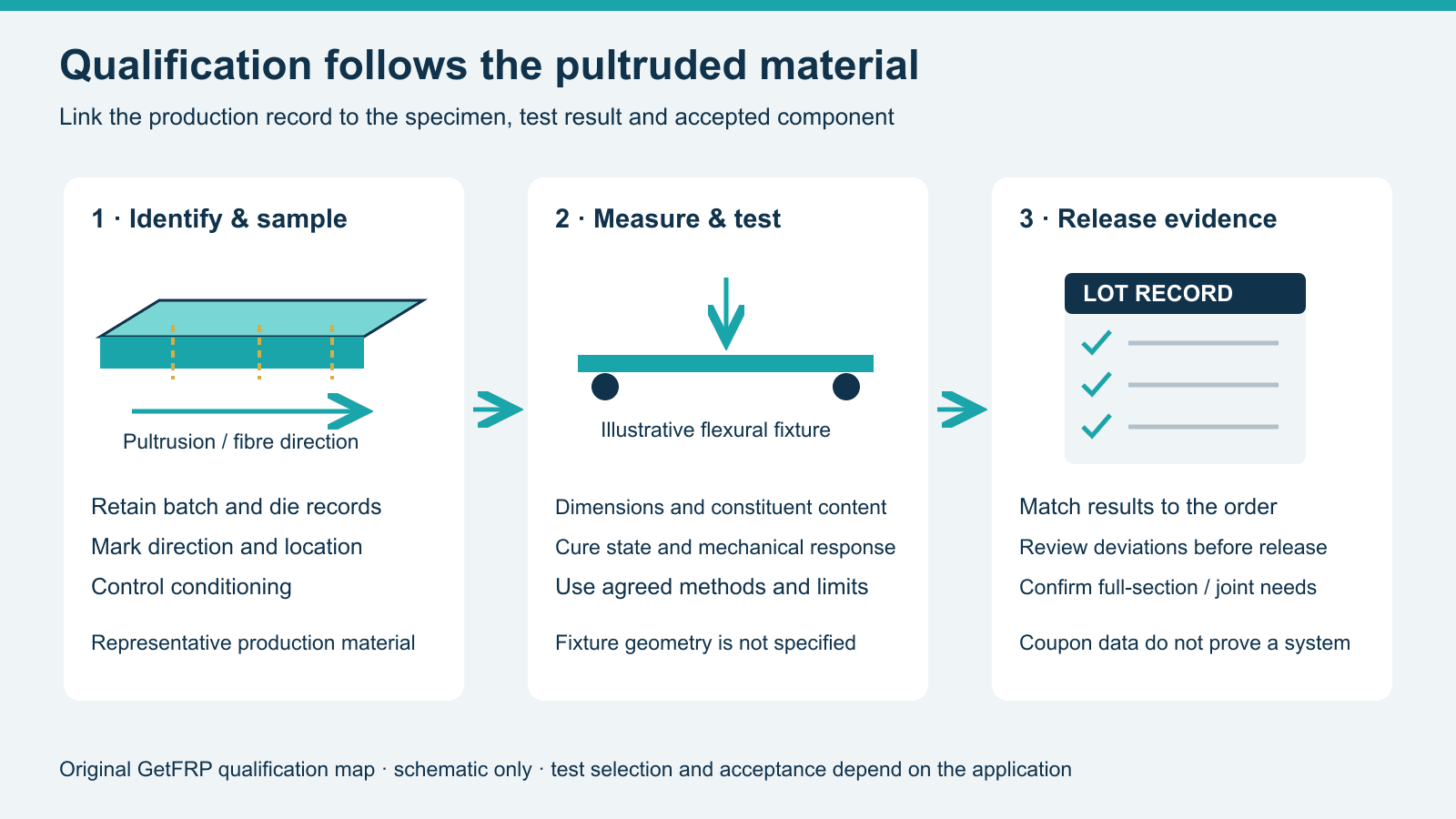
↔ Scroll horizontally to see the full diagram.
| Resin system | Typical line speed | Where it is used | Documented performance point | Indicative price, RMB/t | Evidence |
|---|---|---|---|---|---|
| Unsaturated polyester (ortho, iso, DCPD) | 0.2–1.5 m/min, open bath | Gratings, standard profiles, cable trays, cooling towers; above 90% of Chinese pultrusion resin by the CCIA explainer | EN 13706 E23 reached by standard glass-polyester shapes | 7,100–7,350 (ex-VAT, FRP grade, 2024–2025) | company; official |
| Vinyl ester | 0.5 m/min in the 2023 industrial trial, open bath | Chemical plant, wastewater, offshore, flame-retardant grades | Tg 166–172 °C and flexural 1,331 MPa at 82 wt% glass in the 2023 industrial trial | not published; premium over polyester | peer-reviewed |
| Epoxy | 0.5–1.0 m/min; faster with injection box | Carbon and glass spar planks, cable core rods, high-load profiles | Pultruded carbon plank modulus 157 GPa at 68% fiber volume (ORNL) | 13,200–14,400 (E-51 liquid, 2025) | peer-reviewed; price service |
| Polyurethane | up to about 3 m/min with injection box | Window profiles, PV frames, battery beams, thinner-wall structural shapes | Window profile flexural strength 3–4× unsaturated polyester profile (Owens Corning / Huntsman case) | pMDI 13,900–14,000 plus polyol (Feb 2026) | company |
| Thermoplastic (Elium, PA6) | about 3 m/min class claimed for PA6 injection box | Recyclable rebar, post-formable profiles; commercial grades exist | Commercial Elium 591 and C599 E pultrusion grades listed by Arkema | not published | company |
Source: CCIA pultrusion explainer; KraussMaffei/Pultrex white paper; Chaparala et al., Polymers 2023; ORNL/Sandia; ST Yongyue; ChemicalBook; SunSirs; Owens Corning case study; Arkema product selector. Speeds are vendor ranges, not guarantees.
Interactive model
From line speed to saleable tonnes
Change geometry, speed, availability and yield to see annual output from one die. The inputs are scenario assumptions, not a Chinese industry average or any supplier's capacity claim.
One profile geometry across all cavities.
Calculated annual output
Saleable product, after operating-time and yield assumptions.
Model output, not a production guarantee. Achievable speed depends on resin chemistry, section thickness, die temperature profile and tooling.
Calculation method and model boundaries
Mass per metre (kg/m) = area (mm²) × density (kg/m³) × 10⁻⁶.
Saleable length (m/year) = line speed (m/min) × 60 × scheduled annual hours × operating-time fraction × saleable-yield fraction × identical cavities.
Saleable tonnes/year = mass per metre × saleable length ÷ 1,000.
Operating time is a fraction of the scheduled hours, not a second calendar-hours assumption. Yield is applied once. The model assumes constant profile geometry, line speed and density. It does not calculate curing feasibility, labour cost, tooling life or profitability.
Baseline: 800 mm² × 1,900 kg/m³ = 1.52 kg/m. At 0.5 m/min, 4,800 scheduled hours, 70% operating time, 95% yield and one cavity, saleable output is 95,760 m/year and 145.56 tonnes/year, shown as 146 tonnes/year.
7. Exports, destinations and the duty stack
There is no customs code for pultruded profiles. The closest line is HS 3916.90, rods and profile shapes of plastics other than polyethylene and PVC, which captures glass-fiber-reinforced thermoset profiles together with non-reinforced engineering-plastic profiles. China-reported exports under that line grew from USD 256 million and 74,000 t in 2019 to USD 1,091 million and 249,000 t in 2025, a value compound rate of 27% a year, and accelerated in 2025 with value up 36% and volume up 40% [statistic, UN Comtrade; estimate for the rates]. The United States took 28.5% of 2025 value and Germany 14.3%; EU members combined took about 26% [statistic; estimate].
Two caveats keep this honest. The line overstates FRP because it includes other plastics, and mirror data disagree: US-reported imports of HS 3916.90 from China were USD 62.5 million in 2024 against USD 241.8 million China-reported, a 3.9-fold gap that points to reclassification at US entry or routing through third countries [statistic, Comtrade mirror query]. Glass fiber itself, HS 7019, is a far larger export at USD 3.08 billion and 2.07 Mt in 2025, with roving unit values down 35% since 2021 to USD 662/t [statistic; estimate].
The US duty stack on a Chinese GFRP profile under 3916.90.50 is 5.8% MFN plus 25% Section 301 List 2 plus a new 12.5% Section 301 country tariff from 24 July 2026, or 43.3% in total, after the Supreme Court struck down the IEEPA tariffs on 20 February 2026 and the Section 122 surcharge expired in July 2026 [official text, HTSUS chapter 99 notes 20 and 52]. Even at the 2025 peaks, when the additional duty briefly exceeded 100%, China-reported profile exports to the United States rose 29% for the year [statistic, Comtrade].
Europe protects the fiber rather than the profile. EU anti-dumping duties on Chinese continuous-filament glass fiber (chopped strands, rovings and mats under CN 7019 11, ex 7019 12, 7019 14 and 7019 15) were reset at 17.2% to 23.0% from 26 November 2025 after an interim review, on top of a countervailing duty reviewed in parallel; anti-dumping duties of 11% to 25.4% now also apply to Chinese-owned plants in Egypt, Bahrain and Thailand, and Chinese woven or stitched glass fiber fabrics carry 34% to 69% anti-dumping duty plus 17.0% to 30.7% countervailing duty from August 2026 [official text, Implementing Regulations 2025/2337, 2025/2328, 2026/831, 2026/1203, 2026/1928]. No anti-dumping measure anywhere targets pultruded profiles or grating; the only US case on a glass-fiber-reinforced finished product is fiberglass door panels, with final duties of 42% to 148% in June 2026 [official text, US ITA]. The practical effect is a cost gap in favor of importing finished profiles into the EU, which is consistent with AVK's own description of the European decline.
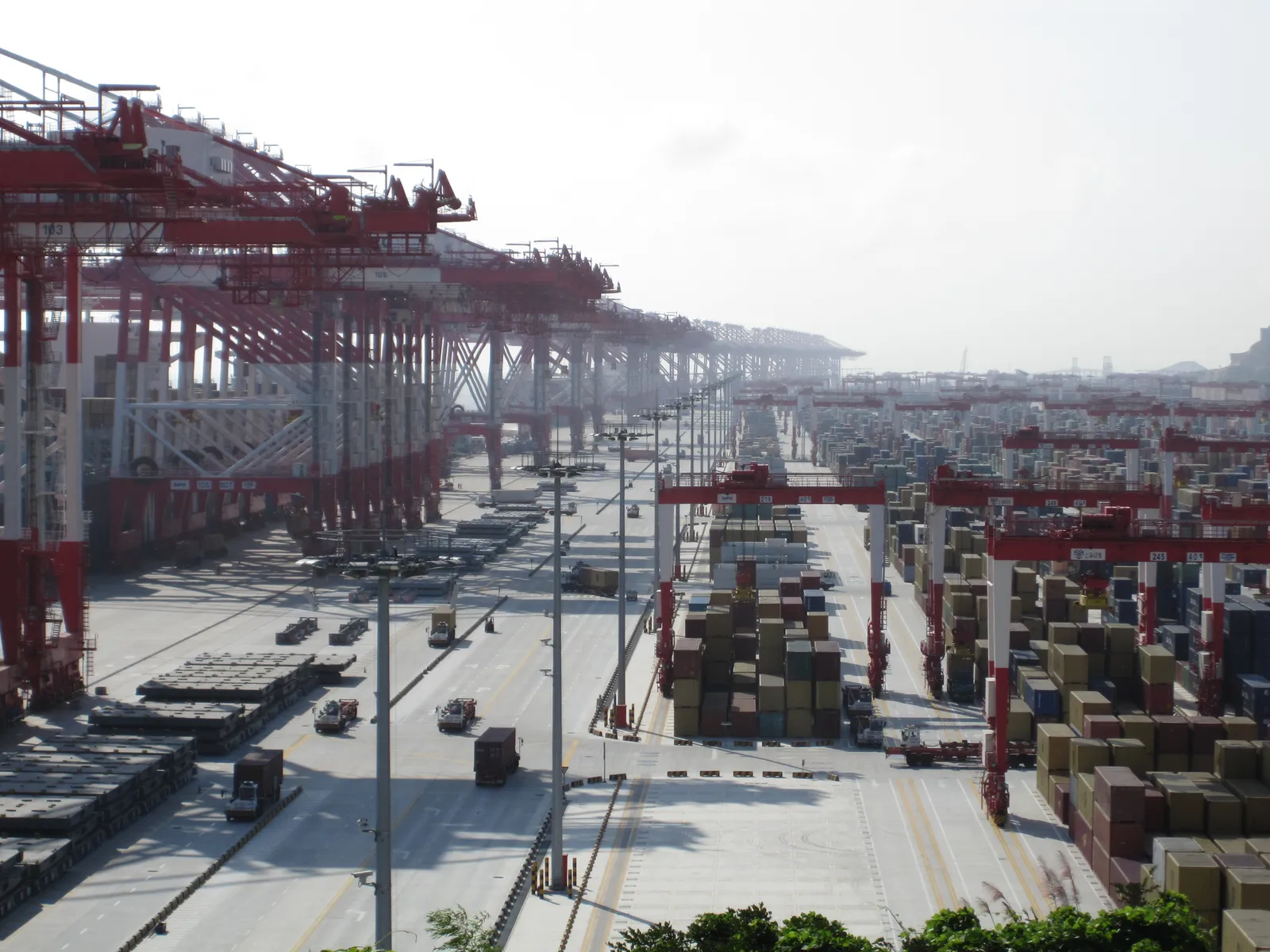
↔ Scroll horizontally to see the full chart and data table.
Source: UN Comtrade, China-reported exports, HS 3916.90 (rods and profile shapes of other plastics), annual, FOB USD. The line includes non-reinforced plastic profiles; unit value was USD 4,377/t in 2025. Mirror-reported US imports are far lower than China-reported exports to the US.
View the chart data and evidence
| Series | Category | Value | Unit | Evidence / value basis | Reported range | Point note |
|---|---|---|---|---|---|---|
| Value, USD million | 2019 | 256 | Not specified | Statistic | — | — |
| Value, USD million | 2020 | 353 | Not specified | Statistic | — | — |
| Value, USD million | 2021 | 442 | Not specified | Statistic | — | — |
| Value, USD million | 2022 | 488 | Not specified | Statistic | — | — |
| Value, USD million | 2023 | 558 | Not specified | Statistic | — | — |
| Value, USD million | 2024 | 801 | Not specified | Statistic | — | — |
| Value, USD million | 2025 | 1092 | Not specified | Statistic | — | — |
| Volume, thousand tonnes | 2019 | 74 | Not specified | Statistic | — | — |
| Volume, thousand tonnes | 2020 | 93 | Not specified | Statistic | — | — |
| Volume, thousand tonnes | 2021 | 113 | Not specified | Statistic | — | — |
| Volume, thousand tonnes | 2022 | 114 | Not specified | Statistic | — | — |
| Volume, thousand tonnes | 2023 | 129 | Not specified | Statistic | — | — |
| Volume, thousand tonnes | 2024 | 178 | Not specified | Statistic | — | — |
| Volume, thousand tonnes | 2025 | 249 | Not specified | Statistic | — | — |
↔ Scroll horizontally to see the full chart and data table.
Source: UN Comtrade, China-reported exports, HS 3916.90 (rods and profile shapes of other plastics), annual, FOB USD. EU-27 members combined about 25.9% [estimate].
View the chart data and evidence
| Series | Category | Value | Unit | Evidence / value basis | Reported range | Point note |
|---|---|---|---|---|---|---|
| — | United States | 28.5 | % | Statistic | — | — |
| — | Germany | 14.3 | % | Statistic | — | — |
| — | United Kingdom | 4.5 | % | Statistic | — | — |
| — | Canada | 4.1 | % | Statistic | — | — |
| — | Australia | 3.2 | % | Statistic | — | — |
| — | Russia | 2.9 | % | Statistic | — | — |
| — | India | 2.8 | % | Statistic | — | — |
| — | Netherlands | 2.7 | % | Statistic | — | — |
| Market and product | Measure | Rate | Basis | Status |
|---|---|---|---|---|
| US, GFRP profiles (3916.90.50) | MFN + Section 301 List 2 + Section 301 country tariff (24 Jul 2026) | 5.8% + 25% + 12.5% = 43.3% | HTSUS chapter 99, US notes 20(d) and 52 | in force |
| US, other glass fiber articles (7019.90.51) | MFN + Section 301 List 3 + country tariff | 4.3% + 25% + 12.5% = 41.8% | HTSUS chapter 99 | in force |
| US, glass fiber rovings (7019.12) | MFN + Section 301 List 3 + country tariff | 4.8% + 25% + 12.5% = 42.3% | HTSUS chapter 99 | in force |
| US, IEEPA fentanyl and reciprocal tariffs | Struck down by the Supreme Court, 20 Feb 2026 | 0% (refunds via CBP portal) | Learning Resources v. Trump | ended |
| EU, chopped strands, rovings and mats from China (CN 7019 11, ex 7019 12, 7019 14, 7019 15) | Anti-dumping (interim review) plus countervailing duty | AD 17.2–23.0% (22.9% for all other companies); CVD on top | Reg. (EU) 2025/2337; CVD Reg. 2021/328 as amended by 2025/2328 | in force from 26 Nov 2025 |
| EU, glass fiber from Egypt, Bahrain, Thailand | Anti-dumping on Chinese-owned plants | 11%, 11.8%, 15.3–25.4% | Reg. (EU) 2026/831; Egypt CVD 13.1% under 2026/2107 | in force |
| EU, woven or stitched glass fiber fabrics from China | Anti-dumping (expiry review) plus countervailing duty (expiry review) | AD 34.0–69.0% + CVD 17.0–30.7% | Reg. (EU) 2026/1203; Reg. (EU) 2026/1928 (7 Aug 2026) | in force |
| EU, pultruded profiles and grating | none | MFN only | — | no case found |
| India, glass fiber from China, Bahrain, Thailand | DGTR final finding, duty recommended | USD 194–394/t | DGTR case 6/17/2024 | imposition not confirmed at cut-off |
| China, export VAT rebate on glass fiber | Rebate cut from 13% to 9% | −4 points | MOF/STA Announcement 15 (15 Nov 2024) | in force |
Source: USITC HTS release 2026 revision 21; EUR-Lex via Official Journal mirror; WTO trade remedies portal; China Jushi 2024 annual report. Verify the live rate before quoting a landed price.
8. Standards: China has caught up on product and design codes
The Chinese standards stack for pultrusion is now complete from product to design, and it has pivoted toward wind. GB/T 31539-2015, the national product standard for structural pultruded profiles, has been joined since 2024 by GB/T 45006-2024 for wind-blade pultruded plates, GB/T 45755-2025 for plate pultrusion dies and GB/T 47972-2026 for mode-I fracture toughness of plate assemblies, in force from 1 February 2027 [official text, SAMR standards registry]. Design is covered by GB 50608-2020 for FRP engineering applications and T/CECS 692-2020 for pultruded profile structures, and the full-section compression test from GB/T 31539 became ISO 23930:2023, the first composites ISO standard proposed and led by China [official text].
International buyers specify against a different set, and the two sets answer different questions. EN 13706-1 to -3:2002 define the E23 and E17 profile grades by full-section modulus and remain the current editions after confirmation in December 2022 with no revision project open; CEN/TS 19101:2022 is the Eurocode-format design specification; ASCE/SEI 74-23 is the US load-and-resistance-factor design standard and requires characteristic values per ASTM D7290; ACI CODE 440.11-22 with ASTM D7957-22 governs GFRP rebar in concrete [official text]. A supplier's claim of EN 13706 should come with the Annex D full-section test report, not coupon data alone.
Fire and durability evidence is where Chinese quotations most often fall short of the specification. Halogen-free flame-retardant glass-polyester profiles reach Euroclass B-s2,d0 under EN 13501-1 from 3 mm wall thickness; US products cite ASTM E84 Class 1 with a flame-spread index of 25 or less; flame-retardant loading can cut transverse strength from 50 to 35 MPa [company, Exel, Strongwell, Fiberline]. For outdoor service ask for the surfacing veil and UV inhibitor in the written specification, because fiber bloom on early unveiled pultrusions is the failure mode that gave the product its reputation problem.
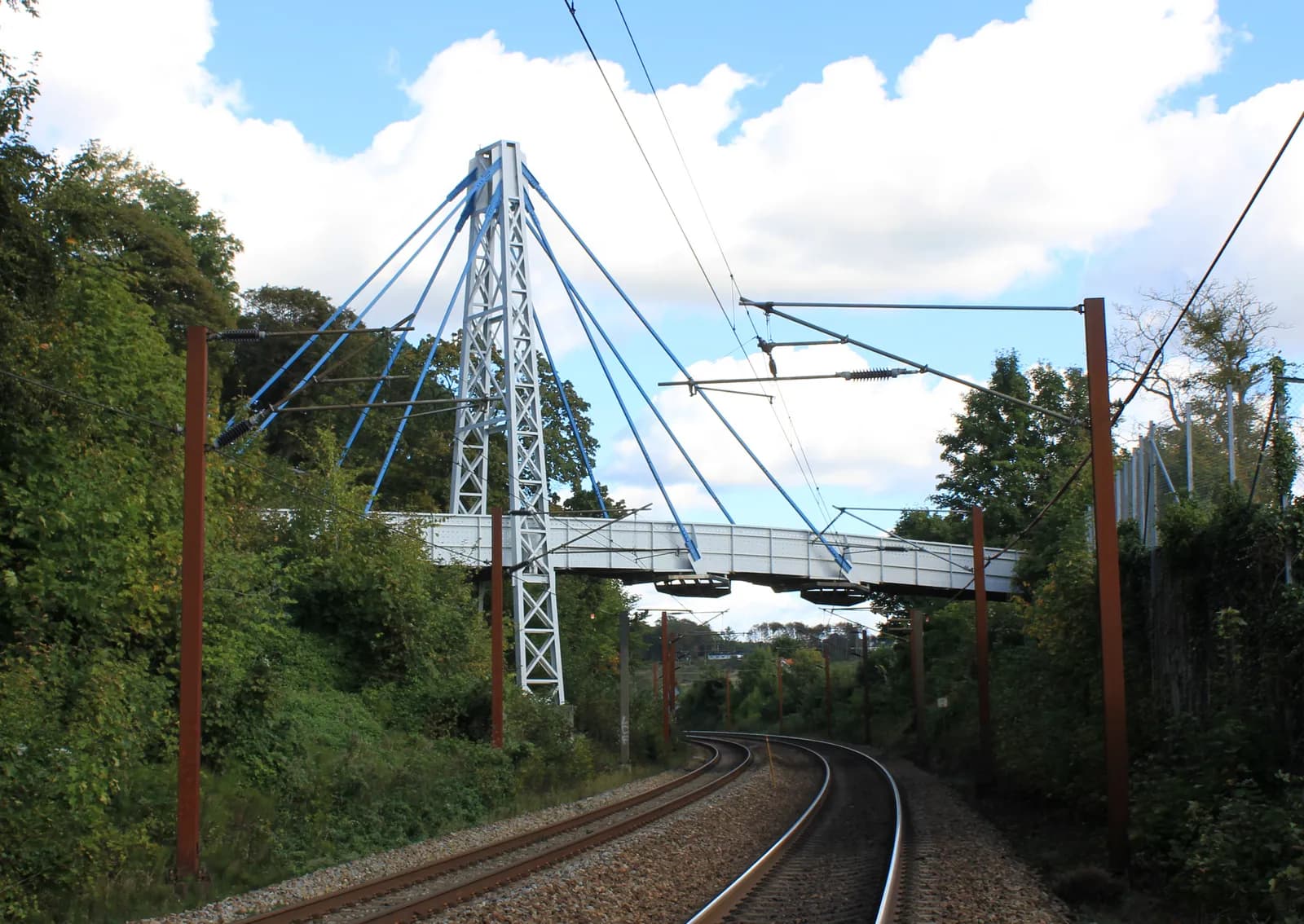
| Standard | Title or scope | Status and dates | What it settles |
|---|---|---|---|
| GB/T 31539-2015 | Pultruded FRP composite structural profiles | In force since 1 Feb 2016; English translation 2020 | Product requirements, screw pull-out and full-section compression tests |
| GB/T 45006-2024 | Pultruded FRP plates for wind turbine blades | In force since 1 Jun 2025 | Spar-cap plate product requirements |
| GB/T 45755-2025 | Pultrusion dies for FRP plates | In force since 1 Dec 2025 | Die requirements for plate pultrusion |
| GB/T 47972-2026 | Mode-I interlaminar fracture toughness of pultruded plate assemblies | In force from 1 Feb 2027 | Bond-line test for stacked planks |
| GB/T 26743-2011; GB 50608-2020 | FRP bars for structural engineering; FRP engineering application standard | In force (2012; 1 Oct 2020) | GFRP rebar product and design |
| T/CECS 692-2020 | Technical specification for pultruded FRP profile structures | Association standard, 2020 | Design, construction and acceptance of profile structures |
| JC/T 941-2016; JG/T 571-2019; T/CECS 591-2019 | Glass-fiber-reinforced polyurethane window profiles, windows and engineering code | In force | Window profile and system requirements |
| DL/T 5579-2020; GB/T 13398-2026 | Composite crossarm design; insulating tubes and rods for live working | In force; GB/T 13398 from 1 Nov 2026 | Electrical product requirements |
| ISO 23930:2023 | Full-section compressive test for pultruded profiles | Published Feb 2023 | China-led test method |
| EN 13706-1/2/3:2002 | Specifications for pultruded profiles; grades E23 and E17 | Confirmed Dec 2022, no revision open | Product grades by full-section modulus |
| CEN/TS 19101:2022 | Structural design of fiber-polymer composite structures (Eurocode format) | Technical specification; prEN 19101 in development | Eurocode-format structural design |
| ASCE/SEI 74-23 | LRFD design of pultruded FRP structures | Published 2023 | US structural design; fiber volume at least 30% |
| ASTM D7290-06(2022); ASTM D7957-22; ACI CODE 440.11-22 | Characteristic values; GFRP rebar specification; GFRP-reinforced concrete code | In force | Statistical material values and rebar design |
| EN 13501-1; ASTM E84 | Reaction to fire; surface burning characteristics | In force | Fire class of the profile, not structural fire resistance |
Source: SAMR national standards registry (openstd), BSI and CEN catalogue entries, ASCE, ASTM, ACI; standard years as listed at the research cut-off.
9. Outlook and buyer guidance
The next two years are decided by three things that can be watched. First, wind: China's 2025 hoisting of about 130 GW followed a 2024 to 2025 project rush, and Sail's own text warns that Chinese carbon fiber supply at about USD 18/kg has already compressed plank margins; the glass-plate side is in a consolidation phase by Zhenshi's account, with price declines narrowing in the first half of 2025. Second, PV frames: the first dated Tier-1 adoption statement, not another capacity announcement, is the signal that moves this segment from under 2% toward the broker forecasts. Third, trade: the US stack at 43.3% did not stop 2025 export growth, but EU action on fiber and fabrics keeps widening the cost gap that favors finished-profile imports into Europe, which is where AVK already records the loss.
For a buyer, the practical consequence of this report is that national market size is the wrong basis for a sourcing decision; qualified, repeatable output is the right one. Standard-profile suppliers compete on dimensional repeatability, availability, fabrication and delivered cost; custom-profile suppliers add tooling, dimensional control and design support; qualified component suppliers compete on documented performance inside a customer's own qualification. A pultruder may serve all three, but the evidence package differs, and the price difference between a conforming E23 profile with full-section data and a coupon-only quotation is usually smaller than the cost of one failed acceptance.
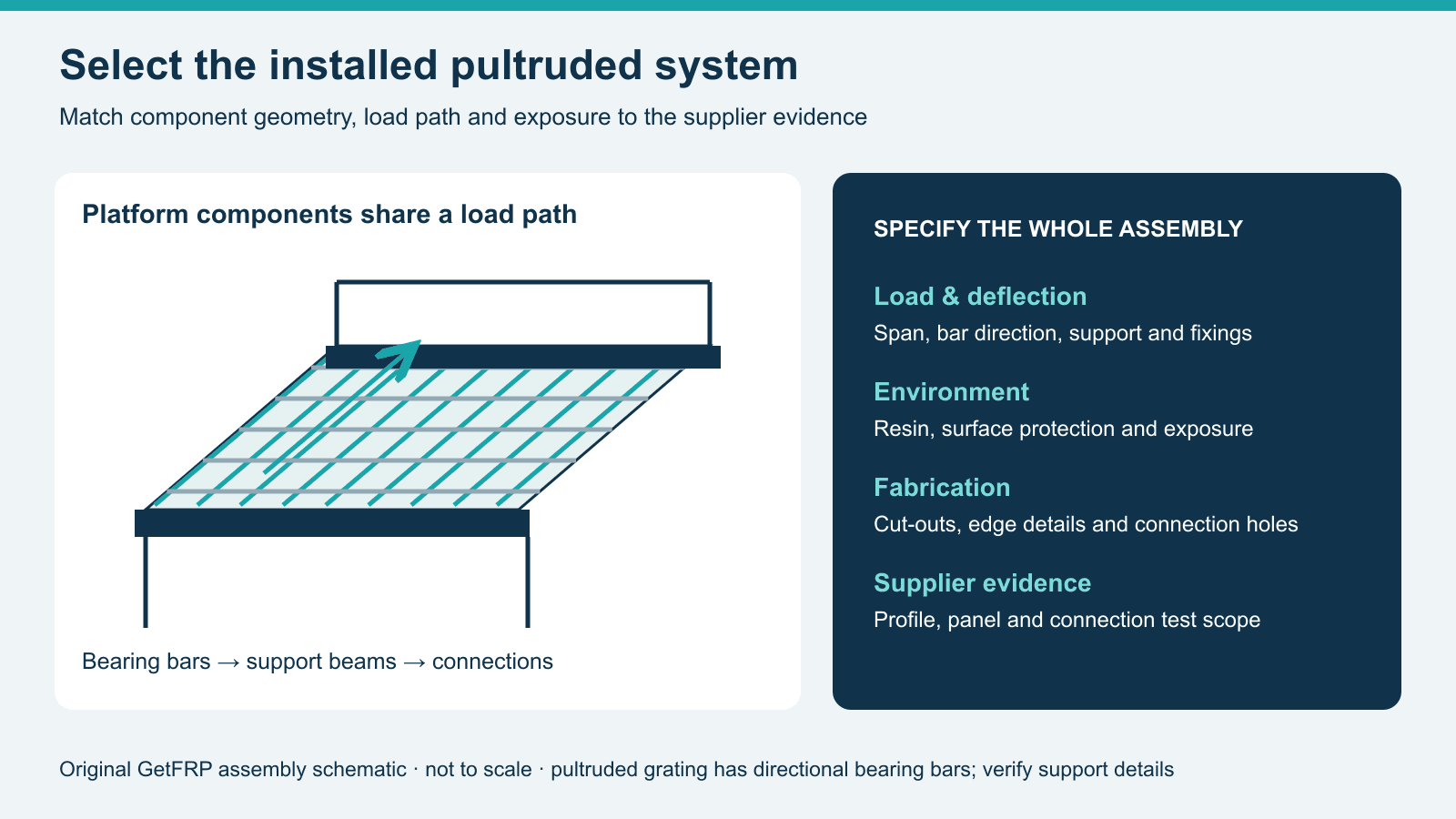
| Scenario | Conditions | Likely effect on Chinese pultruders | Confirming evidence |
|---|---|---|---|
| Wind plateau, consolidation continues | Hoisting falls back from the 2025 peak; offshore share stays near 4% | Fewer, larger glass-plate producers; carbon plank exports keep growing on Vestas and Nordex programs | CWEA 2026 hoisting; Zhenshi and Guangwei price and volume disclosures |
| PV frames cross the bankability line | A Tier-1 module maker publishes composite-frame adoption with IEC module certificates | Direct roving demand recovers; PU pultrusion lines multiply | Tier-1 statement; CPIA data; direct roving output turns positive |
| Trade friction widens | EU opens a case on finished composite products, or the US adds China-specific duties | Export mix shifts to EU, India, Middle East; overseas plants | Official Journal notices; Comtrade destination shares |
| Margin squeeze | Roving price war persists; resin flat; profile prices keep falling | Volume growth without profit; exit of small lines | CGFIA price commentary; listed-company gross margins |
Source: GetFRP analytical scenarios; unweighted and non-numerical.
| Item | Why it matters | Evidence to request |
|---|---|---|
| Drawing revision and section tolerances | Bow, twist and wall variation decide assembly yield | Full-length dimensional report per batch |
| Resin system and reinforcement schedule | Polyester, vinyl ester, epoxy and PU behave differently in heat, chemicals and fire | Resin grade, mat and veil specification, fiber content by burn-off (ASTM D2584 or ISO 1172) |
| Grade and design values | E23 or E17, or ASCE characteristic values, not brochure typical values | EN 13706 Annex D full-section modulus report; ASTM D7290 statistics |
| Cure and process record | Under-cure costs 23–30% of strength | Die temperature profile and line speed with the batch certificate |
| Fire and weathering | Class string, not a resin-family label | EN 13501-1 or ASTM E84 report for the actual wall thickness; veil and UV inhibitor stated |
| Quantity, fabrication, packing, Incoterm | Landed cost includes duty stack and fabrication, not ex-works per kilogram | Quote sheet with HS code, destination and declared duty basis |
Source: GetFRP sourcing practice; see the linked guides.
Frequently asked questions
How big is China's pultrusion market?
No association publishes a pultrusion tonnage. The universe that contains it, thermoset glass-fiber-reinforced plastics, reached 4.51 million tonnes in 2025, up 24.1%, and analysts put China at about one fifth of a global pultruded-profile market estimated at USD 2.2 to 3.2 billion. Any single national pultrusion figure you see is a forecast or an estimate and should be labeled as such.
What drove the 2025 surge in Chinese pultrusion?
Wind blades. High-modulus wind glass yarn output rose 65.1% to 1.44 million tonnes, China hoisted about 130 GW of turbines, and Chinese pultruded spar caps absorbed about 64,000 tonnes of carbon fiber, of which 24,000 tonnes were exported as finished planks. Ordinary direct roving, the feedstock of gratings and standard profiles, fell 9.8%.
Are glass or carbon pultruded plates used in Chinese wind blades?
Both. Glass pultruded plates became the onshore mainstream from 2021; the association's rule is glass below 80 m blade length, carbon-glass hybrid from 80 to 120 m, pure carbon above 120 m. In 2023 only about 18,000 of roughly 360,000 tonnes of spar-plate capacity was carbon; carbon volume then grew fast with 7 to 10 MW onshore platforms.
What duty does a Chinese FRP profile pay into the United States?
Under HS 3916.90.50 the stack in October 2026 is 5.8% MFN plus 25% Section 301 List 2 plus a 12.5% Section 301 country tariff, 43.3% in total. The IEEPA tariffs were struck down in February 2026. We found no anti-dumping case on pultruded profiles in any market, but the EU charges 17.2% to 23.0% anti-dumping duty on Chinese glass fiber rovings, chopped strands and mats, plus a countervailing duty.
Is polyurethane pultrusion better than polyester?
It is faster and stiffer per wall thickness, with injection-box lines running near 3 m/min and window profiles three to four times stronger in flexure than polyester profiles, but the resin costs about twice as much per tonne and needs metering equipment and compatible roving. Polyester still carries the large majority of Chinese pultrusion by the association's own account. Compare complete formulations and conforming output, not resin families.
Which standard should I specify for pultruded profiles from China?
For structural profiles specify EN 13706 grade E23 or E17 with the Annex D full-section modulus report, or ASCE/SEI 74-23 characteristic values per ASTM D7290; Chinese suppliers also work to GB/T 31539-2015, whose full-section compression test is now ISO 23930. Add the fire class under EN 13501-1 or ASTM E84 for the actual wall thickness and state the surfacing veil and UV inhibitor for outdoor use.
Sources and scope
Figures were cross-checked against primary documents where available; secondary citations are marked in each scope note. Company figures are reported as disclosed by the companies themselves. This note is an independent market assessment and not investment advice.
- [S1]China Glass Fiber Industry Association, 2025 annual development report of the glass fiber and products industry (March 2026)
Yarn output 8.43 Mt, GFRP products 8.89 Mt with thermoset 4.51 Mt, yarn by type, exports, capacity and price commentary. GFRP figures are derived by the association from yarn consumption.
- [S2]China Jushi 2024 annual report, industry discussion (reprints CGFIA 2024 data)
2024 yarn 7.56 Mt, GFRP 7.50 Mt (thermoset 3.64, thermoplastic 3.86), Jushi sales of 3.025 Mt, export VAT rebate cut.
- [S3]CGFIA 2023 annual report as republished by the Nanjing Fiberglass Research Institute information service
2023 yarn 7.23 Mt; GFRP 6.72 Mt (thermoset 3.22, thermoplastic 3.50); reinforcement yarn by type.
- [S4]Qianzhan Industry Research, China glass fiber industry analysis (March 2021), quoting CGFIA 2020 data
2020 yarn output 5.41 Mt, up 2.64%; pool-kiln yarn 5.02 Mt, up 2.01%. Consultancy compilation quoting the association.
- [S5]Huaon Industry Research, China glass fiber industry 2021 (CGFIA data)
2021 yarn output 6.24 Mt, up 15.2%; pool-kiln yarn 5.80 Mt. Consultancy compilation quoting the association.
- [S6]Huaon Industry Research, China glass fiber industry 2022 (CGFIA data)
2022 yarn output 6.87 Mt, up 10.2%. Consultancy compilation quoting the association.
- [S7]Securities Star via NetEase, glass fiber industry review citing CGFIA flash data and Sublime China Information prices (13 October 2026)
End-June 2026 total glass fiber yarn capacity about 9.3 Mt, in-production pool-kiln capacity about 8.65 Mt; H1 2026 yarn output up about 7.9%. Secondary summary of association data; also used in the GetFRP eVTOL composites report.
- [S8]China Composites Industry Association, explainer on the pultrusion process
Historical national pultrusion capacity of about 30,000 t (undated, 1990s context); polyester above 90% of pultrusion resin; line speed 0.2–1.5 m/min.
- [S9]China Composites Industry Association, carbon fiber in wind blades (2024)
Blade-length material rule (glass below 80 m, hybrid 80–120 m, carbon above 120 m); 2022 wind carbon fiber 34.7 kt; line-count projection.
- [S10]Guangzhou Sail Carbon Fiber, 2025 global carbon fiber composites market report (April 2026), reproduced by China Composites Expo
Global wind carbon fiber about 100 kt; Chinese wind carbon fiber 64 kt (40 kt domestic, 24 kt exported as planks); China demand 132,027 t; price trend to about USD 18/kg.
- [S11]Guangzhou Sail Carbon Fiber, 2024 global carbon fiber composites market report, republished by cnfrp.com
2024 wind carbon fiber 44 kt; China wind 22 kt with about 10 kt exported as planks; domestic 12K fiber RMB 85–110/kg.
- [S12]Guangzhou Sail Carbon Fiber, 2023 report, republished by Aibang
2023 wind carbon fiber 20 kt, down 42%; Chinese average price fall from USD 33 to 18/kg; two conflicting China wind figures.
- [S13]Zhongfu Lianzhong and Zhongfu Tanxin authors, review of pultruded spar plates (September 2023)
More than 1,420 spar-plate lines and about 360 kt capacity with about 18 kt carbon in 2023; modulus comparisons; adoption history. Company-affiliated.
- [S14]Zhongfu Tanxin 30,000 t/yr digital spar-plate plant opening (July 2024), Sina Finance
80 lines, 30,000 t/yr high-modulus glass plates, pull speed above 1 m/min, glass plate adoption timeline.
- [S15]Zhenshi New Materials, second-round IPO inquiry reply to the Shanghai Stock Exchange (7 November 2025)
Pultruded-profile price −26.94% and volume −11.25% in 2024; market entry and consolidation narrative; RMB 205 million of self-developed pultrusion equipment; gross margins; peer tables.
- [S16]Guangwei Composites carbon-beam results 2023 to 2025 as reported by Jiemian, Economic Information Daily and NetEase
2023 carbon beam revenue RMB 426 million (−35.5%) on 4.09 million meters at an 18.1% gross margin (this article); 2024 RMB 537 million on 11.40 million meters and 2025 RMB 943 million (+75.8%) from the company's annual reports as reported by other press. Company figures via press.
- [S17]Jilin Chemical Fiber investor relations statement on carbon pultruded plates (January 2025), Sina Finance
Group plate sales above 10,000 t in January to November 2024, three times 2023; 2025 target above 30,000 t.
- [S18]Wind Energy magazine feature on carbon fiber blades, republished by ne21.com (September 2024)
Glass pultruded plate about RMB 15/kg with carbon at about five times; more than 300 carbon plank lines and above 40,000 t capacity; price thresholds. Industry statements.
- [S19]Ennis, Das and Norris, Economic competitiveness of pultruded fiber composites for wind turbine applications (OSTI full text; Composites Part B 265, 2023)
Part cost USD 1.92, 2.65, 9.44 and 17.38 per kg; 33–55% pultrusion adder; fiber volume 68% vs 57%; blade mass and cost results.
- [S20]Chinese Wind Energy Association, 2025 China wind power hoisting capacity statistics brief (full version, March 2026), via CWEEA
About 130 GW hoisted in 2025 in 18,272 turbines, up 49.9%; average unit rating 7,160 kW; offshore 5.603 GW or 4.3%. Installation (hoisting) basis, not NEA grid connection. The same source is used in the GetFRP wind power report.
- [S21]National Energy Administration, 2025 renewable energy grid-connection statistics (12 February 2026)
120 GW of new wind and 317 GW of new photovoltaic capacity connected in 2025.
- [S22]Cinda Securities, composite PV frame deep-dive (19 September 2023)
Forecast of 5%, 15% and 25% composite-frame share of global module-frame demand for 2023 to 2025 (20.7, 80.7 and 163.3 GW; 550,200 t in 2025) at 3,400–3,600 t per GW; used here as the forecast that reality missed.
- [S23]Covestro, polyurethane composite PV frames pass 3 GW of cumulative module shipments (June 2025), China5e
More than 3 GW of cumulative module shipments with polyurethane composite frames (about five million panels) by 4 June 2025; aluminum frame put at 10% to 15% of module cost.
- [S24]Jiangsu Shemar Electric: 2025 annual report (SSE 603530)
2025 group and line external-insulation revenue; line gross margin 14.00%, station 48.67%. The line category includes crossarms and other products; not a national market total.
- [S25]AVK, Composites Market Report 2026 (European market 2025)
European pultrusion 46 kt in 2025, down 4.2%; thermoset GRP 952 kt; statements on Asian competition and relocation; JEC global volume range.
- [S26]AVK, Composites Market Report 2023 (European market 2022, with 2018 to 2021 series)
Pultrusion 55, 56, 50, 56, 52 kt for 2018 to 2022.
- [S27]Exel Composites, financial statements release 2025 (13 February 2026)
Revenue EUR 103.2 million, order intake up 61%, India wind plank plant, tariff risk wording, Nanjing site closure in 2023 filings.
- [S28]UN Comtrade, China-reported exports under HS 3916.90, 7019 and 7019.12, 2019 to 2025
Value and net weight series, destination shares and mirror comparisons; preview API queried 24 October 2026.
- [S29]USITC, Harmonized Tariff Schedule chapter 99 (2026 revision 21), US notes 20 and 52
Section 301 list membership of 3916.90.50, 7019 lines and 3926.90.99; the 12.5% China country tariff heading 9903.05.31.
- [S30]Commission Implementing Regulation (EU) 2025/2337 of 24 November 2025 amending Implementing Regulation (EU) 2023/1452 (anti-dumping duty on continuous filament glass fibre products from China)
Anti-dumping rates of 17.2% (Changhai), 20.5% (CPIC), 23% (the Jushi group including Taishan Fiberglass, and PPG Sinoma Jinjing) and 22.9% for all other Chinese imports, in force 26 November 2025; product scope chopped strands, rovings and mats (CN 7019 11, ex 7019 12, 7019 14, 7019 15); review investigation period October 2023 to September 2024.
- [S31]Commission Implementing Regulation (EU) 2026/1203, glass fibre fabrics from China and Egypt (expiry review)
Anti-dumping duties of 34.0% to 69.0% for China and 33.1% for Egypt; Jiangsu Jiuding New Material is listed in Annex II at 34.0%. Read via an Official Journal mirror.
- [S32]KraussMaffei and Pultrex, pultrusion white paper and K-Magazin 1/2017
Pultrex machine reference table (Px250-3T to Px1000-20T, 3–20 t pull force); injection box (iBox) doubling flat glass-profile speed to 2.9 m/min (2017 award); up to 24 die heating zones as an option; fiber volume fraction up to about 75%.
- [S33]Chaparala et al., industrial vinyl ester pultrusion trial, Polymers 15(18):3808 (2023)
0.5 m/min through a 1,000 mm die; degree of cure and flexural strength versus die temperature; Tg 166–172 °C at 82 wt% glass.
- [S34]Strongwell design manual, section 2 (revision November 2024)
Reinforcement architecture: roving, continuous filament mat, multiaxial fabrics and polyester surfacing veil; 50% mat-and-roving shapes versus 70% roving rod.
- [S35]Fiberline Composites, the European standard EN 13706 explained
E23 and E17 minimum values; flame-retardant grey profiles at 35 MPa transverse strength.
- [S36]SAMR national standards registry (openstd), search results for pultrusion and composite bars
Issue and implementation dates of GB/T 31539-2015, GB/T 45006-2024, GB/T 45755-2025, GB/T 47972-2026, GB/T 26743-2011 and related test standards.
- [S37]ST Yongyue Technology, first-quarter 2025 operating data announcement (cninfo)
FRP-grade unsaturated polyester average selling price RMB 7,346/t excluding VAT; raw material prices.
- [S38]Guosen Securities building materials biweekly (7 May 2025) quoting Sublime China Information
2400 tex E-glass direct roving national average RMB 3,735.25/t on 30 April 2025, range 3,500–3,800, delivered with VAT.
- [S39]CCIA visit report on the Zaoqiang composites cluster (January 2024)
More than 500 registered composites enterprises in Zaoqiang, Hebei, and about 200 more with plants elsewhere.
- [S40]Glass fiber industry conference-call summary on 2026 roving and electronic yarn prices, Sina Finance (30 March 2026)
2400 tex direct roving low of RMB 3,050–3,100/t before the November 2025 rebound; at least RMB 3,500/t by March 2026 with high quotes at RMB 3,800–3,900/t; expected 2026 range RMB 3,400–3,800/t. Industry statements, not an official price series.
- [S41]Commission Implementing Regulation (EU) 2026/1928 of 7 August 2026, countervailing duty on woven and/or stitched glass fibre fabrics from China and Egypt (expiry review)
Countervailing duties of 17.0% to 30.7% for Chinese producers (30.7% for Jushi, Hengshi and Taishan and for Annex II companies) and 10.9% for Egypt. Read via an Official Journal mirror.
- [S42]ACMA, Q3-Q4 2024 industry statistics summary (US and Canada composites sales)
Glass-reinforced polyester and vinyl ester thermoset composites sales of 3.63 billion pounds in 2024, down 2.7% from 2023. No pultrusion line is reported.
- [S43]Jiangsu Shemar Electric: 2024 annual report (SSE 603530)
2024 group revenue RMB 1,344.891m; line external-insulation revenue RMB 209.368m and margin 25.95%. Exact comparable base for the 2025 comparison.
Image provenance and usage terms appear in each caption; see image credits. Submit a source correction.