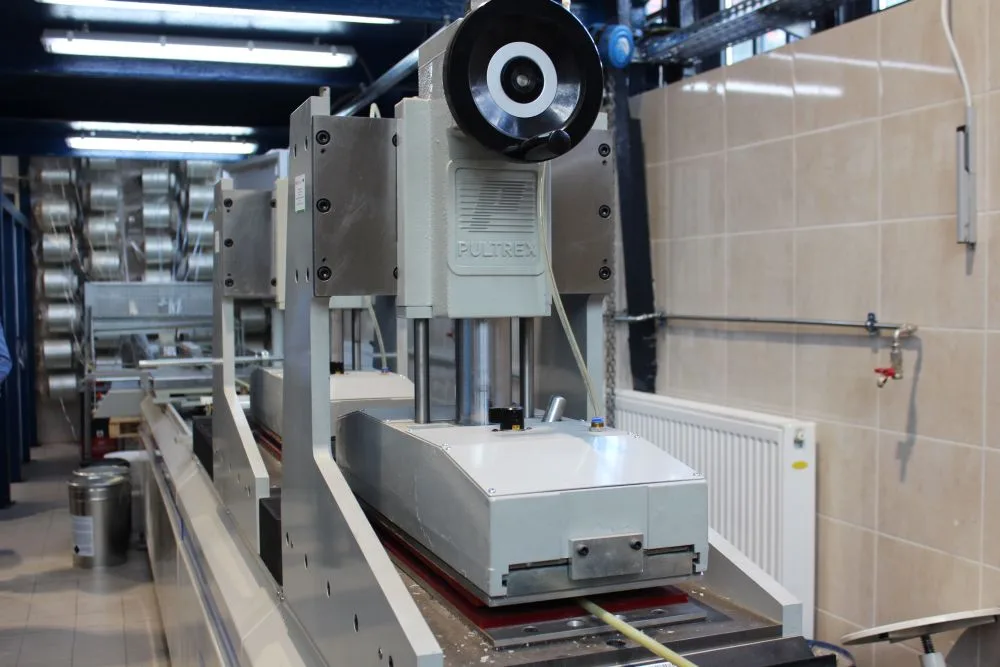
1. What a pultrusion machine actually is: the line modules you must specify
A pultrusion line is seven or eight machines in series, and a quotation for a puller is not a quotation for a line. Reinforcement leaves a creel, passes guide plates and a preformer, is wetted in an open bath or a closed injection box, cures in a heated steel die, is gripped by the puller and is cut by a flying saw that travels with the profile (company data) [S2]. Pultrex sells both bare machines and turnkey packages that add die and infeed design, metering, creels, saws and data collection, which is the main reason two offers for 'a 10-tonne machine' are rarely comparable (company data) [S1].
The specification therefore starts from the product, not the catalog. Fix the largest profile envelope, the reinforcement count, the resin family and the target sustained speed, then let each module follow. Strongwell, which has built more than 200 PULSTAR machines sold into 25 countries alongside its own pultrusion plants, states that its EX2408 envelope of 610 × 203 mm accepts 95% of the profiles currently produced; that is a useful sanity check against buying a larger frame than the product family needs (company data) [S3].
Utilities are part of the specification. A standard Pultrex machine draws 15 to 40 kVA depending on class, and the Sandia and ORNL cost model allows 44 kW continuous for a single line (company data) [S1] [S9]. Chinese catalogs are usually wired for 380 to 415 V at 50 Hz, for example the Qingdao Huameiyuan QDHMY-L10T at 415 V / 50 Hz, while US builders such as Liberty Pultrusions supply 460/480 V three-phase at 60 Hz (company data) [S7] [S4]. A line bought from China for a North American plant needs the voltage, frequency and control-panel standard written into the contract, not assumed.
| Module | Function | Published reference values | Specify in the RFQ |
|---|---|---|---|
| Creel and guides | Holds roving doffs, mat and veil rolls; aligns them to the section | 48- or 100-doff roving creels; mat rolls up to 610 mm wide (Strongwell); carbon needs extra creel tensioning, the reason a carbon line was modeled 2.5% dearer (ORNL) | Doff count per section, tension control for carbon, mat slitter width |
| Impregnation | Wets the fibers with resin | Dip pan for open shapes, straight-through pan for hollow and complex shapes (Strongwell); closed injection box with 2K metering for PU, epoxy or caprolactam (KraussMaffei) | Bath or box, metering ratio and accuracy, resin temperature control |
| Preformer | Shapes the wet bundle before the die entry | Usually built per profile with the die (Strongwell, Pultrex) | Who designs and supplies it; included in the die price or not |
| Die and heating | Shapes and cures the profile | Dies 61–122 cm long (Strongwell), 0.6–1.2 m (CCIA); 2–8 zones standard, up to 24 optional (Pultrex); 3 kW per zone, 0–250 °C, ±1 °C control (Haoli) | Die length, zone count, heater power, thermocouple positions, die steel and plating |
| Puller | Draws the profile at constant speed | 3–20 t standard (Pultrex); 3–40 t (Haoli); clamp force about twice pull force (Pultrex) | Continuous pull at the target speed, clamp force, envelope, speed stability |
| Cut-off saw | Cuts lengths while traveling with the line | Flying saw with pneumatic part clamp and encoder cut length (Strongwell, Liberty) | Wet or dry cut, dust extraction, cut tolerance, blade type |
| Controls and data | Holds speed, temperatures and logs the run | PLC with pull-force and speed trend displays (Strongwell); line-level SCADA with phone access (Zhongfu digital plant) | Logged channels, sample rate, export format, alarm history, remote access |
| Utilities | Power, air, cooling | 15–40 kVA and 0.02–0.06 m³/min air at 6.5 bar (Pultrex); 44 kW per line (ORNL); 415 V/50 Hz (HMY) vs 460/480 V/60 Hz (Liberty) | Voltage, frequency, connected load by operating state, cooling water |
Source: Pultrex/KraussMaffei [S1] [S2]; Strongwell PULSTAR brochure [S3]; Liberty Pultrusions [S4]; Nanjing Haoli [S5]; Qingdao Huameiyuan [S7]; Sandia/ORNL [S9]; CCIA [S11]; Sina Finance on Zhongfu [S15]. All values are company or model data, not GetFRP tests.
2. Reciprocating vs caterpillar pullers, and how much pulling force you need
Two puller families dominate. A reciprocating puller uses two clamp carriages that work hand over hand: one grips and pulls a full stroke while the other releases and returns faster, so the profile moves at constant speed irrespective of the pull required (company data) [S2]. A caterpillar puller presses two endless tracks onto the profile and pulls continuously; KraussMaffei positions it for lower forces and simple geometries, and Strongwell for lower speeds and forces and for high-volume, repetitive pulling of one profile, including multi-cavity dies (company data) [S1] [S3]. Strongwell adds a detail buyers often miss: on a caterpillar, available pull force is a function of pull speed, whereas its reciprocating machines deliver maximum force at every speed (company data) [S3].
Published ratings show how wide the market is. Pultrex standard machines run from the Px250-3T at 3 tonnes to the Px1000-20T at 20 tonnes, with clamping force of about twice the rated pull spread over 600 to 660 mm clamp lengths to avoid crushing thin walls (company data) [S1] [S2]. Strongwell's EX reciprocating machines are rated 5.4 to 9.1 t continuous per puller and 10.9 to 18.1 t in tandem; its caterpillars 3.6 to 6.4 t (company data) [S3]. Liberty lists 2.5 to 15 t with a 25 t option (company data) [S4]. Chinese catalogs go further at the top: Nanjing Haoli's servo-hydraulic series reaches 40 t with a 1,200 × 500 mm clamping window, and Hebei Aoliande lists 3 to 25 t (company data) [S5] [S8].
Pull force is set by the die, not the machine. Force builds up along the die from compaction at the entry taper and viscous drag, rises where gelling resin meets the steel, then continues as sliding friction of the solid profile; an industrial vinyl ester study found that earlier gelation increases that friction and recommends shorter dies to reduce pulling force (peer-reviewed) [S12]. That is why the useful rating is continuous pull at the target speed with margin, not the peak figure. A practical rule from the catalogs: choose the class by profile envelope first, because frame width and clamp height are what Pultrex and Haoli step up with force, then confirm the margin on a trial die.
↔ Scroll horizontally to see the full diagram.
↔ Scroll horizontally to see the full chart and data table.
Source: Pultrex [S1]; Strongwell [S3]; Liberty [S4]; Nanjing Haoli [S5] [S6]; Qingdao Huameiyuan [S7]; Hebei Aoliande [S8]. Catalog maxima, not tested capacity. HMY lists 2 × 50 kN for its dual-stream machine; 50 kN is shown as 5.1 t. Strongwell tandem means both reciprocating pullers clamping together; continuous pull per puller is 9.1 t.
View the chart data and evidence
| Series | Category | Value | Unit | Evidence / value basis | Reported range | Point note |
|---|---|---|---|---|---|---|
| — | Nanjing Haoli HL SYLJ-40T, servo-hydraulic (China) | 40 | t | Company data | — | — |
| — | Hebei Aoliande ZLRCYZ-25 (China) | 25 | t | Company data | — | — |
| — | Pultrex Px1000-20T (UK) | 20 | t | Company data | — | — |
| — | Strongwell EX4008R, tandem (US) | 18.1 | t | Company data | — | — |
| — | Liberty Pulforce 5012 (US) | 15 | t | Company data | — | — |
| — | Pultrex Px1000-12T (UK) | 12 | t | Company data | — | — |
| — | Nanjing Haoli HL YLJ-10T, crawler (China) | 10 | t | Company data | — | — |
| — | Strongwell EX4008C, caterpillar (US) | 6.4 | t | Company data | — | — |
| — | Qingdao Huameiyuan QDHMY-L10T, per stream (China) | 5.1 | t | Company data | — | — |
| — | Pultrex Px250-3T (UK) | 3 | t | Company data | — | — |
| Model | Pull force (kgf) | Clamp force per puller (kgf) | Envelope W × H (mm) | Speed (m/min) | Standard die zones | Electrical (kVA) |
|---|---|---|---|---|---|---|
| Px250-3T | 3,000 | 7,500 | 250 × 125 | 0.06–5.00 | 2 | 15 |
| Px500-6T | 6,000 | 10,700 | 500 × 160 | 0.04–4.00 | 2 | 20 |
| Px750-8T | 8,000 | 21,400 | 750 × 160 | 0.04–3.00 | 4 | 30 |
| Px1000-10T | 10,000 | 21,400 | 1,000 × 160 | 0.04–2.50 | 4 | 30 |
| Px1000-12T | 12,000 | 32,100 | 1,000 × 230 | 0.04–2.25 | 4 | 35 |
| Px1000-20T | 20,000 | 42,800 | 1,000 × 350 | 0.06–2.00 | 8 | 40 |
Source: KraussMaffei / Pultrex white paper, machine reference table [S1]. Clamp force at 6.5 bar air pressure; up to 24 heating zones optional on all machines; optional heights to 350 mm. Company data.
3. Die length, heating zones and line speed by resin system
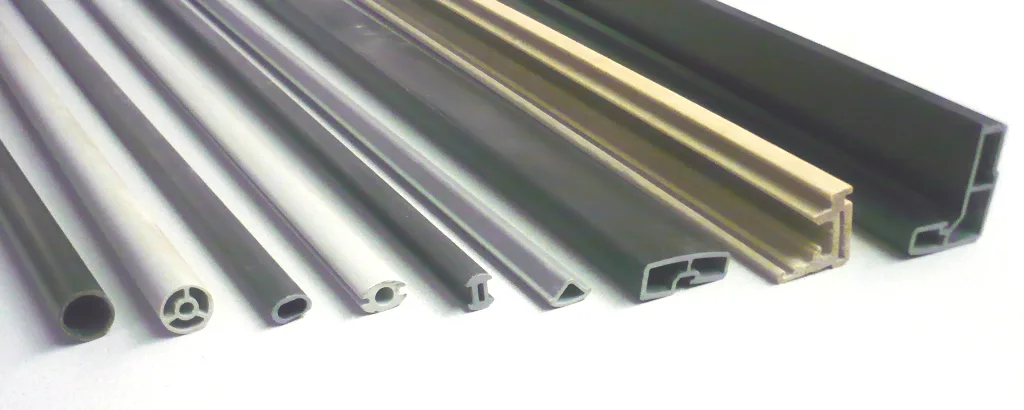
Dies for thermoset pultrusion are typically 0.6 to 1.2 m long, which matches Strongwell's 61 to 122 cm range for its tooling and the China Composites Industry Association's description of Chinese practice (company data) [S3] [S11]. Heat is applied by platens in separately controlled zones: two to eight as standard on Pultrex machines with up to 24 optional, three to six zones up to 230 °C on Covestro's reference polyurethane die, and 3 kW per zone with ±1 °C control on Nanjing Haoli's catalog machines (company data) [S1] [S10] [S5]. The CCIA notes that the temperature step between the three zones of a conventional die is held to about 20 to 30 °C (company data) [S11].
Zone temperature decides cure, and cure decides properties. In an industrial vinyl ester trial at 0.5 m/min through a one-meter, four-zone die, flexural strength was 1,053 MPa at a 100 °C set point, 1,331 MPa at 120 °C and 1,112 MPa at 140 °C, while the degree of cure rose from 86.2% at 100 °C to 97.7% at 140 °C; the authors note that earlier gelation increases friction and therefore pulling force (peer-reviewed) [S12]. A buyer should ask for the die temperature log with every acceptance batch, because a stable window matters more than a maximum-speed demonstration.
Line speed depends on chemistry, wall thickness and the number of streams. The CCIA puts conventional pultrusion at 0.2 to 1.5 m/min (company data) [S11]. The Sandia and ORNL cost model uses 1.27 m/min for a 5 mm glass/epoxy spar plank and 0.90 m/min for carbon (company data) [S9]. China's Zhongfu digital spar-plate plant claims more than 1 m/min on its 80 lines (company data) [S15]. Closed injection changes the ceiling: Pultrex's iBox doubled the speed of flat glass profiles to 2.9 m/min in 2017, and Covestro quotes typical polyurethane speeds up to 2 to 3 m/min at a 3 mm wall, potentially double other resins (company data) [S1] [S10].
Injection pultrusion is a different machine, not an accessory. It needs a 2K low-pressure metering unit, a mixing head and a tempered injection box mounted on the die entry, and Pultrex offers it on every machine class as an alternative to the open bath (company data) [S1]. Covestro specifies a closed injection box for highly reactive systems such as polyurethane, and KraussMaffei's metering units are offered for two-component polyurethane, epoxy and polyamide (company data) [S10] [S1].
Dielectric preheating is the other lever, and the evidence is thinner. Thermex-Thermatron markets a 12.5 kW, 480 V radio-frequency preheater for non-conductive fiber and resin combinations and claims that line speed can be doubled in most cases; that is a vendor claim (company data) [S14]. A 2022 simulation study found that optimizing heater layout on an industrial line running at 20 cm/min could raise pull speed 2.0 to 2.3 times, and that a microwave-assisted die could run 5.6 times faster than a conventional reference at 18 cm/min with lower energy per meter (peer-reviewed, simulation) [S13]. Treat microwave and RF modules as items to trial, not as guaranteed capacity.
↔ Scroll horizontally to see the full diagram.
↔ Scroll horizontally to see the full chart and data table.
Source: Covestro [S10]; KraussMaffei/Pultrex [S1]; CCIA [S11]; Sandia/ORNL [S9]; Sina Finance on Zhongfu [S15]; Chaparala et al. [S12]. Mixed evidence: Chaparala and ORNL are peer-reviewed; the rest are company or association statements. Speeds are per stream and depend on wall thickness; they are not interchangeable guarantees.
View the chart data and evidence
| Series | Category | Value | Unit | Evidence / value basis | Reported range | Point note |
|---|---|---|---|---|---|---|
| — | Polyurethane, injection box, 3 mm wall, upper typical (Covestro) | 3 | m/min | Company data | — | — |
| — | Flat glass profiles, KraussMaffei iBox, 2017 record | 2.9 | m/min | Company data | — | — |
| — | Conventional pultrusion, upper end (CCIA) | 1.5 | m/min | Company data | — | — |
| — | Glass/epoxy spar plank, cost-model baseline (ORNL) | 1.27 | m/min | Company data | — | — |
| — | Glass spar plates, Zhongfu digital lines, claimed minimum | 1 | m/min | Company data | — | — |
| — | Carbon/epoxy spar plank, cost-model baseline (ORNL) | 0.9 | m/min | Company data | — | — |
| — | Vinyl ester industrial trial, 82 wt% glass (Chaparala 2023) | 0.5 | m/min | Company data | — | — |
| — | Conventional pultrusion, lower end (CCIA) | 0.2 | m/min | Company data | — | — |
4. How much can one pultrusion line produce? A capacity model with sourced inputs
Annual saleable output is streams × line speed × minutes per year × uptime × process yield × mass per meter. The Sandia and ORNL model supplies a complete, published input set for a 150 × 5 mm glass/epoxy plank: 1.595 kg/m, 1.27 m/min, 20% annual downtime, 99.7% material yield, 97% process yield and two or three parallel streams on one machine, staffed by two people per shift around the clock (company data) [S9]. Two streams at 80% uptime give 1.07 million meters and 1,703 t a year, which reproduces the model's own Table 1; after the 97% process yield, saleable output is about 1.04 million meters or 1,652 t (estimate: 2 × 1.27 × 525,600 × 0.80 × 0.97 × 1.595 kg).
The sensitivities are large and they are not about the machine. Adding a third stream lifts saleable output to about 2,479 t, the model's preferred glass case because it adds 50% throughput with negligible extra capital, labor or energy; dropping uptime to 65% cuts it to about 1,343 t; running the glass plank at the carbon speed of 0.90 m/min gives about 1,171 t (estimate, same formula) [S9]. Process yield acts directly: the model states that a percentage change in yield changes part cost by the reciprocal (company data) [S9].
Chinese nameplate figures give a reality check. Zhongfu's 80-line digital plant is rated at 30,000 t a year of wind spar plates, or 375 t per line-year, against roughly 1,650 t for the two-stream ORNL plank; the gap reflects section size, stream count and nameplate conventions, which is why a supplier's 'tonnes per line' should always be rebuilt from section mass and sustained speed (estimate from company data) [S15] [S9]. Use the interactive model below with your own section area and qualified speed.
↔ Scroll horizontally to see the full chart and data table.
Source: GetFRP calculation from Sandia/ORNL Table 1 inputs [S9]. Output = streams × speed (m/min) × 525,600 min × uptime × 0.97 process yield × 1.595 kg/m. Baseline gross output before yield is 1,703 t, matching the source table. Not a measured plant result.
View the chart data and evidence
| Series | Category | Value | Unit | Evidence / value basis | Reported range | Point note |
|---|---|---|---|---|---|---|
| — | 3 streams, 1.27 m/min, 80% uptime | 2479 | t/yr | GetFRP estimate | — | — |
| — | 2 streams, 90% uptime | 1859 | t/yr | GetFRP estimate | — | — |
| — | 2 streams, 1.27 m/min, 80% uptime (ORNL baseline) | 1652 | t/yr | GetFRP estimate | — | — |
| — | 2 streams, 65% uptime | 1343 | t/yr | GetFRP estimate | — | — |
| — | 2 streams at 0.90 m/min | 1171 | t/yr | GetFRP estimate | — | — |
| Input | Value used | Source and evidence | What to replace it with |
|---|---|---|---|
| Section mass | 1.595 kg/m (150 × 5 mm glass/epoxy plank, 68% fiber volume) | Sandia/ORNL, company data [S9] | Measured mass per meter of your profile |
| Line speed | 1.27 m/min glass; 0.90 m/min carbon | Sandia/ORNL, company data [S9] | Speed sustained over the FAT run, not the machine maximum |
| Streams per machine | 2 or 3 (glass); 2 maximum (carbon) | Sandia/ORNL, company data [S9] | Cavities proven on the trial die |
| Uptime | 80% (20% annual downtime) | Sandia/ORNL, company data [S9] | Your shift pattern minus changeovers and maintenance |
| Material and process yield | 99.7% and 97% | Sandia/ORNL, company data [S9] | Start-up, shutdown and inspection rejects from trial records |
| Labor | 2 operators per shift, 24-hour operation | Sandia/ORNL, company data [S9] | Local staffing plan |
| Energy | 44 kW continuous per line | Sandia/ORNL, company data [S9] | Metered draw by operating state |
| Tooling | One die per 300 km of product (model assumption) | Sandia/ORNL, company data [S9] | Supplier's die-life statement and re-chrome interval |
Source: Sandia National Laboratories and Oak Ridge National Laboratory cost model [S9]. The model's product cost is not a selling price.
Interactive model
From line speed to saleable tonnes
Change geometry, speed, availability and yield to see annual output from one die. The inputs are scenario assumptions, not a Chinese industry average or any supplier's capacity claim.
One profile geometry across all cavities.
Calculated annual output
Saleable product, after operating-time and yield assumptions.
Model output, not a production guarantee. Achievable speed depends on resin chemistry, section thickness, die temperature profile and tooling.
Calculation method and model boundaries
Mass per metre (kg/m) = area (mm²) × density (kg/m³) × 10⁻⁶.
Saleable length (m/year) = line speed (m/min) × 60 × scheduled annual hours × operating-time fraction × saleable-yield fraction × identical cavities.
Saleable tonnes/year = mass per metre × saleable length ÷ 1,000.
Operating time is a fraction of the scheduled hours, not a second calendar-hours assumption. Yield is applied once. The model assumes constant profile geometry, line speed and density. It does not calculate curing feasibility, labour cost, tooling life or profitability.
Baseline: 800 mm² × 1,900 kg/m³ = 1.52 kg/m. At 0.5 m/min, 4,800 scheduled hours, 70% operating time, 95% yield and one cavity, saleable output is 95,760 m/year and 145.56 tonnes/year, shown as 146 tonnes/year.
5. Western vs Chinese pultrusion machine builders
The Western field is small and specialized. Pultrex in the UK has roots of more than 45 years and was bought by KraussMaffei in 2019, combining its mechanical-drive reciprocating machines with KraussMaffei's metering and iPul injection technology (company data) [S1]. Pultrex argues that its enclosed mechanical drive holds speed to better than 0.5% regardless of load, and criticizes hydraulic machines for poorer speed control and the extra cooling and noise suppression they need; that is a competitive claim, but it names exactly what an acceptance test should measure (company data) [S2]. In the US, Strongwell builds PULSTAR machines at Bristol, Virginia, with closed-loop electrohydraulic speed control and in-line pull-force transducers, and Liberty Pultrusions in Pittsburgh builds 2.5 to 25 t reciprocating machines (company data) [S3] [S4].
Chinese builders cover the volume market and increasingly the high end. Nanjing Haoli publishes crawler machines from 3 to 10 t and servo-hydraulic machines from 20 to 40 t with 6 to 10 heating zones (company data) [S5] [S6]. Qingdao Huameiyuan lists a dual-output crawler machine at 2 × 50 kN, 0.1 to 2.0 m/min and 6,300 kg (company data) [S7]. Hebei makers such as Aoliande in Hengshui list a 3 to 25 t series rated 0.1 to 1.5 m/min with 9.6 to 18 kW of heating (company data) [S8]. Large Chinese pultruders now run digital lines: Zhongfu's 80 lines collect process and equipment data line by line through a SCADA system (company data) [S15].
China also standardizes the machines themselves, which Western markets do not. JC/T 2362-2016 covers fiber-reinforced composite hydraulic pultrusion machines (in force 1 January 2017) and JC/T 2580-2020 covers crawler pultrusion machines (in force 1 April 2021); GB/T 45755-2025, in force since 1 December 2025, covers pultrusion dies for composite plates (official) [S16] [S17]. Asking a Chinese builder which of these its machine is built and tested to is a quick competence check. Where Chinese supply still lags is documented process stability and electrical compliance for export, not frame strength.
GetFRP supplier profiles for pultrusion equipment
Nanjing Loyalty publishes crawler, hydraulic-reciprocating, digital-servo and polyurethane-specific pultrusion machines plus preforming dies; its CE certificates on file are past their printed validity, so request current ones for the quoted model. Newtech Smart Industry in Changzhou lists pultrusion equipment within a wider composites machinery range, and Hebei Weitong in Hengshui sells FRP production equipment and molds alongside its products. Two profiles sometimes filed under composites machinery, Andao Machinery and Changzhou Yueteng, make fiber winders and looms or thermoplastic tape lines, not pultrusion machines.
| Builder | Base | Published range | Speed | Notable published feature | Source |
|---|---|---|---|---|---|
| Pultrex (KraussMaffei) | UK / Germany | 3–20 t; envelope 250 × 125 to 1,200 × 350 mm | 0.04–5.0 m/min | Open bath or iBox on all classes; up to 4 profiles at once; speed stability better than 0.5% | company [S1] [S2] |
| Strongwell PULSTAR | US | Reciprocating 5.4–9.1 t (tandem to 18.1 t); caterpillar 3.6–6.4 t | 2.5–305 cm/min reciprocating; 15–216 cm/min caterpillar | Built by a pultruder; more than 200 machines in 25 countries | company [S3] |
| Liberty Pultrusions | US | 2.5–15 t, 25 t option | 60–120 in/min | Three-zone heater control; 460/480 V, 60 Hz | company [S4] |
| Nanjing Haoli | China | Crawler 3–10 t; servo-hydraulic 20–40 t | 0.05–1.2 m/min | 3 kW per zone, 6–10 zones, ±1 °C; 13 MPa hydraulics | company [S5] [S6] |
| Qingdao Huameiyuan | China | 2 × 50 kN dual-output crawler | 0.1–2.0 m/min | 130 × 100 mm per stream; 415 V/50 Hz; 6,300 kg | company [S7] |
| Hebei Aoliande | China (Hengshui) | 3–25 t | 0.1–1.5 m/min | Listed at USD 8,000–30,000 per set by order tier | company listing [S8] |
Source: Builders' own catalogs and listings, read 3 November 2026. Ratings are catalog maxima; none has been verified by GetFRP.
6. How much does a pultrusion machine cost? China vs West
Published price evidence exists at three levels, and they must not be mixed. At the listing level, Hebei Aoliande advertises its 3 to 25 t hydraulic series at USD 30,000 per set for four to eight sets, USD 20,000 for nine and USD 8,000 for ten or more; the bottom tier is best read as advertising rather than a transaction price (company listing, November 2026) [S8]. At the project level, Zhongfu disclosed RMB 60 million of total investment for its 80-line, 30,000 t/yr digital spar-plate plant built from August 2023 to June 2024, which is under RMB 1 million per line with buildings and data systems included (company data via press) [S15].
At the Western level, the Sandia and ORNL model priced a single complete line running two or three parallel planks at USD 815,000 for glass and USD 835,000 for carbon, quoted from one of the major equipment suppliers, with pultrusion equipment above 90% of the total and the carbon premium coming from creel tensioning (company data) [S9]. The same model assumes one die per 300 km of product. These are 2023 US figures for a turnkey wind-plank line, not a catalog price for a bare puller.
The gap between a USD 8,000 listing and an USD 815,000 turnkey line is mostly scope. A bare frame excludes creels, impregnation or injection, dies, saws, extraction, controls with data logging, commissioning and process transfer, and every one of those appears in Table 1. Normalize offers to the same boundary before comparing, and price the die, the preformer and the process-development trial separately. For a US plant add the duty stack in section 7, which on a Chinese machine is about 40.6% of customs value.
| Level | Evidence | Figure | Scope | Date and evidence type |
|---|---|---|---|---|
| China listing | Hebei Aoliande ZLRCYZ series, 3–25 t | USD 8,000–30,000 per set, by order quantity | Machine set; freight and delivery not stated | November 2026 snapshot; company listing [S8] |
| China project | Zhongfu digital spar-plate plant, Lianyungang | RMB 60 million total for 80 lines, 30,000 t/yr | Total project investment incl. data systems | Built 2023–2024; company via press [S15] |
| Western turnkey line | Sandia/ORNL cost model, major supplier quote | USD 815,000–835,000 per line (glass to carbon) | Complete 2–3 stream line; equipment above 90% | 2023; peer-reviewed model inputs [S9] |
| Tooling | Sandia/ORNL model assumption | One die per 300 km of product | Die life used for amortization | 2023; model input [S9] |
Source: Listings and disclosures as cited. GetFRP did not collect transaction prices; always request dated quotations against one written scope.
7. Export compliance: CE marking, UL and NFPA 79, and import duty
In the European Union a pultrusion line is machinery and needs CE marking. The Machinery Regulation (EU) 2023/1230 replaces Directive 2006/42/EC and applies from 20 January 2027; it keeps the model of essential requirements detailed in harmonized standards, allows digital instructions, and reserves third-party conformity assessment for high-risk machinery (official) [S18]. A line delivered in 2027 should therefore be declared against the Regulation, not the Directive. One Chinese builder profiled on GetFRP shows archived CE certificates for pultrusion machines and cutters citing EN ISO 12100, EN 60204-1 and EN 61000-6-2/-4, but both had passed their printed validity dates, a common finding that buyers should check model by model.
In the United States the test is electrical. OSHA accepts workplace electrical equipment only if it is approved, as defined in 29 CFR 1910.399, and listed or labeled equipment must be installed per its listing (official) [S19]. NFPA 79, the electrical standard for industrial machinery, covers machines up to 1,000 V AC, its 2024 edition replaced the 2021 edition and added a cybersecurity clause, and US inspection authorities most often rely on it for installed machinery (company data, testing laboratory) [S20]. In practice a Chinese line for a US plant needs a control panel built and labeled to UL 508A or field-evaluated, 460/480 V 60 Hz motors and heaters, and documented short-circuit ratings.
Import duty is material. Pultrusion machines enter the US under HTS 8477.80.01, other machinery for working rubber or plastics, at 3.1% MFN (official) [S22]. The subheading is on Section 301 List 1 at 25% under heading 9903.88.01, and Chinese goods also pay the 12.5% country tariff of heading 9903.05.31 in force since 24 July 2026, giving 40.6% in total (official; GetFRP sum) [S21]. The USTR product exclusions under headings 9903.88.69 and 9903.88.70 run only through 9 November 2026 and list no pultrusion machines (official) [S21].
| Market | Requirement | Reference | What to demand from the builder |
|---|---|---|---|
| EU | CE marking under Machinery Regulation (EU) 2023/1230 from 20 Jan 2027 | EU-OSHA summary [S18] | Declaration of conformity naming the Regulation, risk assessment, harmonized standards applied, technical file access |
| EU | Electrical equipment of machines | EN 60204-1 (harmonized standard) | Test report for the actual control panel, not a generic certificate |
| US | Approved electrical equipment | 29 CFR 1910.303(a) [S19] | NRTL listing or field evaluation of the panel and heaters |
| US | Electrical standard for industrial machinery | NFPA 79, 2024 edition [S20] | Wiring, disconnect, protection and documentation to NFPA 79; UL 508A panel label |
| US | Import duty, HTS 8477.80.01 | MFN 3.1% + Section 301 25% + country tariff 12.5% [S21] [S22] | Landed-cost quote on DDP or DAP terms with the duty basis stated |
| China | Machine product standards | JC/T 2362-2016 hydraulic; JC/T 2580-2020 crawler; GB/T 45755-2025 plate dies [S16] [S17] | Which standard the machine is built and inspected to; factory inspection record |
Source: Official sources as cited; NFPA 79 scope via testing-laboratory summary. GetFRP does not provide legal or customs advice; confirm live rates with a licensed broker before import.
8. Factory acceptance (FAT) and site acceptance (SAT): what to test
A factory acceptance test should prove the contracted profile, with the contracted materials, at the contracted sustained speed, with logged evidence. The published specifications give the acceptance values: speed held within 0.5% under varying load is Pultrex's stated capability, ±1 °C zone control is Haoli's catalog figure, and clamping force of about twice the pull rating is Pultrex's design rule (company data) [S2] [S5]. Write the values you need into the contract and have the builder demonstrate them on your die, not on a demonstration profile.
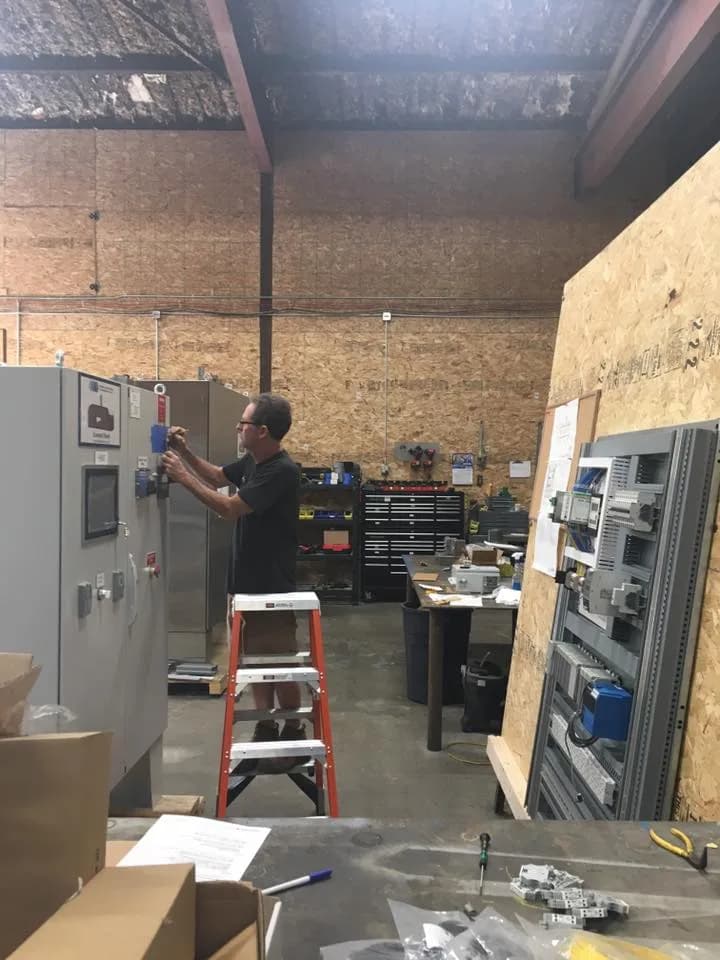
The FAT run should be long enough to expose drift. GetFRP's recommendation is at least one continuous eight-hour run at the target speed after stabilization, with speed, pull force, every zone temperature and saw cut length logged at a fixed interval, plus a controlled stop and restart and a simulated resin interruption. Inspect a sample at the start, middle and end of the run for dimensions, fiber content by burn-off, degree of cure and surface, and keep the material lot numbers. Strongwell's controls already trend pull speed and pull force, and Chinese digital lines log every line's parameters to SCADA, so asking for the data file is a normal request (company data) [S3] [S15].
Site acceptance repeats the critical checks after installation, on local power, with the buyer's operators. Define what counts as start-up scrap, a permitted interruption and a rejected meter before the run, and tie the final payment to the SAT, not to shipment.
| # | Test | Acceptance value to request | Basis |
|---|---|---|---|
| 1 | Sustained speed on the contracted profile | Target speed held for ≥ 8 h continuous after stabilization | GetFRP recommendation |
| 2 | Speed stability under load | ≤ 0.5% deviation across the logged run | Pultrex stated capability [S2] |
| 3 | Die zone temperature control | ±1 °C of set point per zone | Haoli catalog value [S5] |
| 4 | Pull force margin | Logged peak pull ≤ 70% of continuous rating at target speed | GetFRP recommendation; clamp force about 2× pull [S2] |
| 5 | Cut length | Tolerance as per drawing, measured on 20 consecutive cuts | GetFRP recommendation |
| 6 | Cure and fiber content | Degree of cure and burn-off fiber content within spec at start, middle and end | Cure varies 86–98% with die temperature [S12] |
| 7 | Stop, restart and resin interruption | Restart to stable speed without die lock-up | GetFRP recommendation |
| 8 | Data export | Time-stamped CSV of speed, pull, zone temperatures and alarms | Strongwell trend displays; SCADA practice [S3] [S15] |
| 9 | Electrical and safety | Panel label and test report to EN 60204-1 or NFPA 79 / UL 508A; guarded saw and interlocks | [S18] [S20] |
Source: Acceptance values combine published machine capabilities with GetFRP contracting recommendations; they are not OEM guarantees.
9. Dies, spare parts and service: the running cost of a pultrusion line
The die is the most product-specific and most expensive wear item. Strongwell builds dies from a range of steels finished with hard chrome plating or ion nitriding, and states that puller pads must be selected for each profile and are usually obtained together with new dies (company data) [S3]. The Sandia and ORNL model assumes one die per 300 km of product, a useful planning number to compare with a supplier's own die-life statement and re-chrome interval (company data) [S9]. China now has a national standard for plate pultrusion dies, GB/T 45755-2025, which gives buyers a reference for die requirements on spar-plate lines (official) [S17].
Plan the spares list by failure consequence. A worn clamp pad or a failed heater or thermocouple stops the line; a hydraulic seal or a servo drive can stop it for days if parts ship from overseas. Pultrex promotes its enclosed drive as keeping abrasive glass dust off moving parts, and Liberty and Strongwell fit water-cooled hydraulics on reciprocating machines, so dust exposure and oil cooling are maintenance items to cost (company data) [S2] [S3] [S4]. Ask for a two-year critical spares kit priced in the offer: heater platens, thermocouples and controllers for every zone, one set of clamp pads per profile, saw blades, hydraulic seal kits, proportional valves or servo drives, and PLC and HMI spares with software backups.
Service terms matter more than brochure claims. Specify response time, remote access to the PLC, availability of the original commissioning engineer, and whether process recipes and die drawings transfer to the buyer. Where the builder keeps the recipe, write down how process changes will be supported once production starts.
10. RFQ checklist for a pultrusion line
A comparable RFQ fixes the product, the line boundary and the acceptance basis, and leaves the builder to propose the machine. The table below lists the requirements GetFRP recommends stating, with values to request where published references exist. Send the profile drawing and the resin data sheet with the RFQ; without them every builder quotes a different machine.
Consistency note with the China pultrusion market report
GetFRP's China pultrusion report cites 0.5 to 1.5 m/min for open-bath lines, about 3 m/min with injection and 3 to 20 t pullers. The sources read for this report support the injection figure (2.9 m/min record, PU 2 to 3 m/min) and the 3 to 20 t range as Pultrex's standard classes, but the open-bath range appears in the CCIA explainer as 0.2 to 1.5 m/min rather than in the KraussMaffei white paper, and Chinese and US builders publish pullers up to 25 to 40 t. Read 3 to 20 t as the standard Western range, not the market limit.
| # | Requirement | Value or document to request |
|---|---|---|
| 1 | Product definition | Controlled drawing, largest envelope, wall thicknesses, reinforcement schedule and roving count |
| 2 | Resin system | Resin family and data sheet; open bath or injection box; metering ratio and accuracy for 2K systems |
| 3 | Puller | Continuous pull at target speed with ≥ 30% margin; clamp force about 2× pull; clamp length; speed stability ≤ 0.5% |
| 4 | Speed range | Minimum and maximum, and the sustained speed guaranteed on your profile |
| 5 | Die and heating | Die length (typically 0.6–1.2 m), zone count, kW per zone, ±1 °C control, die steel and plating |
| 6 | Streams | Number of profiles run simultaneously and whether each stream has independent heating |
| 7 | Creel and preforming | Doff count, carbon tensioning if used, mat and veil handling, preformer design responsibility |
| 8 | Cut-off | Flying saw type, wet or dry cut, extraction, cut-length tolerance |
| 9 | Controls and data | PLC brand, logged channels, export format, remote access, recipe ownership |
| 10 | Electrical | Voltage and frequency of the destination plant; CE declaration under (EU) 2023/1230 or NFPA 79 / UL 508A panel |
| 11 | Standards | JC/T 2362-2016 or JC/T 2580-2020 conformity for Chinese machines; GB/T 45755-2025 for plate dies |
| 12 | Acceptance | FAT protocol of Table 7 on the buyer's die and materials; SAT on site; payment tied to SAT |
| 13 | Spares and service | Two-year critical spares list with prices; response time; training days; drawings and software backups |
| 14 | Commercials | Incoterm, HS code 8477.80.01 and declared duty basis, payment schedule, warranty start at SAT |
Source: GetFRP procurement checklist built on the published references cited in sections 1 to 9.
Frequently asked questions
How much does a pultrusion machine cost?
It depends on scope. Hebei sellers list hydraulic pultrusion machine sets in a 3 to 25 tonne series at USD 8,000 to 30,000 per set depending on order quantity (November 2026). A complete Western line running two or three parallel profiles was modeled at USD 815,000 to 835,000 in a 2023 Sandia and ORNL study, with equipment above 90% of that. A Chinese 80-line digital plant disclosed RMB 60 million of total investment. Compare offers only on the same line boundary.
How much pulling force does my pultrusion machine need?
Choose by profile envelope first, then confirm on a trial die. Pultrex standard machines step from 3 tonnes (250 × 125 mm envelope) to 20 tonnes (1,000 × 350 mm), Strongwell reciprocating machines offer 5.4 to 9.1 tonnes per puller and up to 18.1 in tandem, and Chinese servo-hydraulic machines reach 40 tonnes. Keep the logged peak pull well below the continuous rating at your target speed; hotter dies and slower lines raise the force required.
What is the difference between a reciprocating and a caterpillar puller?
A reciprocating puller uses two clamp carriages working hand over hand and delivers its full rated force at every speed, which suits high-force profiles and frequent changeovers. A caterpillar uses two endless tracks that grip continuously; its available force falls as speed rises, and Strongwell positions it for lower forces and high-volume runs of one profile, including multi-cavity dies. Published caterpillar ratings run about 3 to 10 tonnes.
How fast does a pultrusion line run?
Conventional open-bath pultrusion runs about 0.2 to 1.5 m/min according to the China Composites Industry Association. A glass/epoxy wind plank was modeled at 1.27 m/min and carbon at 0.90 m/min in the ORNL cost model. Closed injection boxes are faster: KraussMaffei reached 2.9 m/min on flat glass profiles and Covestro quotes polyurethane at up to 2 to 3 m/min for a 3 mm wall.
How long is a pultrusion die and how many heating zones does it need?
Thermoset pultrusion dies are typically 0.6 to 1.2 m long (Strongwell quotes 61 to 122 cm). Pultrex machines come with two to eight heating zones as standard and up to 24 as an option; Covestro's reference polyurethane die is 1 m with three to six zones up to 230 °C; Chinese catalog machines use about 3 kW per zone with ±1 °C control.
How many tonnes can one pultrusion line produce per year?
Rebuild it from the section: streams × speed × minutes × uptime × yield × kg per meter. With the ORNL inputs for a 1.595 kg/m glass plank at 1.27 m/min, two streams, 80% uptime and 97% process yield, one line makes about 1,650 saleable tonnes a year, or about 2,480 t with three streams. A Chinese spar-plate plant's nameplate works out to 375 t per line-year.
What import duty applies to a Chinese pultrusion machine in the US?
Pultrusion machines are classified under HTS 8477.80.01 at 3.1% MFN. Chinese machines also pay 25% under Section 301 List 1 and the 12.5% country tariff in force since 24 July 2026, about 40.6% in total. The Section 301 exclusion headings run only through 9 November 2026 and do not cover pultrusion machines. Confirm the live rate with a customs broker.
Does a pultrusion machine from China need CE or UL certification?
For the EU it needs CE marking; from 20 January 2027 the declaration should cite Machinery Regulation (EU) 2023/1230 rather than Directive 2006/42/EC, with EN 60204-1 for the electrical equipment. For the US, OSHA requires approved electrical equipment and inspectors rely on NFPA 79; specify a UL 508A labeled panel and 460/480 V, 60 Hz components. Check that any certificate covers the quoted model and is still valid.
Sources and scope
Figures were cross-checked against primary documents where available; secondary citations are marked in each scope note. Company figures are reported as disclosed by the companies themselves. This note is an independent market assessment and not investment advice.
- [S1]KraussMaffei / Pultrex, More speed and efficiency in pultrusion: composite production on an industrial scale (white paper)
Pultrex machine reference table (Px250-3T to Px1000-20T: pull, clamp force, envelope, 0.04–5.0 m/min, 2–8 zones up to 24, 15–40 kVA); 3–20 t range; iBox doubling speed to 2.9 m/min (2017 award); KraussMaffei acquisition of Pultrex in 2019; 700+ lines, 3,000+ toolings; caterpillar vs gripper positioning. Company data; the table lists 103,000 kgf for the Px750-10T, read here as a typo for 10,000.
- [S2]Pultrex, The pultrusion process explained (process guide and machine features)
Process sequence; hand-over-hand reciprocating pullers; clamping force about 2× pull over 600 mm clamps, up to 11,000 kg per clamp unit; speed stability better than 0.5%; critique of hydraulic drives. Manufacturer claims.
- [S3]Strongwell, PULSTAR pultrusion machinery, equipment and services brochure
EX machine specifications (caterpillar and reciprocating pull, clamp, speed, weight); die lengths 61–122 cm and die finishes; creels; resin pans; 200+ machines in 25 countries; EX2408 accepts 95% of profiles. Company data, 2020 printing.
- [S4]Liberty Pultrusions, pultrusion machines and equipment
Pulforce machine table: 2.5–15 t (25 t option), 60–120 in/min, three-zone heater control, 460/480 V 60 Hz, water-cooled hydraulics. Company data.
- [S5]Nanjing Haoli Hydraulic Equipment, servo-hydraulic traction pultrusion machine (HL SYLJ series)
20/30/40 t pull, 0.05–1.2 m/min, clamping windows to 1,200 × 500 mm, 3 kW × 6–10 heating zones, 0–250 °C, ±1 °C, 13 MPa. Company data, translated.
- [S6]Nanjing Haoli Hydraulic Equipment, crawler traction pultrusion machine (HL LLJ series)
3/5/10 t crawler machines, 0.1–1 m/min, contact lengths 900–2,900 mm, 18–24 kW heating. Company data, translated.
- [S7]Qingdao Huameiyuan, pultrusion equipment (QDHMY-L10T)
Dual-output track machine: 2 × 50 kN pull, 2 × 80 kN clamp, 0.1–2.0 m/min, 130 × 100 mm, 23 kW, 415 V/50 Hz, 6,300 kg; dies with 16 zones of 3 kW. Company data.
- [S8]Hebei Aoliande Chemical Equipment, FRP pultrusion profile machine listing on Made-in-China
Tiered listing price USD 30,000 / 20,000 / 8,000 per set by quantity; ZLRCYZ 3–25 t table with speeds, heating kW and weights; Hengshui, Hebei. Company listing read 3 November 2026; not a transaction price.
- [S9]Ennis, Das and Norris, Economic competitiveness of pultruded fiber composites for wind turbine applications (Sandia/ORNL; OSTI full text of Composites Part B, 2023)
Table 1 inputs: 1.27 and 0.90 m/min, 20% downtime, 99.7%/97% yields, 2–3 streams, USD 815k/835k capital quoted from a major equipment supplier, die life 300 km, 44 kW, two operators per shift; yield-cost relation. Model inputs, not a market survey.
- [S10]Covestro, Fiberglass pultrusion profiles for window applications with polyurethane resins (white paper)
PU pultrusion equipment list (2K metering, closed injection box, 1 m die with 3–6 zones up to 230 °C, grippers or caterpillar); typical speed up to 2–3 m/min at 3 mm wall; potentially double other resins. Company data.
- [S11]China Composites Industry Association, explainer on the pultrusion process (translated)
Line speed 0.2–1.5 m/min; dies 0.6–1.2 m; three heating zones with 20–30 °C steps; polyester above 90% of resin. Association explainer, undated.
- [S12]Chaparala et al., Characterisation of curing of vinyl ester resin in an industrial pultrusion process: influence of die temperature, Polymers 15(18):3808 (2023)
0.5 m/min, 1 m four-zone die, 65% fiber volume; flexural strength 1,053 / 1,331 / 1,112 MPa at 100 / 120 / 140 °C; degree of cure 86.2% to 97.7%; earlier gelation raises pulling force. Peer-reviewed.
- [S13]Barkanov et al., Effectiveness and productivity improvement of conventional pultrusion processes, Polymers 14(4):841 (2022)
Simulation: optimized heater layout raises pull speed of a 20 cm/min industrial process 2.0–2.3×; microwave-assisted process 5.6× faster than an 18 cm/min reference with 1.7× lower energy per meter. Peer-reviewed numerical study.
- [S14]CompositesWorld, Radio frequency pultrusion preheater (Thermex-Thermatron TP12.5A), 17 January 2011
12.5 kW, 480 V RF preheater for non-conductive fiber/resin; vendor claim that line speeds can be doubled in most cases. Trade press reporting a company claim.
- [S15]Sina Finance, Zhongfu carbon-core cable company opens 30,000 t/yr digital spar-plate plant (23 July 2024)
80 digital pultrusion lines, 30,000 t/yr wind spar plates, nearly 400 lines and 100,000 t company-wide, speed above 1 m/min, SCADA data logging, RMB 60 million investment, August 2023 to June 2024. Company statements via press, translated.
- [S16]National Public Service Platform for Standards Information, industry standard filing database (query results for pultrusion machines and grating)
JC/T 2362-2016 hydraulic pultrusion machine (issued 11 Jul 2016, in force 1 Jan 2017); JC/T 2580-2020 crawler pultrusion machine (issued 9 Dec 2020, in force 1 Apr 2021); JC/T 490-2010 profile dimensional tolerances. Official registry; titles translated.
- [S17]SAMR national standards registry (openstd), search results for pultrusion standards
GB/T 45755-2025 pultrusion dies for FRP plates (issued 30 May 2025, in force 1 Dec 2025); GB/T 45006-2024; GB/T 31539-2015; GB/T 47972-2026. Official registry; titles translated.
- [S18]EU-OSHA, Regulation (EU) 2023/1230 on machinery (legislation summary, updated 16 January 2025)
Applies from 20 January 2027, replaces Directive 2006/42/EC; harmonized standards; digital instructions; third-party assessment for high-risk machinery. Official EU agency summary.
- [S19]OSHA, 29 CFR 1910.303 Electrical, general
Equipment acceptable only if approved (as defined in 1910.399); listed or labeled equipment installed per listing. Official regulation.
- [S20]Intertek, NFPA 79-2024 update, part 1 (7 October 2025)
NFPA 79 applies to machinery up to 1,000 V AC / 1,500 V DC; 2024 edition replaces 2021 and adds cybersecurity clause 4.10; US AHJs rely on it. Testing-laboratory summary, not the standard text.
- [S21]USITC, Harmonized Tariff Schedule of the United States 2026 revision 22, chapter 99
US note 20(b) lists 8477.80.01 under heading 9903.88.01 (Section 301 List 1, 25%); heading 9903.05.31 (12.5%, China) with the 24 July 2026 transition; exclusion headings 9903.88.69/.70 through 9 November 2026. Official schedule.
- [S22]USITC, HTS search result for subheading 8477.80.01
8477.80.01.00 Other machinery: general rate 3.1%. Official schedule data.
Image provenance and usage terms appear in each caption; see image credits. Submit a source correction.



