1. Vacuum infusion vs RTM: which process should you use?
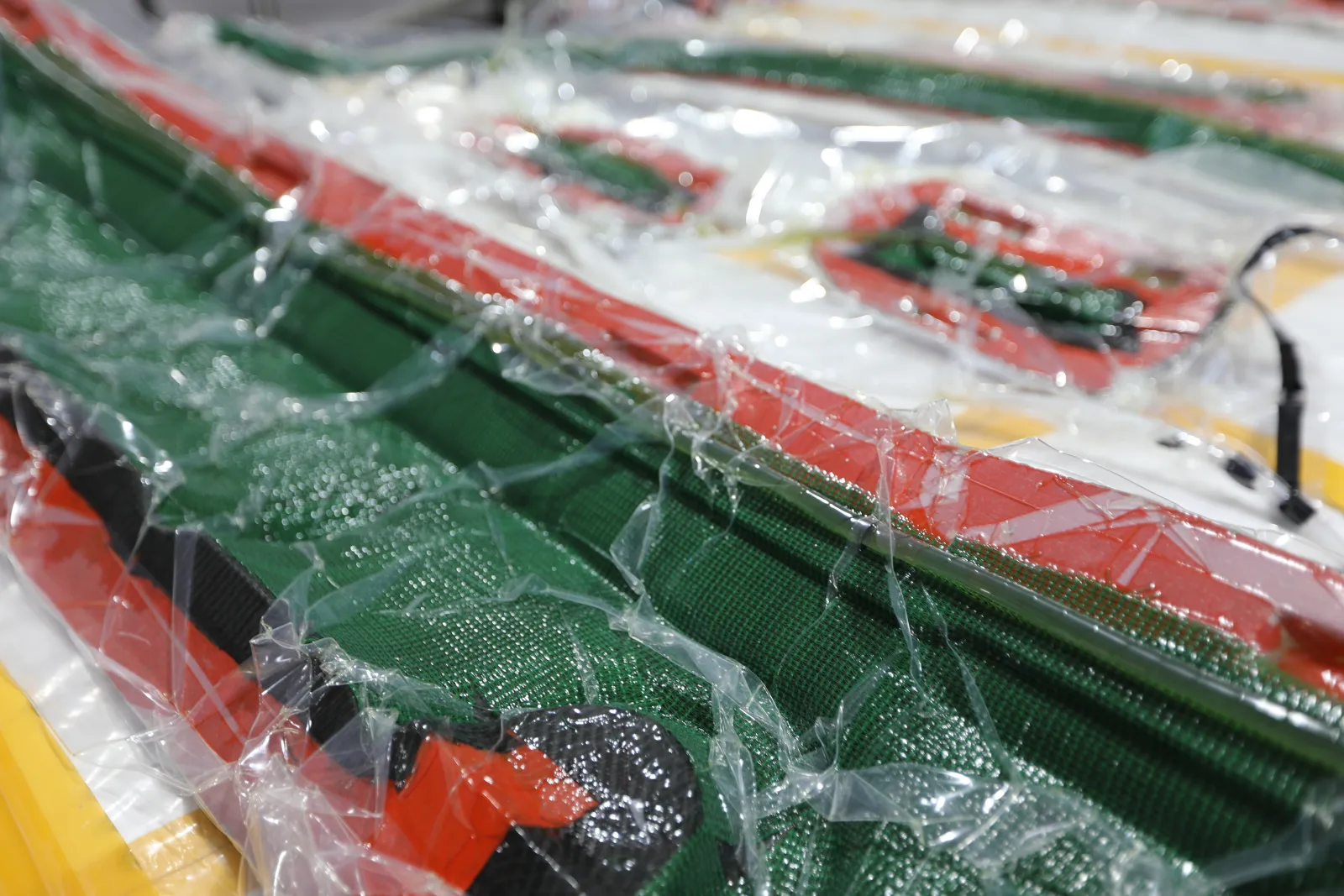
Both processes start from dry reinforcement and finish with a liquid resin that wets it in the mold, which is why AVK counts infusion inside its RTM segment [S42]. The difference is the boundary. In vacuum infusion the dry stack sits on a one-sided rigid mold under a sealed bag; resin and fiber compaction are both driven by pressures of 101.3 kPa or less [S8]. In RTM the preform is closed in a matched tool and resin is pumped in: about 10 to 20 bar for standard low-pressure RTM, up to 150 bar in the mixing head and 30 to 120 bar inside the mold for high-pressure RTM [S10]. Light RTM sits between them, with a semi-rigid counter-mold clamped by flange vacuum and injection held below 1 bar [S9].
That boundary sets everything a buyer cares about. Infusion makes one tool face, accepts enormous parts on cheap molds and is slow: the main molding cycle for a 100-meter-class offshore blade at Sinoma was cut to 48 hours in 2024 [S23]. RTM gives two tool faces and thickness set by the cavity, with standard cycles of 30 to 60 minutes [S10]; HP-RTM brings that to a realistic 3 to 7 minutes and has moved annual volumes from 1,000 to 4,000 parts a year two decades ago to 12,000 to 50,000 now [S10]. As a rule of thumb, infuse anything longer than a few meters or made in tens per year, use light RTM or RTM for hundreds to a few thousand parts with two good faces, and reserve HP-RTM for automotive volumes with a press budget to match.
↔ Scroll horizontally to see the full diagram.
| Attribute | Vacuum infusion (VARTM, SCRIMP) | Light RTM | Conventional RTM | HP-RTM | Source |
|---|---|---|---|---|---|
| Tool | One rigid mold plus bag | Rigid mold plus semi-rigid counter-mold, vacuum clamped | Matched rigid tool, clamped or pressed | Matched steel tool in a hydraulic press | [S8] [S9] [S10] |
| Resin pressure | ≤101.3 kPa | Injection below 1 bar; cavity vacuum 15 in Hg; flange vacuum at least 23 in Hg | 10–20 bar | Up to 150 bar at mix head; 30–120 bar in mold | [S8] [S9] [S10] |
| Finished faces | One | Two | Two | Two | [S9] |
| Fiber content | Vf about 57% (glass blade laminate); epoxy VARTM approaching 60% | About 30% glass by weight in typical parts | Not consistently published | Fiber weight up to 75% claimed | [S12] [S8] [S9] [S10] |
| Cycle time | Hours; 48 h main molding cycle for a 100 m blade | As little as 20 min; 4–6 parts per shift unheated, up to 20 heated | 30–60 min | 3–7 min realistic | [S23] [S16] [S9] [S10] |
| Typical volume | Units to hundreds per mold | Hundreds to low thousands | Thousands; 45,000/yr fan housings on multiple tools | 12,000–50,000 parts/yr | [S9] [S17] [S10] |
| Typical parts | Wind blades, hulls, decks, large panels | Covers, hoods, boat parts with two good faces | Housings, panels, structural parts | Automotive CFRP body and structure | [S43] [S9] [S17] [S19] |
Source: Technical papers, trade press and vendor data as cited; typical values, not guarantees.
2. How resin flows: Darcy's law and infusion fill time
Resin flow through a fiber bed follows Darcy's law: the flow rate rises with permeability and pressure gradient and falls with viscosity [S1]. For a one-dimensional front, integrating it gives a fill time t = φμL² / (2KΔP), where φ is porosity, or one minus fiber volume fraction, μ is viscosity, L is flow length, K is permeability and ΔP is pressure difference; the permeability benchmarks measure K exactly this way, by fitting the square of front position against time [S1]. The square on L is the key: doubling the flow length quadruples the fill time, while doubling the pressure only halves it.
Realistic inputs are now published. An international benchmark measured a carbon twill at about 1.4 × 10⁻¹⁰ m² in the principal direction at 45% fiber volume, with ±20% scatter between laboratories [S1]. For a 295 g/m² E-glass twill, benchmark-based values fall from 0.666 × 10⁻¹⁰ m² at 46.2% fiber volume to 0.434 × 10⁻¹⁰ at 50.3% and 0.285 × 10⁻¹⁰ at 53.4%, with transverse permeability five to six times lower [S2]. A DNV GL-approved infusion epoxy, SikaBiresin CR83, mixes at 155 to 170 mPa·s depending on hardener, with pot lives from 60 to 300 minutes [S3].
Putting those numbers into the formula shows why infusion relies on flow media. With 50.3% fiber volume glass, K = 0.434 × 10⁻¹⁰ m² and μ = 0.155 Pa·s, resin pushed through the laminate itself by a full atmosphere would take about 36 minutes to travel 0.5 m, 2.4 hours to travel 1 m and 9.7 hours to travel 2 m [estimate: Figure 2 inputs]. The fast hardener's 60-minute pot life is gone before the 1 m mark. Infusion beats this by spreading resin across the top in a high-permeability mesh or grooved core, the principle of the SCRIMP patent filed in 1989 [S14], so that the critical flow path becomes the laminate thickness rather than the part length. RTM beats it with pressure: at 10 bar the same 1 m path fills in about 15 minutes, and at 20 bar in about 7.4 minutes [estimate].
Two practical consequences follow. First, a larger vacuum pump cannot raise ΔP above one atmosphere; only shorter flow paths, more permeable media, lower viscosity or warmer resin speed up infusion. Second, permeability changes with compaction and with how fabric drapes into corners, so flat-panel fill trials do not prove a shaped part. Race-tracking along edges, where permeability is locally much higher, is the classic way a gate plan that works on paper leaves dry spots in practice [S33].
↔ Scroll horizontally to see the full chart and data table.
Source: GetFRP calculation, t = φμL²/(2KΔP), with permeability from Sousa, Lomov and Ivens [S2], viscosity from SikaBiresin CR83 [S3], infusion pressure limit from NASA [S8] and RTM pressures from CompositesWorld [S10]. Inputs: Vf = 50.3%, so φ = 0.497; K = 0.434 × 10⁻¹⁰ m² (E-glass twill); μ = 0.155 Pa·s (CR83 with CH83-2 hardener at room temperature); ΔP = 101.3 kPa, 1 MPa and 2 MPa. Isothermal, constant permeability, flow through the laminate only, no flow media. Real infusions are faster because mesh shortens the path; real RTM is faster when resin is heated.
View the chart data and evidence
| Series | Category | Value | Unit | Evidence / value basis | Reported range | Point note |
|---|---|---|---|---|---|---|
| Infusion, 1.013 bar | 0.25 m | 9.13 | minutes | GetFRP estimate | — | — |
| Infusion, 1.013 bar | 0.5 m | 36.5 | minutes | GetFRP estimate | — | — |
| Infusion, 1.013 bar | 1.0 m | 146.02 | minutes | GetFRP estimate | — | — |
| RTM, 10 bar | 0.25 m | 0.92 | minutes | GetFRP estimate | — | — |
| RTM, 10 bar | 0.5 m | 3.7 | minutes | GetFRP estimate | — | — |
| RTM, 10 bar | 1.0 m | 14.79 | minutes | GetFRP estimate | — | — |
| RTM, 20 bar | 0.25 m | 0.46 | minutes | GetFRP estimate | — | — |
| RTM, 20 bar | 0.5 m | 1.85 | minutes | GetFRP estimate | — | — |
| RTM, 20 bar | 1.0 m | 7.4 | minutes | GetFRP estimate | — | — |
3. Fiber volume fraction and void content by process
Pressure is what consolidates a laminate, so infusion sits below closed-mold and pultruded parts on fiber content. In a peer-reviewed ORNL and Sandia cost study, infused glass spar-cap laminate runs at a fiber volume fraction of 0.57, or 73% by mass, against 0.68 for a pultruded glass plank, and pultrusion gives a 17% higher design strength at constant fiber volume [S12]. An IACMI and ORNL analysis put carbon spar caps at 50% fiber volume by vacuum-assisted RTM against 58% pultruded [S13]. That gap is why most new blade spar caps moved to pultruded planks while the shells stayed infused.
Infusion is still a high-quality process when it is controlled. NASA's work on high-temperature VARTM reports epoxy laminates approaching 60% fiber volume and void contents below 3% on biaxial carbon and below 2% on uniweave, against the less-than-2% voids desired for aerospace, measured by acid digestion to ASTM D3171 and micrographs [S8]. The original SCRIMP patent reports panels averaging 26.1% resin by weight [S14]. For HP-RTM, fiber weights up to 75% have been claimed, while structural reaction injection molding typically stays at up to 30% by weight [S10]; light RTM parts commonly carry about 30% glass by weight [S9].
Voids are the number to put in the contract. In wind-blade laminates, each 1% increase in interlaminar voids is reported to reduce mechanical properties by about 7% [S33]. A 2024 DTU study of vacuum infusion at inlet pressures of 283, 533 and 1,013 mbar found the slowest, lowest-pressure infusions produced the fewest voids [S34], a reminder that filling fast is not the same as filling well.
↔ Scroll horizontally to see the full chart and data table.
Source: Ennis, Das and Norris, ORNL [S12]; IACMI and ORNL [S13]. Model inputs from two separate studies; compare within each study, not across them.
View the chart data and evidence
| Series | Category | Value | Unit | Evidence / value basis | Reported range | Point note |
|---|---|---|---|---|---|---|
| — | Glass, vacuum infusion (ORNL) | 57 | % | Statistic | — | — |
| — | Glass, pultruded plank (ORNL) | 68 | % | Statistic | — | — |
| — | Carbon, VARTM (IACMI) | 50 | % | Statistic | — | — |
| — | Carbon, pultruded (IACMI) | 58 | % | Statistic | — | — |
| Process and context | Fiber content | Voids | Source |
|---|---|---|---|
| Vacuum infusion, glass blade spar cap | Vf 57% (73% by mass) | Not stated | [S12] |
| VARTM, carbon spar cap | Vf 50% | Not stated | [S13] |
| High-temperature VARTM, aerospace epoxy | Vf approaching 60% | Below 3% biaxial; below 2% uniweave; target below 2% | [S8] |
| SCRIMP patent example panels | 26.1% resin by weight | Not stated | [S14] |
| Light RTM, typical parts | About 30% glass by weight | Not stated | [S9] |
| HP-RTM, automotive | Fiber weight up to 75% (claimed) | Not stated | [S10] |
| Pultruded plank, for comparison | Vf 68% glass; 58% carbon | Not stated | [S12] [S13] |
Source: Values are from different studies, fibers and test methods; use them to set expectations, then specify your own limits.
4. Cycle time and production rate
Cycle time spans three orders of magnitude across this family. At the slow end, Sinoma Blade cut the main molding cycle of its SI122 100-meter-class offshore blade to 48 hours in 2024, and reported 44% shorter production cycles and 76% more output per mold across its plants that year [S23]. Hours-long cures are normal for infusion epoxies: CR83 is specified at 8 hours at 70 °C [S3].
Closed molds are faster but not always fast. Light RTM can cycle in as little as 20 minutes [S16]; a vendor puts unheated light RTM at 4 to 6 parts per shift against 10 to 12 for unheated RTM, and up to 20 with heated molds [S9]. Conventional RTM runs 30 to 60 minutes, falling to 5 minutes only for very small parts [S10]; a US molder made 45,000 RTM fan housings a year at 30 to 45 minute cycles by running many composite tools in parallel [S17]. HP-RTM parts are realistically produced in 3 to 7 minutes [S10], and Fraunhofer ICT notes that 50,000 to 80,000 parts per line per year require a cycle of 3 minutes or less [S11].
For capacity planning, multiply tools rather than speed. A single heated light RTM mold at 20 parts per shift delivers about 5,000 parts per year on one shift over 250 working days [estimate: 20 × 250]; an HP-RTM line at 3 minutes and the same 250 days of 24 hours delivers about 120,000 shots, which is why the Fraunhofer figure assumes real-world downtime [estimate: 250 × 24 × 20]. Ask suppliers for demonstrated cycle and uptime on a comparable part, not the resin datasheet's gel time.
↔ Scroll horizontally to see the full chart and data table.
Source: Fraunhofer ICT [S11]; CompositesWorld [S10] [S19] [S16] [S17]. Upper ends of reported ranges, except light RTM (minimum quoted) and Fraunhofer (166 s measured). A 100 m infused blade's 48-hour main molding cycle [S23] is off this scale.
View the chart data and evidence
| Series | Category | Value | Unit | Evidence / value basis | Reported range | Point note |
|---|---|---|---|---|---|---|
| — | HP-RTM, Fraunhofer ICT demonstrator | 2.8 | minutes | Media report | — | — |
| — | HP-RTM, realistic production | 7 | minutes | Media report | — | — |
| — | HP-RTM, BMW i3 cure | 10 | minutes | Media report | — | — |
| — | Light RTM, minimum | 20 | minutes | Media report | — | — |
| — | RTM fan housings, VEC process | 45 | minutes | Media report | — | — |
| — | Conventional RTM | 60 | minutes | Media report | — | — |
5. Process variants: light RTM, HP-RTM, compression RTM, SCRIMP and VARTM
SCRIMP and VARTM are the infusion branch. William Seemann's SCRIMP patent, filed in March 1989 and granted in February 1990, put a resin distribution medium on the laminate so that resin spreads over the surface and then soaks through the thickness [S14]; NASA describes VARTM as resin injection and fiber compaction both achieved at 101.3 kPa or less [S8]. Wind blades are made by vacuum-assisted resin transfer molding in this sense [S12].
Light RTM keeps the low pressure but adds a second face. The semi-rigid counter-mold is clamped by a flange channel held at at least 23 in Hg, the cavity is held at about 15 in Hg, and injection stays below 1 bar, so the molds are simpler and cheaper because they do not have to contain high cavity pressure [S9] [S16]. Conventional RTM adds an injection machine and clamping for 10 to 20 bar [S10].
HP-RTM and compression RTM are the automotive branch. HP-RTM meters reactive epoxy or polyurethane through a high-pressure mixing head and injects it into a preform in a hot steel tool [S10]. In compression RTM the tool is left slightly open during injection and then closed: a Fraunhofer pressure-controlled variant with a fixed 0.3 mm gap held cavity pressure at a 30 bar limit and needed 75% less press force than injection RTM [S11], and a GM and ESI simulation found unrestricted injection peaking at 237 bar while a fast resin cut cost per part from USD 160 to USD 60 [S15]. Wet compression molding, used with HP-RTM in the BMW 7 Series Carbon Core, skips the preform and presses resin-wetted fabric stacks [S20].
↔ Scroll horizontally to see the full diagram.
| Variant | Pressure | Tooling | Resin | Where it fits | Source |
|---|---|---|---|---|---|
| VARTM / SCRIMP infusion | ≤101.3 kPa | One mold, bag, flow medium | Low-viscosity epoxy, polyester, vinyl ester | Blades, hulls, very large parts | [S8] [S14] |
| Light RTM | Below 1 bar injection; vacuum clamp | GFRP mold and semi-rigid counter-mold | Polyester, vinyl ester, epoxy | Two-faced panels, low volume | [S9] [S16] |
| Low-pressure RTM | 10–20 bar | Matched composite, nickel-shell or steel tool | Polyester, epoxy | Medium volume, 30–60 min cycles | [S10] [S17] |
| HP-RTM | 30–120 bar cavity; up to 150 bar mix head | Steel tool in hydraulic press | Snap-cure epoxy or PU, 50–200 cP | Automotive, 12,000–50,000 parts/yr | [S10] |
| Compression RTM | Can be capped near 30 bar | Steel tool with controlled gap | Fast-cure epoxy | Large thin automotive parts | [S11] [S15] |
| Wet compression molding | Press-defined | Steel tool, no preform | Fast epoxy | Simpler-shaped automotive parts | [S20] |
Source: As cited.
6. Infusion and RTM resins: viscosity, pot life and cure
Infusion needs low viscosity and long pot life; HP-RTM needs low viscosity and very fast cure. HP-RTM practitioners recommend 50 to 200 cP at injection [S10]. Hexion's EPIKOTE MGS RIMR 135 infusion resin is 700 to 1,100 mPa·s alone and is mixed 100:30 with hardeners of 10 to 80 mPa·s; heating takes the mix down to about 150 mPa·s, with pot lives from about 0.5 to 4 hours depending on hardener [S4]. SikaBiresin CR83 mixes at 155 to 170 mPa·s, gives 60 to 300 minutes of pot life, cures 8 hours at 70 °C and reaches a Tg of 80 to 84 °C [S3]. Vinyl ester for RTM, such as DERAKANE 8084, runs at 360 mPa·s with a Tg of 115 °C [S5].
At the fast end, Dow launched VORAFORCE 5300 for HP-RTM at an extremely low 15 mPa·s with cure under 90 seconds and about 60 seconds possible [S6]; Olin now sells it as LITESTONE VF4530 and VF4535, alongside LITESTONE infusion systems with a Tg around 80 °C [S7]. BMW's i3 used Huntsman Araldite LY 3585 with hardener XB 3458, curable in as little as five minutes at 100 °C [S19].
Two listed Chinese formulators show the scale of the domestic resin base. Shanghai Swancor Advanced Materials, which trades as Shangwei, makes infusion, hand lay-up and mold resins, adhesives and spar-cap pultrusion resin; it reported revenue of RMB 1.797 billion in 2025, up 20.3%, and acknowledges a gap to Olin globally [S28]. Kangda New Materials sold nearly 90,000 t of wind epoxy structural adhesive, infusion resin and related products in 2024 [S29]. Zhuzhou Times New Material's average purchase price for wind-blade raw materials was RMB 26,981/t in 2024, RMB 30,379/t in 2025 and RMB 32,171/t for January to September 2026 [S25] [S26] [S27]. That is a blended materials basket, not an epoxy price, but it shows the 2025–2026 cost direction.
↔ Scroll horizontally to see the full chart and data table.
Source: Dow via CompositesWorld [S6]; Hexion [S4]; Sika [S3]; CompositesWorld [S10]; INEOS [S5]. Measured at different temperatures: VORAFORCE at processing temperature, Hexion after heating, Sika and INEOS at 25 °C. Use the datasheet curve at your mold temperature.
View the chart data and evidence
| Series | Category | Value | Unit | Evidence / value basis | Reported range | Point note |
|---|---|---|---|---|---|---|
| — | Dow VORAFORCE 5300 (HP-RTM) | 15 | mPa·s | Company data | — | — |
| — | Hexion RIMR 135 mix, heated | 150 | mPa·s | Company data | — | — |
| — | SikaBiresin CR83 with CH83-2 | 155 | mPa·s | Company data | — | — |
| — | SikaBiresin CR83 with CH83-6 | 170 | mPa·s | Company data | — | — |
| — | HP-RTM guideline, upper end | 200 | mPa·s | Company data | — | — |
| — | INEOS DERAKANE 8084 vinyl ester | 360 | mPa·s | Company data | — | — |
| System | Use | Viscosity | Pot life or cure | Tg | Source |
|---|---|---|---|---|---|
| SikaBiresin CR83 + CH83-2/-6/-10 | Vacuum infusion; DNV GL approved | Resin 610; mixed 155–170 mPa·s | Pot life 60/180/300 min; 8 h at 70 °C | 80–84 °C | [S3] |
| Hexion EPIKOTE MGS RIMR 135 + RIMH 134–137 | Infusion, wind and marine | Resin 700–1,100; about 150 mPa·s mixed when heated | About 0.5–4 h pot life | Not on TDS read | [S4] |
| INEOS DERAKANE 8084 | Elastomer-modified vinyl ester; RTM, hand lay-up | 360 mPa·s at 25 °C | Promoted to suit | 115 °C | [S5] |
| Dow VORAFORCE 5300 (now Olin LITESTONE VF4530/VF4535) | HP-RTM | 15 mPa·s | Cure under 90 s; about 60 s possible | About 140 °C class | [S6] [S7] |
| Huntsman Araldite LY 3585 / XB 3458 | HP-RTM, BMW i3 | Not stated in source | As little as 5 min at 100 °C | Not stated | [S19] |
Source: Manufacturer datasheets and trade press as cited.
7. Tooling cost and the volume break-even between infusion and RTM
Tooling is where the processes really separate, and published numbers are scarce enough that every one counts. For light RTM, one US vendor estimates a car-hood mold at about USD 140 to 210 per square foot, excluding the master pattern [S9], or roughly USD 1,500 to 2,260 per square meter [estimate: × 10.764]. Composite RTM mold skins last 2,000 to 6,000 cycles and cost about one quarter to one half of steel or nickel-shell RTM tooling, while nickel shell or steel is chosen for higher volumes of 50,000 and more [S17]. Sinoma depreciates its wind-blade molds by usage over 400 pieces [S47], which gives a useful benchmark for infusion mold life in blade service.
HP-RTM adds a press. BMW's Leipzig i3 line used seven 3,000-ton Schuler presses, each with two KraussMaffei injection units [S19]; the UK National Composites Centre installed a 36,000 kN Schuler press with a 3.6 × 2.4 m bed for HP-RTM development [S21]; and China's PGTEX ordered a 3,600-ton Schuler press with Hennecke dosing for HP-RTM and wet compression molding of electric-SUV body parts [S22]. HP-RTM still cut BMW's manufacturing cost for CFRP body components by about 50% compared with its earlier roof production [S10].
There is no peer-reviewed infusion-versus-RTM break-even volume, because the answer depends on part size, faces and labor. What the sources do support is a set of volume bands. Infusion and composite light RTM tools fit units to a few thousand parts, consistent with blade molds rated for about 400 pieces [S47] and composite RTM skins for 2,000 to 6,000 cycles [S17]. Metal RTM tools start to make sense toward 50,000 parts [S17], and HP-RTM targets 12,000 to 50,000 parts a year per line [S10]. To find your own break-even, ask each bidder for tool cost, tool life in cycles, cycle time and labor minutes per part on the same drawing; break-even quantity is the tooling difference divided by the per-part cost difference.
| Item | Value | Date | Evidence | Source |
|---|---|---|---|---|
| Light RTM mold, car hood | USD 140–210 per ft² (about USD 1,500–2,260 per m²) | Undated vendor page, read Nov 2026 | company | [S9] |
| Composite RTM mold skin life | 2,000–6,000 cycles | 2007 | media | [S17] |
| Composite vs steel or nickel-shell RTM tool cost | About 1/4 to 1/2 | 2007 | media | [S17] |
| Volume for nickel-shell or steel RTM tools | 50,000 parts and more | 2007 | media | [S17] |
| Wind-blade mold depreciation | By usage over 400 pieces | FY2024 | company | [S47] |
| HP-RTM presses, BMW Leipzig | Seven 3,000-ton presses, two injection units each | 2014 | media | [S19] |
| HP-RTM press, PGTEX China | 3,600 t with Hennecke dosing | Shipping early 2019 | media | [S22] |
Source: No dated RMB price range for Chinese infusion or RTM tooling was found in a primary source; request itemized tool quotations.
8. Wind blades: the largest infusion application and China's blade makers
Wind blades are by far the largest use of vacuum infusion. The world installed 117 GW of wind in 2024, 109 GW onshore and 8 GW offshore, and China added 79.8 GW of it [S31]. A peer-reviewed bill-of-materials study found that a single 20 t blade for a 4 MW onshore turbine uses 13.4 t of glass fabric and 7.2 t of epoxy, and a single 55 t blade for a 12 MW offshore turbine 37.4 t of glass fabric and 20.0 t of epoxy, with about 10% material loss [S32]. For a three-blade rotor that is about 9.3 to 10.0 t of glass fabric and 5.0 to 5.4 t of epoxy per megawatt [estimate: 3 × 37.373 ÷ 12 and 3 × 13.386 ÷ 4; 3 × 19.986 ÷ 12 and 3 × 7.155 ÷ 4].
Chinese blade makers dominate the volume. Sinoma Wind Power Blade, a subsidiary of Sinoma Science and Technology, sold 24 GW of blades in 2024 and 36.2 GW in 2025, up 51%, with blade revenue of RMB 12.59 billion and net profit attributable of RMB 0.62 billion; it describes its market share as first in the world, runs 15 Chinese plants and one in Brazil, and offers blades from 31 to 147 m for 6 to 20 MW-plus turbines [S23] [S24]. Zhuzhou Times New Material sold 21.09 GW in 2024 for RMB 8.20 billion, 31.79 GW in 2025 for RMB 10.27 billion, and 22.21 GW in the first nine months of 2026 for RMB 7.38 billion [S25] [S26] [S27]. Both list glass and carbon fiber, balsa, PET or PVC core and epoxy as the main materials [S24].
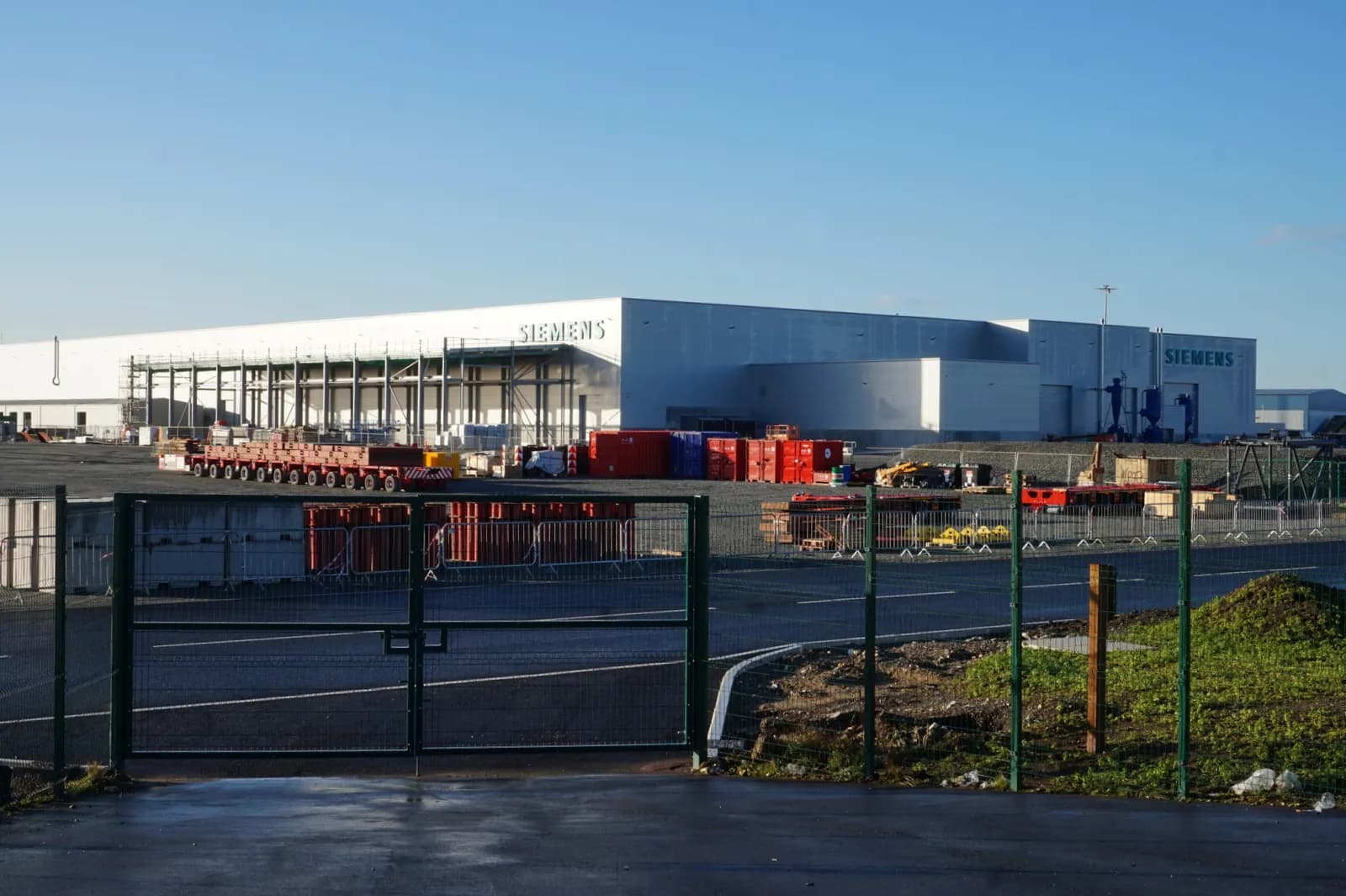
Outside China the picture is thinner. TPI Composites, the US independent blade maker, filed for Chapter 11 in August 2025 with up to USD 27.5 million of new debtor-in-possession money [S44] and emerged under new ownership in July 2026 [S45]. Siemens Gamesa still molds 75 m offshore blades in one piece at Hull, 450 a year at capacity [S43]. For buyers of infused parts other than blades, the blade industry matters because it sets the price and availability of multiaxial glass fabric, infusion epoxy, core and consumables in China.
↔ Scroll horizontally to see the full chart and data table.
Source: Sinoma Science and Technology annual report summaries [S23] [S24]; Zhuzhou Times New Material operating data announcements [S25] [S26]. Company-reported blade sales in GW of turbine capacity. Times New Material sold a further 22.21 GW in January to September 2026 [S27]. The two series are company totals and are not summed.
View the chart data and evidence
| Series | Category | Value | Unit | Evidence / value basis | Reported range | Point note |
|---|---|---|---|---|---|---|
| Sinoma Wind Power Blade | 2024 | 24 | GW | Company data | — | — |
| Sinoma Wind Power Blade | 2025 | 36.2 | GW | Company data | — | — |
| Zhuzhou Times New Material | 2024 | 21.09 | GW | Company data | — | — |
| Zhuzhou Times New Material | 2025 | 31.79 | GW | Company data | — | — |
9. Automotive HP-RTM: what BMW proved and where China stands
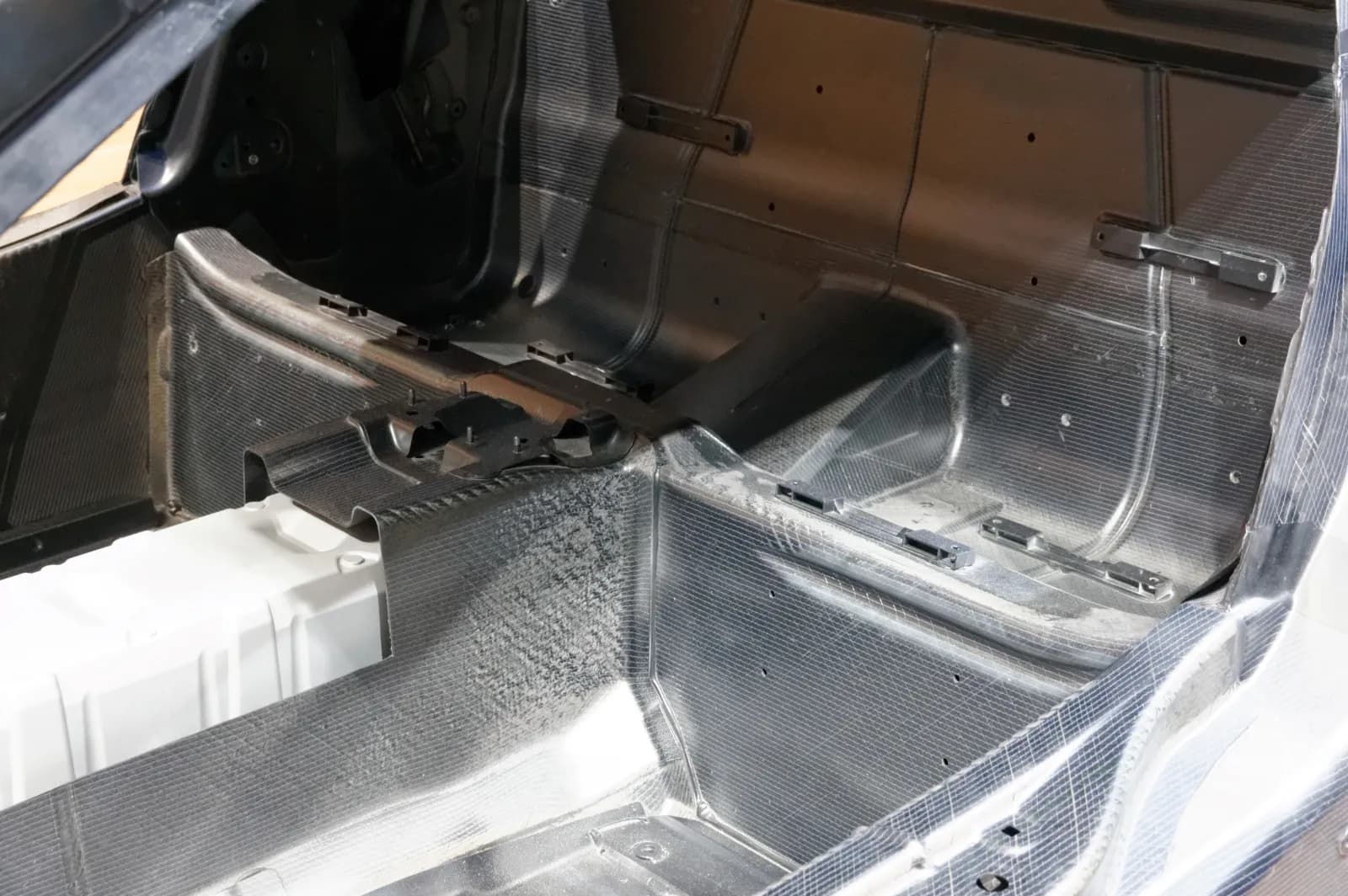
BMW's i3 remains the reference case for HP-RTM in series production. Each Life Module was built from 39 stacked fabric kits, formed into 49 preforms and molded into 16 HP-RTM parts; resin was injected at more than 40 bar and cured in under 10 minutes, in seven 3,000-ton Schuler presses, while about 100 cars a day left the Leipzig plant [S19]. KraussMaffei supplied 20 HP-RTM machines for BMW's Leipzig and Landshut plants [S18]. The later 7 Series Carbon Core combined HP-RTM, wet compression and other methods to make 16 CFRP parts, about 4,000 parts a day [S20].
China's HP-RTM base is smaller and newer. PGTEX, better known as a glass-fabric weaver, ordered a 3,600-ton Schuler press with Hennecke dosing for HP-RTM and wet compression molding of electric-SUV body parts [S22]. The same company appears in the EU fabric anti-dumping regulation at 37.6% [S48], which illustrates how Chinese fabric makers are integrating forward into parts. Buyers evaluating Chinese HP-RTM capacity should ask for the press tonnage, bed size, dosing equipment make, preform cell and demonstrated cycle on a comparable part.
10. Standards, Chinese supply base and trade measures
Laminate acceptance uses common test standards on both sides. Void content is measured to ASTM D2734-23 [S39] or, for carbon laminates in China, GB/T 3365-2008, which covers void content and fiber volume of carbon-fiber-reinforced plastics and, by reference, glass and aramid [S36]. Resin content of glass laminates by burn-off is GB/T 2577-2005 [S37], and density is GB/T 1463-2005, to be replaced by a 2026 edition from 1 December 2026 [S38]. Blades are designed and certified to IEC 61400-5:2020 [S40], DNV-ST-0376, edition April 2024 [S41], and in China GB/T 25383-2025, in force since 1 December 2025 [S35].
The Chinese supply base for infusion is deep. China produced 8.43 Mt of glass fiber in 2025, and China Jushi alone sold 3.20 Mt of roving and products [S30]; Taishan Fiberglass has more than 1.7 Mt of capacity including high-modulus yarn and multiaxial warp-knitted fabrics for blades [S24]. Swancor and Kangda supply epoxy infusion resins and adhesives [S28] [S29]. AVK puts European RTM and infusion output at 109 kt in 2025, down 3.5% [S42], while applying the per-megawatt ratios in Section 8 to China's 79.8 GW of 2024 wind additions implies roughly 0.74 to 0.80 Mt of glass fabric for blades alone [estimate: 79,824 MW × 9.3–10.0 t/MW], an upper bound because pultruded spar caps replace part of the fabric.
Trade measures bite hardest on fabric. The EU's June 2026 expiry review kept anti-dumping duties on woven and stitched glass-fiber fabrics from China at 69.0% for Jushi, Hengshi and Taishan and for all other companies, 37.6% for PGTEX and Chongqing Tenways, and 34.0% for Jiangsu Jiuding, covering CN 7019 61 to 7019 66 and extending to imports consigned from Morocco and Turkey and to offshore installations [S48]. In the United States most woven and stitched glass fabric lines in HTS 7019.61 to 7019.66 are on Section 301 List 3 at an additional 25% [S46]. Finished infused parts and blades fall under different headings, so check the classification of the finished article before assuming the fabric duty applies.
| Standard | Title or scope | Status | Use |
|---|---|---|---|
| ASTM D2734-23 | Void content of reinforced plastics | Current edition | Void acceptance |
| ASTM D3171 | Constituent content of composites (acid digestion) | Used by NASA for VARTM void and fiber checks | Fiber volume and voids |
| GB/T 3365-2008 | Carbon fiber reinforced plastics, void content and fiber volume content | In force since 1 Apr 2009 | Chinese void and Vf test |
| GB/T 2577-2005 | Resin content of glass fiber reinforced plastics | In force | Burn-off resin and glass content |
| GB/T 1463-2005 | Density and relative density of FRP | Replaced by GB/T 1463-2026 from 1 Dec 2026 | Density |
| GB/T 25383-2025 | Wind energy generation systems, wind turbine blades | Issued 30 May 2025; in force 1 Dec 2025 | Chinese blade standard |
| IEC 61400-5:2020 | Wind turbine blades | Edition 1, June 2020 | International blade design and manufacture |
| DNV-ST-0376 | Rotor blades for wind turbines | Edition April 2024 | Certification basis |
11. Infusion and RTM defects: dry spots, race-tracking and voids
Dry spots are the signature defect of liquid molding. In blades they come from race-tracking, where resin runs ahead along a high-permeability edge or gap and encircles an unfilled region, or from bottlenecking at thick sections [S33]. The same study measured 12 to 20% thickness variation across an infused blade section and found that fiber waves cut failure stress to about 74 to 77% of a flat laminate [S33]. RTM adds tool-specific risks: preform edges that do not fit the cavity race resin around the perimeter, and vents that are not at the last point to fill trap air.
Inspection has to match the risk. Visual inspection catches surface dry spots and wrinkles; ultrasonic testing, X-ray and acoustic emission find internal defects [S33]; acid digestion, burn-off and micrographs measure fiber and void content on witness panels or cut-outs [S8] [S37]. Set void and fiber limits in the purchase specification, for example voids below 2% where structural performance matters, the level NASA treats as desirable for aerospace [S8], and require the supplier to show where the witness coupons are taken.
| Defect | Typical cause | Check | Acceptance to agree |
|---|---|---|---|
| Dry spots | Race-tracking, bottlenecking, leaks, short pot life | Visual, tap test, ultrasonic | No dry areas; repair procedure defined |
| Voids and porosity | Air leaks, fast fill, volatiles, low compaction | ASTM D2734, GB/T 3365, micrographs | Void limit, for example below 2% |
| Fiber waviness and wrinkles | Ply bridging, compaction, preform handling | Visual, ultrasonic, sectioning | Wave height-to-length limit in critical zones |
| Thickness variation and resin-rich areas | Bag compaction (infusion), preform fit (RTM) | Thickness mapping, burn-off | Thickness tolerance; Vf range by burn-off or digestion |
| Undercure | Low mold temperature, wrong mix ratio | DSC or Tg on witness coupon | Tg minimum per resin datasheet |
12. RFQ checklist for infused and RTM parts
An RFQ for liquid-molded parts should fix the laminate and the evidence, and let the supplier propose the gate plan. Ask for process data that can be checked on the first article, and for the same documents from every bidder so that infusion and RTM offers can be compared on cost per accepted part.
- 1. Process and tool: infusion, light RTM, RTM or HP-RTM; number of finished faces; tool material (GFRP, aluminum, nickel shell, steel); tool life in cycles; tool ownership.
- 2. Laminate: fabric types and areal weights, ply schedule, core type and grooving, target fiber volume fraction (for example 50–57% for infused glass) with tolerance.
- 3. Resin: system name and hardener, mixed viscosity at process temperature (for example 150–200 mPa·s), pot life versus planned fill time, cure cycle and Tg, DNV or other approval if required.
- 4. Fill plan: inlet and vent locations, flow media, planned fill time, vacuum level and leak-rate check (for infusion), injection pressure and clamping (for RTM).
- 5. Quality limits: voids below an agreed level (for example 2%) to ASTM D2734 or GB/T 3365; fiber or resin content by burn-off (GB/T 2577) or acid digestion (ASTM D3171); thickness tolerance; no dry spots.
- 6. NDT: ultrasonic or tap testing coverage, witness-panel locations, Tg on witness coupons.
- 7. Capacity: demonstrated cycle time and molds available for the part family; for HP-RTM, press tonnage, bed size and dosing equipment.
- 8. Standards: IEC 61400-5, DNV-ST-0376 or GB/T 25383-2025 for blade work; customer specification otherwise.
- 9. Trade: HS code for the finished part, EU anti-dumping exposure if fabric is imported separately (34.0–69.0% on Chinese glass fabrics), US Section 301 status.
- 10. First article: full dimensional report, sectioned coupon, fill video or log, batch records for resin and fabric.
Frequently asked questions
What is the difference between vacuum infusion and RTM?
Vacuum infusion uses a one-sided mold and a sealed bag, and atmospheric pressure of at most 101.3 kPa both compacts the dry fabric and drives the resin. RTM closes the preform in a matched tool and injects resin, at about 10–20 bar for standard RTM and 30–120 bar in the cavity for HP-RTM. Infusion gives one finished face and suits very large parts; RTM gives two faces and much shorter cycles.
Which gives higher fiber volume fraction, infusion or RTM?
Closed-mold and pressed processes generally compact more. Infused glass spar-cap laminate runs at about 57% fiber volume against 68% for a pultruded plank, and carbon VARTM spar caps at 50% against 58% pultruded. Controlled aerospace VARTM can approach 60% fiber volume with voids below 2–3%, and HP-RTM parts have been claimed at up to 75% fiber by weight.
How long does vacuum infusion take compared with RTM?
Infusion is measured in hours: Sinoma's 100-meter-class blade has a main molding cycle of 48 hours, and a typical infusion epoxy cures 8 hours at 70 °C. Light RTM can cycle in about 20 minutes, conventional RTM in 30–60 minutes, and HP-RTM in a realistic 3–7 minutes.
What is light RTM?
Light RTM, or RTM Light, closes a rigid mold with a thin semi-rigid counter-mold clamped by flange vacuum of at least 23 in Hg, holds the cavity at about 15 in Hg and injects resin below 1 bar. It gives two finished faces without a press; a vendor estimates molds at about USD 140–210 per square foot and output of 4–6 parts per shift unheated or up to 20 heated.
What resin viscosity is needed for infusion and RTM?
Infusion epoxies typically mix at about 150–200 mPa·s, for example SikaBiresin CR83 at 155–170 mPa·s with 60–300 minutes of pot life. HP-RTM practitioners recommend 50–200 cP at injection, and snap-cure HP-RTM epoxies run as low as 15 mPa·s with cures of about 60–90 seconds.
Why is vacuum infusion used for wind turbine blades?
Blades are up to 147 m long and made in hundreds per mold, so a one-sided mold under a bag is the only economic route. Sinoma Blade sold 36.2 GW of blades in 2025 and Zhuzhou Times New Material 31.79 GW, both by infusion of glass and carbon fabrics with epoxy. Spar caps have largely moved to pultruded planks for higher fiber content, while shells stay infused.
When does RTM become cheaper than vacuum infusion?
There is no published universal break-even. Composite RTM tools last 2,000–6,000 cycles at a quarter to a half of steel tool cost, steel or nickel-shell tools suit 50,000 parts and more, and HP-RTM lines target 12,000–50,000 parts a year. Compute your own break-even as the tooling difference divided by the per-part cost difference, using itemized bids on the same drawing.
Are there duties on glass fabrics for infusion imported from China?
Yes. The EU applies anti-dumping duties of 69.0% to Jushi, Hengshi and Taishan fabrics and to non-cooperating Chinese makers, 37.6% to PGTEX and other cooperating companies and 34.0% to Jiangsu Jiuding, under a June 2026 expiry review. In the US most woven and stitched glass fabric lines are on Section 301 List 3 at an additional 25%.
Sources and scope
Figures were cross-checked against primary documents where available; secondary citations are marked in each scope note. Company figures are reported as disclosed by the companies themselves. This note is an independent market assessment and not investment advice.
- [S1]Vernet et al., Experimental determination of the permeability of engineering textiles: Benchmark II, Composites Part A 61:172–184 (2014)
Peer-reviewed: Darcy formulation and squared-flow-front method; carbon twill K1 about 1.4 × 10⁻¹⁰ m² at about 45% Vf with ±20% scatter.
- [S2]Sousa, Lomov and Ivens, permeability of a glass fabric from radial benchmark data, Frontiers in Materials (2022), DOI 10.3389/fmats.2022.871235
Peer-reviewed: 295 g/m² E-glass twill K1 0.666, 0.434 and 0.285 × 10⁻¹⁰ m² at 46.2, 50.3 and 53.4% Vf; K2 values. Used as the Figure 2 permeability input.
- [S3]Sika, SikaBiresin CR83 product data sheet (July 2025)
Infusion epoxy: resin 610 mPa·s, mixed 155–170 mPa·s, pot life 60–300 min, cure 8 h at 70 °C, Tg 80–84 °C, DNV GL approval.
- [S4]Hexion, EPIKOTE MGS RIMR 135 and RIMH 134–137 technical data sheet (rev. 2015, distributor copy)
Resin 700–1,100 mPa·s, hardeners 10–80 mPa·s, about 150 mPa·s mixed when heated, pot life about 0.5–4 h, mix 100:30.
- [S5]INEOS Composites, DERAKANE 8084 technical data sheet (2021, distributor copy)
Vinyl ester 360 mPa·s at 25 °C; RTM and other processes; Tg 115 °C.
- [S6]CompositesWorld, Dow epoxy joins the fast-cure race (17 March 2014)
VORAFORCE 5300: 15 mPa·s, cure under 90 s, about 60 s possible. Trade press reporting company data.
- [S7]Olin, LITESTONE composite systems brochure, EMEAI (2025)
VORAFORCE 5300 renamed LITESTONE VF4530/VF4535 (ultra fast, Tg class 140); infusion grades with Tg about 80.
- [S8]NASA Technical Reports Server 20100021133, Ghose et al., high-temperature VARTM
VARTM pressures 101.3 kPa or less; aerospace void target below 2%; HT-VARTM voids below 3% and 2%; Vf approaching 60%; ASTM D3171 acid digestion.
- [S9]RTM Composites, Light RTM (LRTM) process page
Vendor data: injection below 1 bar, cavity 15 in Hg, flange at least 23 in Hg, mold USD 140–210 per ft², 4–6 parts per shift unheated, up to 20 heated, about 30% glass by weight. Undated.
- [S10]CompositesWorld, The rise of HP-RTM (1 May 2015)
Mix-head up to 150 bar, 30–120 bar in mold; LP-RTM 10–20 bar and 30–60 min; HP-RTM 3–7 min; 50–200 cP; fiber weight up to 75% claimed; 12,000–50,000 parts/yr; BMW 50% cost cut. Trade press quoting companies.
- [S11]CompositesWorld, Fraunhofer ICT in-mold pressure sensors for HP-RTM (27 September 2017)
166 s cycle; 50,000–80,000 parts per line per year need 3 min or less; PC-RTM at 30 bar limit and 75% lower press force. Trade press reporting research data.
- [S12]Ennis, Das and Norris, Economic competitiveness of pultruded fiber composites for wind turbine applications, Composites Part B 265 (2023), OSTI full text
Infused glass Vf 0.57 (mass 0.73) vs pultruded 0.68; 17% higher design strength; blades made by VARTM.
- [S13]IACMI and ORNL, cost and performance metrics for composite spar caps and automotive parts (January 2018), OSTI
Carbon VARTM spar cap Vf 50% vs 58% pultruded; spar-cap cost comparisons; HP-RTM floor-pan cost metrics.
- [S14]Seemann, US Patent 4,902,215, Plastic transfer molding techniques for the production of fiber reinforced plastic structures (SCRIMP), 1990
Filed 30 March 1989, granted 20 February 1990; resin distribution medium; example panels 26.1% resin by weight.
- [S15]GM and ESI, compression RTM process simulation and cost study, OSTI
Unrestricted injection peak 237 bar; fast vs slow resin cure times; cost per part USD 160 to USD 60. Undated report.
- [S16]CompositesWorld, Revisiting the fundamentals of light resin transfer molding (19 August 2020)
Light RTM cycle as little as 20 minutes; simpler molds without high cavity pressure. Sponsored content.
- [S17]CompositesWorld, Inside manufacturing: 45,000 fan ducts per year from RTM (1 October 2007)
45,000 parts/yr, 30–45 min cycle; composite mold skins 2,000–6,000 cycles at 1/4–1/2 the cost of steel or nickel-shell; steel or nickel for 50,000 and more.
- [S18]Modern Machine Shop, More details on molding the BMW i3 electric car (24 March 2014)
KraussMaffei supplied 20 HP-RTM machines to BMW Leipzig and Landshut; HP-RTM cuts cycles from up to 24 hours to minutes.
- [S19]CompositesWorld, BMW Leipzig: The epicenter of i3 production (31 May 2014)
39 kits, 49 preforms, 16 HP-RTM parts; more than 40 bar; seven 3,000-ton Schuler presses with two KraussMaffei units each; Huntsman LY 3585, 5 min at 100 °C; cure under 10 min; 100 cars a day.
- [S20]CompositesWorld, Is the BMW 7 Series the future of autocomposites? (7 October 2016)
Carbon Core: 16 CFRP parts by four technologies including wet compression; about 4,000 CFRP parts a day.
- [S21]CompositesWorld, Schuler composite press in operation at National Composites Centre (2015)
36,000 kN press, 3.6 × 2.4 m clamping area, parts in under five minutes.
- [S22]Tube China, PGTEX orders 3,600-ton Schuler press for HP-RTM and wet compression molding
PGTEX (Jiangsu) 3,600 t HP-RTM/WCM press with Hennecke dosing for electric-SUV parts, shipping early 2019. Trade media.
- [S23]Sinoma Science and Technology, 2024 annual report summary (March 2025, cninfo)
Blade sales 24 GW (+10.9%), world number one share claim, revenue RMB 8.57 bn; SI122 main molding cycle 48 h; production cycle −44%, output per mold +76%.
- [S24]Sinoma Science and Technology, 2025 annual report summary (March 2026, cninfo)
Blade sales 36.2 GW (+51%), revenue RMB 12.59 bn, net profit RMB 0.62 bn; 15 domestic bases and Brazil; 31–147 m blades; blade materials; Taishan Fiberglass capacity above 1.7 Mt with HM yarn and multiaxials.
- [S25]Zhuzhou Times New Material Technology, 2024 operating data announcement (April 2025)
Blade sales 21.09 GW, revenue RMB 8.200 bn; wind raw-material average purchase price RMB 26,981/t.
- [S26]Zhuzhou Times New Material Technology, 2025 fourth-quarter and full-year operating data (March 2026, cninfo)
Blade sales 31.79 GW, revenue RMB 1,026,889.23 thousand; wind raw-material price RMB 30,379/t (2025) vs 26,981 (2024).
- [S27]Zhuzhou Times New Material Technology, third-quarter 2026 operating data (October 2026, cninfo)
January–September 2026 blade sales 22.21 GW, revenue RMB 738,350.26 thousand; wind raw-material price RMB 32,171/t.
- [S28]Shanghai Swancor Advanced Materials, 2025 annual report summary (March 2026, cninfo)
Revenue RMB 1.797 bn (+20.3%); infusion, hand lay-up and mold resins, adhesives, pultrusion resin; gap to Olin acknowledged.
- [S29]Kangda New Materials, investor relations record (June 2025, cninfo)
Nearly 90,000 t of wind epoxy structural adhesive, infusion resin and related products sold in 2024.
- [S30]China Jushi, 2025 annual report summary (March 2026, cninfo)
Roving and products sales 3.2026 Mt; China 2025 glass fiber output 8.43 Mt (+11.5%).
- [S31]Windtech International, Global wind energy capacity grows by 117 GW in 2024 (GWEC data, 23 April 2025)
117 GW in 2024 (109 onshore, 8 offshore); China 79,824 MW. Association data via trade media.
- [S32]Ramos Junior et al., wind blade materials case study, Gestao e Producao (2023), DOI 10.1590/1806-9649-2022v29e12122
Peer-reviewed: 4 MW set 13.386 t glass fabric and 7.155 t epoxy; 12 MW set 37.373 t and 19.986 t; about 10% loss.
- [S33]Galappaththi et al., Review of inspection and quality control techniques for composite wind turbine blades, RE&PQJ 11 (2013)
1% voids reduces properties about 7%; dry spots from race-tracking or bottlenecking; 12–20% thickness variation; fiber waves to 74–77% failure stress; inspection methods.
- [S34]Canalis, Pierce and Andersen (DTU), Effect of inlet pressure and binder on the void content of vacuum infusion, ECCM21 (2024)
Inlet pressures 283, 533 and 1,013 mbar; slowest, lowest-pressure cases gave the lowest voids.
- [S35]GB/T 25383, Wind energy generation systems — Wind turbine blades (Code of China listing, 2010 and 2025 editions)
GB/T 25383-2025 issued 30 May 2025, in force 1 December 2025, replacing the 2010 edition. Secondary listing.
- [S36]GB/T 3365-2008, Carbon fiber reinforced plastics — Determination of void content and fiber volume content (Code of China listing)
In force 1 April 2009; carbon laminates, glass and aramid by reference. Secondary listing.
- [S37]GB/T 2577-2005, Test method for resin content of glass fiber reinforced plastics (Code of China listing)
Burn-off (ignition loss) method. Secondary listing.
- [S38]GB/T 1463-2005, Test methods for density and relative density of fiber-reinforced plastics (Code of China listing)
To be replaced by GB/T 1463-2026 on 1 December 2026. Secondary listing.
- [S39]ASTM D2734-23, Standard test methods for void content of reinforced plastics
Current void-content test method. Catalogue entry.
- [S40]IEC 61400-5:2020, Wind energy generation systems — Part 5: Wind turbine blades (catalogue entry)
Edition 1, published 16 June 2020.
- [S41]DNV, DNV-ST-0376 Rotor blades for wind turbines (edition April 2024)
Blade certification standard; edition date only.
- [S42]AVK, Composites Market Report 2026 (European market 2025)
RTM segment including infusion: 131, 138, 130, 123, 113 and 109 kt for 2020–2025; definition excludes RTM with NCFs as defined in the report. Europe only.
- [S43]IMechE, Windy city: how wind turbine blade manufacturing is boosting Hull's economy
Siemens Gamesa Hull: one-piece hollow blades in vacuum molds, balsa and resin-impregnated glass fiber, 75 m and 28 t, 450 blades a year, opened December 2016.
- [S44]Windtech International, TPI Composites starts voluntary Chapter 11 process (August 2025)
Chapter 11 in the Southern District of Texas; up to USD 27.5 million new DIP financing plus USD 55 million roll-up.
- [S45]GeneOnline, TPI Composites exits Chapter 11 under new ownership (July 2026)
Exit on 6 July 2026 under new ownership. Media report.
- [S46]USITC, Harmonized Tariff Schedule chapter 99 (2026), US note 20(f)
Glass fabric subheadings in 7019.61–7019.66 listed under heading 9903.88.03 (Section 301 List 3, +25%); a few lines appear under List 4A instead.
- [S47]Sinoma Science and Technology, 2024 annual report, financial notes (SZSE)
Blade molds depreciated by usage over 400 pieces; other molds over 3 years straight-line.
- [S48]Commission Implementing Regulation (EU) 2026/1203, anti-dumping duty on glass fibre fabrics from China and Egypt (8 June 2026), Official Journal mirror
Expiry review; woven and/or stitched glass fabrics, CN ex 7019 61–7019 69 and 7019 90; China 69.0% (Jushi, Hengshi, Taishan and all others), 37.6% (PGTEX, Chongqing Tenways, other cooperating), 34.0% (Jiangsu Jiuding); extension to Morocco and Turkey consignments and offshore installations.
Image provenance and usage terms appear in each caption; see image credits. Submit a source correction.